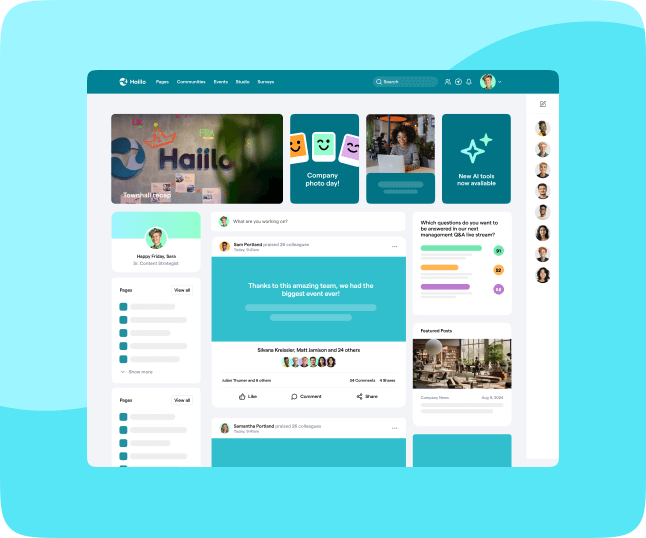

Business communication is the secret ingredient to driving engagement within and outside the organization. So, how do you get it right?
Business communication is the lifeblood of every organization. Without a clear and effective business communication strategy, it becomes much harder to engage employees, strengthen relationships, and retain customers over time.
Poor communication creates confusion, slows down collaboration, and weakens trust. Over time, that impacts productivity, morale, and the overall customer experience. Even the best ideas, products, or strategies can fall flat if people don’t feel informed, connected, or heard.
At the end of the day, your business success depends on how well people understand your vision, values, and goals. That’s why strong communication plays such a critical role in building a strong community around the brand. It helps employees feel part of something bigger and gives customers more reasons to stay loyal.
📚Before we move forward, check out our blog on Employee Communications!
But great communication is about far more than simply sharing updates about your products or business. The best organizations create meaningful two-way conversations. They encourage feedback, inspire action, and make people feel valued. This is where strong corporate communications best practices make a real difference.
When employees feel informed and included, engagement grows naturally. When customers feel connected to your brand, trust becomes easier to build. Consistent communication also helps teams stay aligned during change, growth, and uncertainty.
In this post, we share practical business communication best practices to help you drive stronger engagement both inside and outside your organization. From improving internal alignment to building better customer relationships, these ideas will help you communicate with more clarity, purpose, and impact. We hope you find it useful!
Get a demo now and see the benefits of an IC tool for your business
What Is Business Communication?
Business communication is the exchange of information between different people and groups connected to a business. It helps organizations share knowledge, align teams, support decision-making, and build stronger relationships both internally and externally.
The messages can cover a wide range of topics, from product updates and service launches to company culture, employee initiatives, leadership changes, business goals, and long-term strategy. Communication also plays a key role during periods of change, growth, or uncertainty, when employees and stakeholders need clarity and direction the most.
Strong communication keeps everyone connected to the bigger picture. It helps employees understand how their work contributes to company success while making it easier for customers and partners to trust your brand.
The Golden Rule: Your Business Communication Should Be Goal-Oriented
When it comes to business communication, the key is to build a goal-oriented strategy. One of the most effective corporate communications best practices is making sure every message supports a clear business objective. This helps align employees with the company’s vision, priorities, and long-term goals.
Without clear goals, communication can quickly become noisy, inconsistent, or overwhelming. Employees may receive updates regularly but still struggle to understand what matters most or what action they should take.
For example, when you craft your internal communication, your final goal is not simply to share information internally to keep employees informed about the business. Instead, your goal is to help employees access the right information at the right time — including company news, updates, and resources — so they can do their jobs effectively and contribute to the company’s growth.
Goal-oriented communication also improves focus and consistency across departments. Teams understand priorities more clearly, leaders communicate with more purpose, and employees are more likely to stay engaged.
Because your business communication strategy is goal-oriented, you’re going to build specific communication campaigns that support the objectives your organization wants to achieve.
Your communication campaigns will look different depending on your business goals. For example, your messaging may focus on improving employee experience, attracting top talent, strengthening company culture, increasing alignment during change, or repositioning your brand in the market.
Related: 11 Reasons Why Business Communication is Critical to Your Company’s Success
Internal and External Business Communications
When it comes to business communication, organizations communicate with both their internal audience — mainly employees — and their external audience, including customers, suppliers, investors, media representatives, and business partners.
Both types of communication are equally important. Internal communication keeps employees informed, engaged, and aligned. External communication shapes how people outside the organization understand and experience your brand.
To build trust and consistency, the messaging shared internally and externally should support the same company values, goals, and brand identity.
Internal Business Communication
Internal business communication is the foundation of every successful organization. It includes the exchange of information within the business and all the conversations happening between employees, managers, team leaders, executives, and leadership teams.
Effective internal communication helps employees stay connected, informed, and motivated. It supports collaboration across departments, improves transparency, and reduces misunderstandings that can slow teams down.
Internal communication can take many forms, including company announcements, team meetings, employee newsletters, intranet updates, leadership messages, training materials, and feedback conversations. The goal is not just to distribute information but to create a culture where employees feel heard, valued, and involved.
Organizations that invest in strong internal communication often build more engaged teams, stronger workplace cultures, and better employee experiences overall.
But internal business communication is not limited to peer-to-peer communication, it also includes team communication and it’s the secret sauce ingredient to breaking down silos in the workplace.
Building a great internal business communication is a top priority for most businesses, but the current state of internal comms is alarming:
- Only 43% of leaders focus solely on internal communication and employee engagement
- 60% of companies don’t have a long-term internal communication strategy in place
- As a result, 74% of employees have the feeling they’re missing out on important information and only 13% are engaged at work
- 72% of employees don’t have a full understanding of the company’s strategy
- 28% of leaders report poor communication as the primary cause of failing to deliver a project within its original time frame
- Only 17% of employers think line managers are good communicators
- Just 40% of IC professionals believe that employees understand “well” or “very well” the contribution they’re making to their organization’s strategy
And the list goes on…
It’s your business overall that may suffer from poor internal communication. Basically, your internal business communication has a direct impact on:
- Employee productivity
- Collaboration in the workplace
- Teams’ success
- Employee experience
- The company culture
- The ability to drive innovation in the workplace
- Employee engagement
- The ability to attract and retain top talent
- The business’s growth
- The company’s success overall.
Want to learn more? Check out our post 10 Shocking Internal Communications Stats You Can’t Ignore where we’ve compiled the most astonishing internal comms stats.
The Era of Digital Communication
When it comes to internal business communication, the key is to connect employees through digital channels.
The workplace landscape is changing fast, and one of the best ways to keep up is to adapt how you communicate with employees to match their habits, expectations, and ways of working.
Think about it: hybrid and remote work are now part of everyday business life. According to Gallup, more than half of employees with remote-capable jobs in the US now work in a hybrid model. Flexible work has changed how people consume information, collaborate with colleagues, and connect with company culture.
At the same time, the workforce continues to evolve. Employees expect more flexibility, faster access to information, and more transparent communication from leadership. Digital-first communication is no longer a “nice to have”. It’s essential for keeping teams aligned and engaged across locations and time zones.
So, how do you connect with your employees?
The secret lies in the communication channels you use for your internal business communication.
Building effective internal communication means sharing the right messages with the right employees at the right time and through the channels they actually use and prefer — especially digital channels. One of the most important corporate communications best practices is making communication easy to access, relevant, and consistent across the employee experience.
Employees are overwhelmed with information every day. If communication feels difficult to find, too long, or irrelevant, people quickly disengage. That’s why successful organizations focus on creating clear, targeted, and employee-friendly communication experiences.
External Business Communication
Your external communication is just as important as your internal communication strategy.
The messages you share with your external audiences — and the way you share them — directly influence how your brand is perceived by customers, partners, investors, candidates, and the public.
Strong external communication helps organizations build trust, strengthen reputation, and create more meaningful relationships with their audience. Every interaction matters, whether it’s a social media post, a customer email, a press release, or a leadership statement.
Consistent messaging also helps customers understand what your brand stands for and why they should trust your business over competitors.
The Power of Word-of-Mouth in Business Communication
Building a strong brand reputation can take years, but damaging it can happen in minutes. Welcome to the reality of social media and always-on communication.
Even the strongest brands face criticism online. Customers now share experiences publicly and instantly, which means businesses have less control over conversations about their brand than ever before.
But there’s good news: the way you communicate can shape those conversations. And your employees can play a huge role in building trust with external audiences. That’s the power of word-of-mouth.
According to Edelman Trust Barometer 2024, people continue to place higher trust in individuals and peers than in corporate messaging alone. Employees are often seen as more authentic, relatable, and credible voices for the business.
And this makes sense. People naturally trust other people more than polished brand statements. Employees can humanize the organization and help audiences connect with the company in a more genuine way.
That’s why more businesses are encouraging employees to share their expertise, stories, and perspectives externally. Employee advocacy has become one of the most effective corporate communications best practices for strengthening trust and expanding brand reach organically.
Business Communication Is Even More Critical in Crisis and Change Management
Business communication’s role in the company’s success becomes even more important during periods of crisis or change.
A social media post, a public mistake, negative press coverage, or an internal issue can quickly escalate into a major reputation challenge if communication is handled poorly.
The way your organization responds — and how quickly it communicates — can have a major impact on public trust and the brand’s ability to recover.
But communication is also critical during organizational change, including restructuring, mergers, acquisitions, leadership transitions, or major strategic shifts.
For example, during a merger or acquisition, employees often feel uncertainty about their future, roles, and workplace culture. Clear and transparent communication helps reduce confusion, ease anxiety, and maintain alignment throughout the process.
At the same time, external audiences also need reassurance. Customers, investors, and partners want clarity about what the change means for them. Silence creates uncertainty, and uncertainty often leads to assumptions and rumors that can damage trust in your business.
Business Communication Is the Secret Ingredient to Driving Employee & Customer Engagement
Like in any other relationship, communication plays a central role in the connections you build with employees and customers.
The way organizations communicate influences how people feel about the company, how engaged they are, and whether they choose to stay loyal over time.
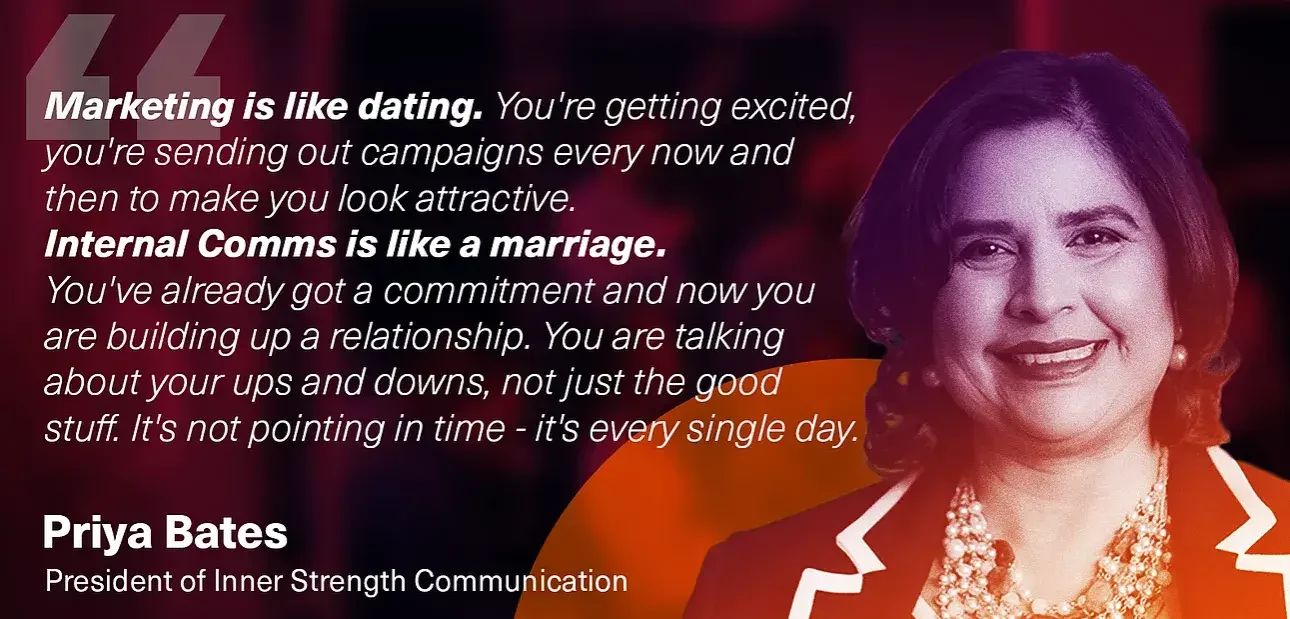
We hosted a webinar called “The Great Comms Debate” where Priya Bates, President of Inner Strength Communication, Jason Anthoine, Managing Founder of Audacity, and Mike Klein, Principal at Changing the Terms, shared their thoughts on the internal communication trends reshaping today’s workplace.
I personally like Priya’s analogy: “Marketing is like dating” and “internal comms is like a marriage”.
It’s a simple but powerful comparison. Marketing helps attract attention and create interest. Internal communication, on the other hand, is about building long-term trust, consistency, and connection with employees.
Indeed, the way you communicate with employees and external audiences has a direct impact on your ability to retain top talent, strengthen culture, improve engagement, and keep customers connected to your brand.
Think about it: business communication is all about driving engagement. Keeping your employees and external audiences informed about the business is a good start, but it’s not enough.
Communicating doesn’t mean sending out messages. Instead, it means exchanging information, driving discussions, and inspiring action.
As a communicator, one of your top priorities is to nurture long-term relationships with your employees and your customers. And to do so, you need to inspire them, connect them with your brand, and generate emotions.
But building a great business communication doesn’t come easy. It takes time and effort to improve employee engagement and keep your customers loyal.
10 Best Practices for Driving Engagement Through Great Business Communication
We share bellow tips and best practices for driving engagement through great business communication. And the cool thing about these best practices is that you can use them in different contexts: during a crisis, when your company is undergoing a merger or acquisition, or when you’re about to launch a new product.
Are you ready? Let’s dive in!
1. Don’t Sugarcoat Your Messages. Tell the Truth
If you want to build long-term relationships with your employees and your external audiences, one of the first things you’ll have to do is earning their trust.
And that’s not going to be an easy task: today, 96% of consumers don’t trust ads. What’s more, a recent survey by TeamBlind found that in some companies, up to 80% of employees don’t trust HR. Ouch!
So, what does that mean for your business?
Simply put, it means that you need to build an open and transparent business communication. No matter what happens at the company, you need to inform your audiences and drive discussions with them.
In times of crisis, don’t try to make things look better than they are. Information will start leaking anyway, so you may want to be proactive and tell the truth before your employees and your customers start making assumptions that turn into rumors.
Related: Crisis Communication — How to Communicate with Employees During a Crisis?
But your customers don’t want to hear about your business only in times of crisis! They want to learn about your vision, your core values and the social causes your company supports.
The same goes for your employees: they want to understand the company’s north star metric, your strategy overall, and how their jobs contribute to the business’s success.
Keep in mind that business communication is an on-going process. Don’t open up only in times of crisis — keep the discussions going on. It’s the only way to build a solid brand!
2. Communicate Complex Situations in a Simple Way
Don’t get me wrong — being transparent doesn’t mean sharing with your employees and external audiences long presentations, financial reports (that no one is going to read), or unengaging activity reports!
Neither your customers or employees like business jargon. And let’s be honest, they don’t have time for that!
Think about it: employees spend more than 25% of their time searching for the information they need to be successful in their jobs. So you need to keep your messages short and sweet!
The key here is to repurpose your content. Turn your reports and presentations into videos, infographics, or short posts that your employees and customers (if you share your reports externally) can easily digest.
Remember, infographics, images and videos are processed by the human brain 60,000 times faster than text!
3. Don’t Share Messages. Enhance Dialogues!
The thing is, your employees’ and customers’ expectations have changed. They don’t want to have a passive role in your business communication, they want their voice to be heard.
They don’t expect you to share messages with them. Instead, they want to join your community and share their own messages and thoughts with the other members of your community.
The old days of one-way communication where top management would communicate the messages they want with the employees and the customers are over!
Most businesses are turning their communication strategies into dialogues. They organize poll surveys, focus groups, and one-on-one sessions to collect employees’ feedback and improve their business communication accordingly.
Related: Internal Communications: the Shift Toward Two-Way Relationships
And when it comes to communicating with external audiences, more and more brands encourage their customers to test and rate their products, comment on their content, or participate in webinars and podcasts.
After all, communicating is all about sharing knowledge and enhancing dialogues!
4. Don’t Guess. Get to Know Your Audiences
Segmentation is the key when it comes to business communication. And that’s because you can’t build a successful brand without tailoring your communication to your audiences’ needs.
Indeed, business communication doesn’t mean sharing standardized information. Instead, it means sharing personalized messages and enhancing dialogues that are relevant to your audiences.
And to do so, you need to have a great understanding of your audiences.
You need to understand their habits, needs, and the way they consume information so you can share the right information with them — the information they expect to receive from you.

Even though many businesses have detailed strategies to understand and target their external audiences, most still struggle to segment their internal audiences effectively.
And that’s when internal communication starts becoming chaotic. Email newsletters are ignored, employees feel overwhelmed by constant updates, and information overload makes it harder for people to focus on the work that matters most. Over time, communication silos begin to form, slowing collaboration and hurting productivity across teams.
One of the most effective corporate communications best practices is treating employees like unique audience groups instead of one large audience. Different teams have different priorities, challenges, and communication needs.
When it comes to internal communications, you need to customize the messages you share based on employees’ roles, departments, locations, working environments, and even the languages they speak.
For example, frontline workers may need fast mobile updates, while office-based employees may prefer more detailed communication through collaboration platforms or intranet channels. Leadership teams may require strategic business updates, while managers need practical information they can share with their teams.
That’s the only way you can make sure employees receive the right information at the right time and in the right format. Personalized communication improves relevance, reduces noise, and helps employees stay more engaged with company messaging.
5. Don’t Inform, Inspire Your Audiences
When it comes to business communication, simply informing employees and external audiences about your products, updates, or company news is no longer enough. You need to go further.
Instead of only sharing information, communicate ideas that inspire your audiences. People connect with organizations that stand for something meaningful. To do this well, you need to communicate openly about your company culture, vision, purpose, and values.
Related: Company Values: Definition, Importance and Examples
Think about Apple and the way the company has built a loyal global community around its brand. Apple’s communication has never been just about selling products. It’s about innovation, creativity, simplicity, and challenging the status quo.
You can see this through Apple’s community platform, where customers actively engage with the brand and with each other. Beyond official channels, entire online communities, forums, and fan groups have formed around the Apple ecosystem.
No matter which part of the community people join, they feel connected to something bigger than the product itself.
And guess how Apple got there?
They built a business communication strategy around emotions. It’s about creating an emotional connection with the brand while delivering a strong experience for both employees and customers.
Their communication goes beyond product features and launches. Their messaging consistently reinforces the company’s vision, identity, and culture.
When you work at Apple or buy one of their products — whether it’s an iMac, iPad, or AirPods — you’re not just purchasing technology. You become part of a community that values innovation, creativity, and change. In other words, you become part of the story the brand is telling.
While many companies focus heavily on inspiring external audiences, they often forget to apply the same thinking internally with employees.
In other words, they fail to build strong internal marketing strategies. And that’s one of the biggest reasons many organizations struggle to improve employee engagement and alignment.
Employees want more than company updates and operational announcements. They want to understand the purpose behind their work and feel emotionally connected to the organization they work for.
That’s why inspiring communication matters. Employees who feel connected to company values, goals, and culture are more likely to stay engaged, motivated, and invested in the company’s success.

Attracting and retaining top talent isn’t easy in today’s highly competitive industries and it’s not surprising that HR experts call it the “talent war”!
So, if you want to improve employee engagement at your workplace, you’ll need to communicate your company values and your vision as well.
You’ll need to make your employees believe in your product, brand, and company overall. In other words, don’t take your employees for granted!
Related: Internal Marketing: Definition and Impact on Employee Engagement
6. Don’t Make Your Employees and External Audiences Wait. Get Ready to Answer their Questions. Anytime.
Most customers use social media for customer service: nearly 70% of consumers have used social media to reach out to brands for support on at least one occasion.
And when they need information or support from brands, customers don’t like to wait: 60% of customers who complain in social expect a response within one hour.
That’s not surprising that businesses are developing their social media customer service plans: by the end of next year, 90% of companies are expected to use social media for customer service.
Your customers expect to get the information they need from you when they need it, and the same goes for your employees. They spend 2.5 hours a day searching for the information they need to do their jobs.
This lack of information is frustrating, isn’t it?
Poor communication leads to employee frustration, lower productivity, and disengagement in the workplace.
So, if you want to help your employees be successful in their jobs, you’ll need to build an internal communication that allows them to find the information they need when they need it.
One of the best ways to do so is to use an employee communications platform where employees can find the information they need through their favorite channels and devices.
Also, make sure they can personalize their news feed and ask questions or comment on the content you share with them.
Business communication is an ongoing process, so make sure you instantly share with your employees the information they need and enhance dialogues in the workplace.
Related: Top Communication Channels to Consider for Your Business
7. Remember the Power of Storytelling
As mentioned earlier, you need to inspire your audiences to drive engagement inside and outside the organization. You need to generate emotions and deliver a great experience to retain your employees and your customers.
One thing that is missing in most business communications is storytelling, especially when it comes to communication in the workplace because yes, your employees want to hear stories!
But don’t get me wrong: that doesn’t mean you’re going to completely change the messages you’re sharing with your employees. Instead, it means that you need to change the way you communicate your messages.
Make the most of your employee communications platform to turn your content into digital newsletters, engaging videos, and personalized posts.
There are so many different ways you can use storytelling for your employee communications!
Telling stories helps connect with employees and it’s also a great way to build a community around the brand. The key is to find the angle and tone of voice that fit your company’s vision and core values.
8. Make Life Easier for Your Employees and Customers
We’re living in the era of information overload.
Think about it: we create 2.5 quintillion bytes of data each day on the Internet. Google now processes over 7 billion search queries a day worldwide and there are over 1.94 billion websites on the Internet. In parallel, 25-54s spend at least 1h39 per day on social media.
It becomes tricky to process all the information we receive every day. Today, 1 in 5 Americans admit feeling overwhelmed with information overload.
Studies have shown that information overload is strongly connected with cognitive overload (and brain fog), anxiety, and difficulties to focus and make decisions.
But information overload has entered the workplace as well. As a result, employees get stressed, collaboration is compromised, meetings become less effective, and a serious amount of time gets wasted.
Think about: knowledge workers spend on average 20 hours a week managing emails, and 1 in 3 of these emails are considered unnecessary.
The Harvard Business Review found that overall, information overload costs the U.S. economy $900 billion a year. The cost of information overload is massive, isn’t it?
So, what does that mean for your business?
Basically, it means that you need to make sure that your employees get only the information they need, nothing more.
Forget about massive and standardized communication. Instead, segment your internal audiences and personalize your employees’ news feeds based on their roles within the organization, their location and the languages they speak.
And the same goes for your customers: you need to segment your external audiences and tailor the messages you share with them according to their needs.
When it comes to business communication, you need to share the right information with the right audience, both internally and externally. It’s the only way you can get your message through.
9. Align Your Internal & External Messages
To build a robust business communication strategy, you need to align the messages you share internally with the ones you share outside the organization.
Business communication is all about consistency! Neither your employees or your external audiences should notice a gap between the messages you share internally and externally.
Indeed, your employer brand starts from the inside.
Even though talent attraction and talent retention are two different things, the employee experience you deliver has a great impact on your ability to attract top talent.
That’s because internal and external communications aren’t two separate worlds: with the rise of word-of-mouth and employer review sites such as Glassdoor, people easily know what’s going on within the organization.
Most candidates don’t hesitate to check online reviews and testimonials before applying for a job.
Related: Employee Experience: The Ultimate Guide to Retaining Your Top Talent
But candidates are not the only ones wondering what’s happening at your organization, your customers want to know more about the company overall as well.
What’s more, your customers are not only interested in your product or service, they also want to know what your company values are, what your long-term vision is, and what kind of working environment you offer to your employees. And trust me, they’ll find the information they’re looking for!
So, if you want to win the “talent war” mentioned earlier and maintain a long-term relationship with your customers, make sure the messages you share externally are consistent with the ones you share internally.
Related: 12 Reasons Why Internal & External Communications Go Hand-in-Hand
10. Measure the Success of Your Business Communication
Don’t trust your gut feelings when it comes to business communication!
One of the most important steps to building a successful business communication is measuring the results you drive. That’s the only way you can identify the communication bottlenecks that are holding your communication strategy back.
Without measurement, you can’t analyze and improve your strategy. Yet, 60% of IC practitioners are still not measuring internal communication. Ouch!
Even though measuring the performance of your business communication doesn’t come easy, you need to allocate adequate resources to it. Make sure you pick the right KPIs — KPIs that are aligned with your business goals — and you build a communication strategy that supports the business goals.
Related: How to Measure Internal Communication (IC): Best Practices & Examples
Final Words
Business communication is the cornerstone of any organizations’ success. You can’t build a successful brand without developing a great business communication.
One of your top priorities as a communicator is to drive engagement, whether it’s employee engagement or customer engagement. And to do so, you need to create an emotional connection with the brand.
Informing your audiences about your product and the company news is not enough, you need to build a community around your brand. Be authentic, share engaging content, enhance dialogues within and outside the organization, tell stories, and personalize your messages.
After all, business communication is all about the experience you deliver!
Curious to learn more? Check out our report on IC trends in 2023

Frequently asked questions about corporate communications best practices
What are the most effective corporate communications best practices?
One of the most important corporate communications best practices is making communication relevant, consistent, and audience-focused. Employees and external audiences don’t want more noise — they want clear information that helps them take action or feel connected to the business. Strong communication strategies also focus on timing, channel selection, personalization, and two-way feedback. Businesses that invest in modern employee communication tools are often better equipped to keep teams aligned and engaged.
Why is internal communication important for employee engagement?
Internal communication helps employees understand company goals, stay informed during change, and feel more connected to their work. Poor communication creates confusion, silos, and disengagement. Effective communication, on the other hand, builds trust and improves collaboration across teams. Companies that prioritize clear communication are also better positioned to support hybrid and remote work environments. You can learn more about this in our guide to multi-channel communications.
How can businesses improve communication across different teams and locations?
The key is to deliver the right message to the right people through the right channels. That means segmenting audiences based on role, location, language, or work environment instead of sending the same update to everyone. Centralized communication platforms and better analytics also help teams understand what content is working. Solutions like communication analytics tools can help organizations measure engagement and improve communication performance over time.
What skills are most important for effective business communication?
Strong business communication depends on clarity, empathy, active listening, and consistency. Leaders also need to adapt communication styles based on different audiences and situations. As workplaces become more digital, communication skills like transparency and responsiveness are becoming even more important. If you want to strengthen communication across your organization, check out our article on top communication skills and how to improve them. AI-powered tools such as Haiilo AI features can also help teams create more effective and engaging communication faster.