
Proper employee communication in the workplace has never been so important. Since the introduction of remote and hybrid work, organizations worldwide have become more aware of the importance of workplace communications in making employees more engaged and providing a better employee experience. Strong staff communication is now a key driver of alignment, productivity, and retention—especially when teams are no longer in the same physical space.
In this blog, you will learn about the best practices for boosting employee communications in your organization and improving everyday staff communication across distributed teams.
The Shift Towards Asynchronous Employee Communications
Before the pandemic, most employees depended on synchronous communication and real-time collaboration with their colleagues. Conversations happened in meetings, quick desk chats, or instant replies.
Today, however, this is not the case anymore. Teams are more distributed, work across time zones, and rely less on being online at the same time. This has pushed organizations to rethink how staff communication works on a day-to-day basis.
A growing number of employees now prefer asynchronous communication—where messages don’t require an immediate response. This allows people to focus, manage their time better, and avoid constant interruptions. It also creates a written record, making information easier to revisit and share.
As remote and hybrid work continue to evolve, improving staff communication means balancing both synchronous and asynchronous approaches—so employees stay informed without feeling overwhelmed.

Since then, many employers have learned that this transition wasn’t as difficult for employees as expected. In fact, some have seen noticeable improvements in employees’ engagement and productivity at work. With fewer interruptions and more control over their schedules, employees can focus better and contribute more effectively. Strong staff communication plays a major role in making this shift successful.
Hence, more flexible working environments are here to stay. To make them work, however, employers need to rethink how their teams connect and share information. This means refining employee communication strategies, embracing asynchronous communications, and ensuring the right technologies are in place to support seamless staff communication across locations and time zones.
📹 Before we move forward, take a look at our Masterclass: Best Practices for Managers to Improve Internal Communications
.
How to Make Employee Communications Work in 2026 and Beyond
The shift towards asynchronous employee communications is forcing employers to adopt new best practices to keep employees informed without overwhelming them. Clear and effective staff communication is essential to eliminate organizational and cross-departmental silos, improve employee experience, and ensure teams stay aligned regardless of where or when they work.
Research consistently shows that poor communication has serious consequences. In fact, 86% of employees and executives cite lack of collaboration or ineffective communication as a leading cause of workplace failures. When staff communication breaks down, productivity drops, decisions slow down, and frustration builds across teams.
Today, with a more dispersed workforce, the consequences of poor communication and collaboration are even more visible. Misalignment happens faster, and small gaps in communication can quickly turn into larger operational issues.
So let’s take a look at how to embrace employee communications in your workplace in 2024 and beyond—and build a stronger foundation for effective staff communication.
💡 Before digging deeper, also read: Top 13 Communication Barriers and How to Tackle Them.
1. Enforce the importance of trust
As nicely put by Harvard Business Review:
“managers who cannot “see” their direct reports sometimes struggle to trust that their employees are indeed working… ultimately disrupting their work-home balance and causing more job stress.”
This research showed that 34% of employees agreed that their supervisors “expressed a lack of confidence in their work skills.”, and even more employees reported feeling that they needed to be constantly available—which has a significant impact on employee wellbeing.
A lack of trust directly weakens staff communication. Employees are less likely to share ideas, ask questions, or engage with updates when they feel monitored or undervalued. Over time, this creates disengagement and silence instead of open dialogue.
Employers need to put more effort into understanding manager communication principles and building trust across the workplace. This includes setting clear expectations, focusing on outcomes instead of activity, and encouraging transparency in everyday staff communication.
When there is no trust, it is unrealistic to expect employees to engage with company communications or collaborate effectively.
💡 Related: 7 Steps to Create a Successful Employee Experience Strategy.
2. Drive frequent, honest, and consistent communications
Manager to employee and peer to peer communications need to happen more often when teams rely on asynchronous communication. Without regular touchpoints, teams and departments start working in silos, making alignment harder and slowing down progress.
Company leaders and internal communications professionals should take ownership of driving more frequent, honest, and consistent communication. Strong staff communication ensures that employees understand priorities, feel connected to the business, and know where they stand.
According to a Gallup study, employee engagement increases when managers provide clear and consistent communication. Employees who receive regular updates are more likely to stay motivated and aligned with company goals.
Another study found that 4 out of 5 employees wanted to hear more frequently from their leaders about how their company was performing, and more than 90% of employees surveyed said they would rather hear bad news than no news. This highlights a simple truth: transparency builds trust, and silence creates uncertainty.
To improve staff communication, organizations should create predictable communication rhythms, share updates openly, and encourage two-way conversations rather than one-way messaging.

Furthermore, pay special attention to inconsistencies. If your internal and external communications are misaligned, employees will quickly notice—and trust will erode. Consistent messaging is a core part of strong staff communication, helping employees feel confident in leadership and clear about company direction.
💡 Related: 9 Steps to Create Successful Organizational Communication Strategy.
3. Engage leaders more
Good leadership plays one of the most important roles in building a positive workplace culture and improving employee communication efforts. Over the past few years, organizations have seen that when leaders communicate openly and regularly, employees are more engaged and aligned.
Leaders also have a major influence on preventing miscommunication in the workplace. When expectations, priorities, and updates are clearly shared from the top, there is less room for confusion or mixed messages—both critical for effective staff communication.
Research shows that miscommunication remains a widespread issue, affecting collaboration, morale, and productivity. Without clear direction from leadership, teams are left to interpret information on their own, which often leads to errors and delays.
Leadership, together with internal communications teams, should actively monitor communication gaps, clarify messages quickly, and correct misinformation before it spreads. Strong staff communication starts with visible, accessible leaders who set the tone for transparency.
4. Make information more relevant and engaging
In order to make employee communications work in your organization, you need to invest more time and effort into producing and distributing relevant, engaging content that employees actually care about.
Content irrelevancy is one of the main causes of information overload and missed messages. When employees receive too much content that doesn’t apply to them, they start ignoring everything—including important updates.
A large portion of workplace communication fails because it isn’t tailored. Many organizations still lack effective ways to segment employees by job role, department, location, language, or interests.
As a result, they send broad, generic messages that don’t resonate.
To improve staff communication, companies need to personalise content and deliver it through the right channels. When employees receive relevant information at the right time, they are far more likely to engage, act, and stay informed.
If relevance is missing, even the benefits of asynchronous communication become irrelevant.
5. Encourage employees’ share of voice
Many employees still hesitate to speak up at work, which limits feedback, innovation, and problem-solving. When people don’t feel heard, staff communication becomes one-sided and far less effective.
Only around half of employees consistently share their opinions with leaders. This means organizations are missing valuable insights from the people closest to the work.
Encouraging a stronger employee voice should be a priority. This includes creating safe spaces for feedback, actively asking for input, and showing that employee contributions lead to real action.
When employees feel comfortable sharing ideas and concerns, staff communication becomes more dynamic, transparent, and impactful.

Bottom-up employee feedback and employees’ share of voice are essential for improving employee communications. When staff communication flows in both directions—not just top-down—employees feel heard, valued, and more connected to the organization.
Organizations where employees feel comfortable sharing their opinions, raising concerns, and contributing ideas tend to have healthier workplace cultures and higher engagement levels. Open dialogue builds trust and helps surface issues early, before they grow into bigger problems.
This is why many organizations now rely on employee surveys and feedback tools to collect continuous input. However, gathering feedback is only the first step. To truly improve staff communication, employers need to act on that feedback and close the loop—so employees know their voices lead to change.
💡 Related: 10 Ways to Foster Upward Communication in the Workplace.
6. Provide a single source of truth and enable easy knowledge-sharing
According to research, improving knowledge sharing through digital tools can significantly reduce time spent searching for information and increase overall productivity.
When employees are in the office, it is much easier to share knowledge informally—by asking quick questions or having spontaneous conversations. In remote and hybrid environments, this becomes much harder, and gaps in staff communication become more visible.
That’s why every company should have a central knowledge database where employees can easily find accurate, up-to-date information. This “single source of truth” reduces confusion, prevents duplicated work, and ensures everyone is aligned.
To make staff communication more effective, this knowledge should be easy to access, well-organised, and regularly updated. Employees shouldn’t have to search across multiple tools or ask around to find what they need.
💡 Learn about how to enable knowledge workers for success in your organization.
7. Introduce new channels based on employees’ interests
If you want your employees to engage in company conversations, consider creating communication channels and spaces tailored to their needs and interests. Strong staff communication isn’t just about pushing information—it’s about creating opportunities for interaction.
Designated spaces where employees can ask questions, comment on leadership announcements, engage with peers, and provide feedback help foster a sense of community and belonging.
Different teams and roles may prefer different channels—some may engage more through chat tools, while others prefer structured platforms or forums. By offering a mix of options, you make staff communication more accessible and inclusive for everyone.
For example, you could create departmental channels where you share targeted updates, ensuring each team receives information that is relevant to their work. This makes staff communication more focused and reduces the noise employees often experience with company-wide messages.
You could also introduce interest-based channels, such as a WFH-tips space where employees can exchange advice, tools, and best practices for remote work. These types of channels encourage participation and make staff communication more engaging and community-driven.
💡 Related: How to Build a Successful Communication Plan.
8. Don’t neglect the importance of technology
No matter the nature of your employees’ jobs, it is nearly impossible to make employee communications work without the right employee communications technology.
Whether your employees work remotely, in hybrid setups, or on the frontline, effective communication depends on the tools you provide them. Without the right platforms, even the best communication strategies will fall short.
Modern employee communications apps are built to support today’s workplace needs. They allow organizations to deliver personalised content at the right time, provide a central hub where important information is accessible to everyone, and enable smoother collaboration across teams.
They also help measure the effectiveness of staff communication, gather continuous employee feedback, and identify gaps in engagement. This makes it easier for organizations to improve their communication strategies over time and ensure employees stay connected and informed.
💡 Related: Why Every Organization Needs an Employee Experience Platform.
The Benefits of Proper Employee Communications [INFOGRAPHIC]
Today, communications professionals are among the most important strategic partners within organizations. Their role now goes beyond messaging—it directly impacts employee engagement, motivation, and productivity through effective staff communication.
With the emergence of remote work, many organizations are working to reshape their communication efforts and rebuild their employee communications strategies to better support distributed teams.
As awareness of the importance of workplace communication continues to grow, more employers are actively investing in improving communication and collaboration across their organizations.
So take a quick look at the 11 most important reasons why companies are investing in employee communications, including higher employee engagement, lower turnover, and many others.

Top 12 Employee Communication Facts You Can’t Ignore
Clearly, communication in the workplace is more important than ever. Internal communication professionals have become one of the most important strategic business partners because of their impact on employee experience and productivity. Strong staff communication is now directly linked to how well organizations perform, adapt, and retain talent.
Let’s take a look at the top 12 statistics that highlight the impact of effective employee communications and why improving staff communication should be a priority.
- According to the Connected culture report, 71% of employees who said they were more productive also felt well-connected to their colleagues.
- According to McKinsey’s report, employees who feel included in workplace communication are almost 5 times more likely to report increased productivity.
- Miscommunication in the workplace can cost companies millions each year, especially as teams scale and communication becomes more complex.
- CMSWire reports that 97% of employees believe communication impacts their task effectiveness on a daily basis.
- According to research, a significant portion of employees point to poor communication as a key reason for missed deadlines and delays.
- Employees working in organizations with effective communication strategies are significantly more likely to outperform their peers, especially when communication is centralized and silos are reduced.
- According to research, more than 80% of employees believe communication is crucial for building trust with employers.
- Workforce Institute study showed that 24% of employees who quit did so because they didn’t feel trusted.
- According to Buffer’s report, communication and collaboration remain among the biggest challenges of remote work.
- Research shows that as many as 85% of employees feel more motivated when they are regularly updated about company news and information.
- 86% of employees and executives cite ineffective communication and poor collaboration as key reasons for workplace failures.
- Harvard Business Review cites that 72% of employees feel their performance would improve with more constructive feedback from their managers.
Start Improving Employee Communications Today!
Communication systems in the workplace have become increasingly complex. There are now multiple communication channels organizations use to keep employees informed, aligned, and engaged, while also trying to leverage the benefits of multichannel workplace communications.
Without a clear strategy, this can quickly lead to fragmented staff communication, duplicated messages, and missed information.
To improve and streamline employee communications, many organizations are implementing new technologies that consolidate these channels into a single platform. This helps reduce noise, improve message visibility, and create a more consistent communication experience for employees.
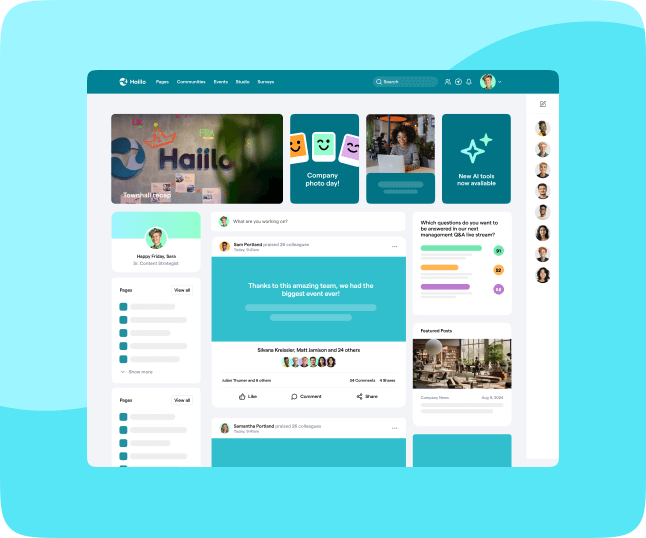
Haiilo is one of the leading employee communications and advocacy solutions on the market. It enables enterprises to create, aggregate, and deliver personalised content to every employee, improving both reach and relevance. Platforms like Haiilo make staff communication more structured, measurable, and impactful.
Peer-to-peer review website G2, which helps businesses find the best software, identifies Haiilo as a leader in their Employee Communications grid.
FAQs about staff communication
1. What is staff communication and why is it important?
Staff communication refers to how information is shared between employees, managers, and leadership across an organization. It includes everything from daily updates to company-wide announcements and feedback loops. Strong staff communication is critical because it directly impacts productivity, engagement, and trust. For example, studies show that nearly 97% of employees say communication affects how well they perform their jobs. When communication is clear and consistent, employees understand expectations, collaborate better, and feel more connected to the business.
2. What are the biggest challenges in staff communication today?
One of the biggest challenges is information overload. Employees receive messages from multiple channels—email, chat, meetings—and often struggle to keep up. Another issue is misalignment, especially in remote and hybrid teams where people aren’t working at the same time. Poor staff communication can lead to missed deadlines, confusion, and lower morale. In fact, many employees report that unclear communication is a major cause of workplace stress and inefficiency. The challenge is not just sending messages, but making sure the right people get the right information at the right time.
3. How can companies improve staff communication?
Improving staff communication starts with clarity and consistency. Organizations should define clear communication guidelines, use the right channels for different types of messages, and avoid overloading employees with unnecessary updates. Personalising communication—so employees only receive relevant information—also makes a big difference. Leaders play a key role too. When managers communicate openly and regularly, employees are more engaged and aligned. Finally, using the right tools, such as a central communication platform, helps keep information accessible and organised.
4. What role does technology play in staff communication?
Technology is essential for modern staff communication, especially in distributed workplaces. The right tools help centralise information, reduce noise, and make communication more accessible for everyone. They also enable real-time updates, asynchronous collaboration, and data-driven insights into what’s working. Research shows that better communication tools and processes can significantly improve productivity and reduce time wasted searching for information. Without the right technology, even well-planned communication strategies are difficult to execute effectively.
Curious to learn more? Read about 10 principles of modern employee communications