
Implementing the right communication channels in your organization is the key to keeping your employees productive, engaged, and aligned with your business goals.
Today, employees feel more isolated and disconnected from the rest of the organization than ever before.
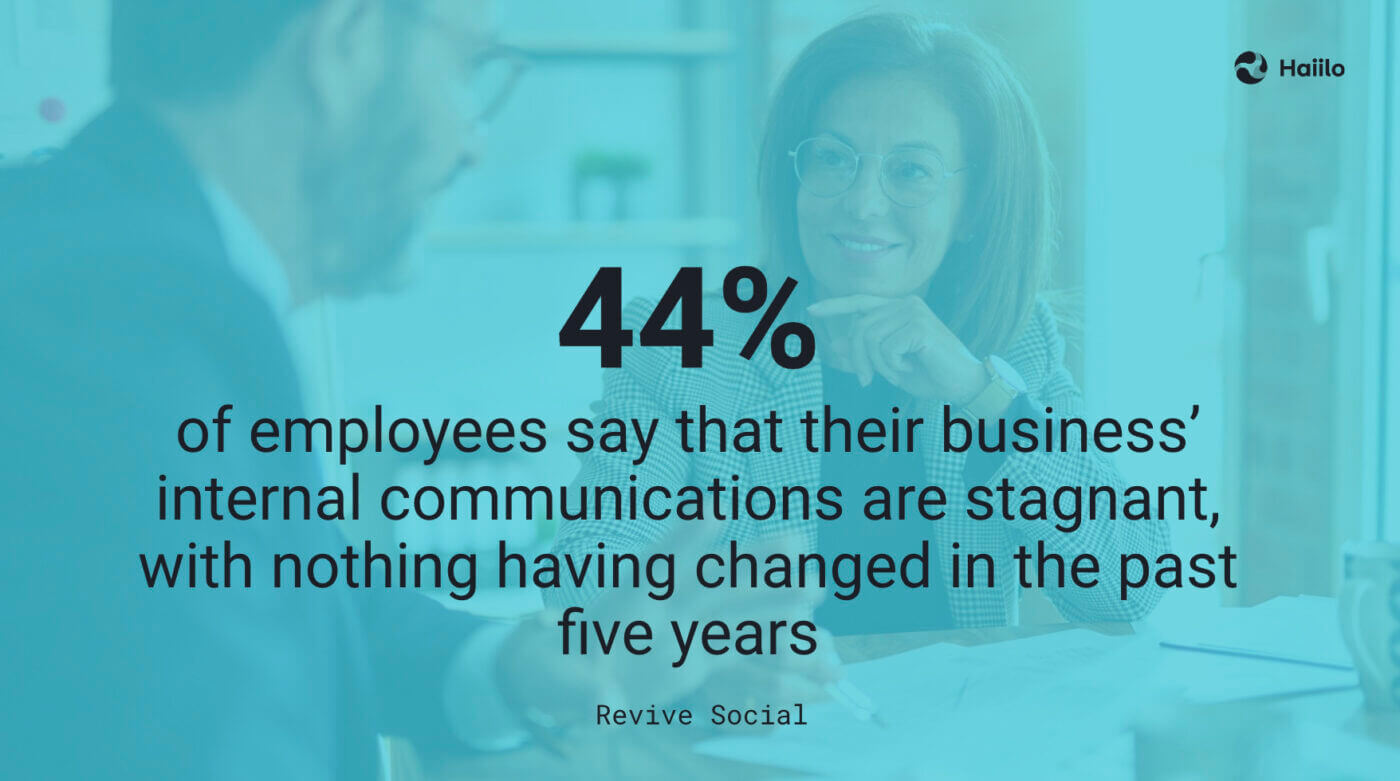
According to a recent study, the root problem is that 60% of employees feel less-than-enthusiastic about internal communications. 44% say their approach has not evolved in the past five years. In reality, many internal communication channels have not kept pace with how people work today. Messages get lost across tools, deskless employees are left out, and managers fill the gaps inconsistently. The result is not just disengagement, but confusion about priorities and a growing disconnect from the wider organization.
For that reason, companies are now implementing new solutions to improve their internal communication efforts.
However, effective workplace communication is not easy to achieve. The real challenge is not adding more tools, but making your internal communication channels work together. You need to share the right content with the right employees at the right time through their preferred channels and devices. Otherwise, even important updates get ignored or missed entirely.
In this blog, we will go over the list of internal communication channels to consider for your business, including where they work best and where they fall short, so you can make clearer, more confident choices.
Related: Read our guide on the best internal communication tools and software solutions to use.
Communication Channels in the Workplace: Definition
Communication channels are the means through which people in an organization communicate and interact with each other. With so many different types of internal workplace communications, choosing the right internal communication channels becomes critical to avoid confusion and duplication.
Without the right communication channels in place, it becomes extremely challenging to align employees with business goals, break down silos, and drive innovation. Teams end up working in parallel instead of together, often without a clear understanding of priorities.
Furthermore, the communication channels you use at your workplace directly shape the employee experience. They influence employee engagement and your ability to help employees stay productive through strong leadership and clear communication skills.
The thing is, with the shift to remote work, communication has become more fragmented. Employees now switch between multiple tools, locations, and schedules, which makes it harder to keep everyone informed and included.
As a result, many employers struggle to understand how information actually flows across internal communication channels, resulting in much more grapevine communication when official channels fall short.
Unsurprisingly, using the wrong channels for collaboration, peer-to-peer updates, or leadership communication can slow decisions, create misalignment, and ultimately impact your company’s success.
📹 Before we move forward, check out our Masterclass about how to eliminate communication barriers in your workplace!
Reach your employees where they are via their preferred channel by using a multichannel comms platform
6 Types of Business Communication Channels
When looking at all the possible communication channels, we can segment them into two main groups:
- Communication channels by formality
- Communication channels by mean
Communication channels by formality
There are three different communication channels based on formality: formal, informal, and unofficial.

1. Formal communication channels
Formal communication includes the exchange of information such as goals, policies, and procedures within an organization. These internal communication channels create structure and ensure everyone works from the same source of truth.
Some of the most common examples include company business plans, strategy documents, goals, annual reports, agreements, company-wide announcements, workplace safety guidelines, and board presentations. When used well, they provide clarity and reduce uncertainty. When overused or poorly managed, they can feel one-sided and easy to ignore.
2. Informal communication channels
Informal communication channels are used to share information in a more natural, day-to-day way. They often fill the gaps that formal channels leave behind and help teams stay connected.
Examples include quick conversations about ongoing work, team chats, lunchtime discussions, or spontaneous check-ins. These internal communication channels are where collaboration happens in real time. They can speed up decisions and build trust, but without some structure, important information can get lost or stay within small groups.
3. Unofficial communication channels
In addition to official communication channels, there is also an unofficial mode of communication that is common in every workplace. These internal communication channels exist outside formal structures and are often driven by personal relationships.
Unofficial communication includes conversations that happen outside of work environments or on topics not directly related to work. While they may seem irrelevant, they often influence how employees perceive company news and decisions. If formal channels lack clarity, these spaces quickly become the main source of information.
Communication channels by mean
Besides formality, communication channels can also be divided by mean, meaning the way and tools employees use to communicate with each other. This perspective helps you evaluate whether your internal communication channels actually match how your employees work day to day.
Let’s take a look at the 3 main means of communication in the workplace.
1. Digital communication channels
Electronic means of communication include various online tools employees rely on to stay connected and keep up with company updates. These internal communication channels have become the backbone of how work gets done, especially in distributed teams.
Today, digital communication channels are the most widely used in the workplace. But more tools do not automatically mean better communication. When messages are spread across platforms, employees spend more time switching between tools than actually absorbing information, which often leads to missed updates and growing communication barriers.
Examples include email or business email software, internal communication platforms, employee collaboration tools, and intranets. The challenge is not access, but clarity on where communication should happen.
2. Face-to-face communication
Even though digital tools dominate, face-to-face communication remains essential. These internal communication channels are where context, tone, and trust come together.
Whether in person or via video, this form of communication allows for immediate feedback, clearer alignment, and stronger relationships. It is especially valuable for sensitive topics, team alignment, and leadership communication where nuance matters most.
Related: Interpersonal Communication: Definition, Importance and Must-Have Skills
3. Written communication
While often overlooked, written communication still plays a critical role in the workplace. These internal communication channels create a reliable record employees can revisit when needed.
Policies, memos, manuals, notices, and official announcements rely on written formats to ensure consistency and accountability. Without them, important information becomes harder to track, especially in larger or regulated organizations.
The rise of digital communication channels in the workplace
With the shift to remote and hybrid work, the use of digital internal communication channels has grown rapidly in recent years and continues to increase as organizations adapt to more flexible ways of working.
As employees are more dispersed, companies need better ways to keep remote and deskless employees connected, informed, and aligned. This has made digital channels essential, but also exposed their limits.
Most organizations now recognize that email alone is not enough. It is not the right channel to keep employees engaged in ongoing conversations or to create a sense of belonging.
It also falls short when it comes to improving cross-functional collaboration in the workplace. When communication stays siloed in inboxes, teams struggle to share knowledge, coordinate effectively, and move work forward together.
Instead, employers need to rethink how their internal communication channels fit into employees’ daily routines. The focus should be on more modern, intuitive, and mobile-first communication channels that reflect the simplicity and accessibility people expect from the apps they already use outside of work.
Technology has fundamentally changed how we communicate and that shift is still ongoing. Employees expect faster access, clearer updates, and the ability to respond, not just receive information.
Effective two-way communication through the right internal communication channels can improve peer collaboration, strengthen knowledge sharing, and reduce the manual effort for internal communications teams. Instead of chasing engagement, you create space for real conversations.
Simply put, the best internal communication channels are the ones that help you deliver the right message to the right employee at the right time and make important information easy to find when it is needed, not buried across tools.
💡 Did you know that artificial intelligence and generative AI are becoming more popular among communications professionals? Learn about how AI can be leveraged to embrace internal communications in your organization!
12 common internal communication channels
Most organizations rely on digital communication channels to reach and engage employees. They are often seen as the most productive option, but only when they are used with clear purpose and structure.
1. Intranet
Intranets are one of the most effective employee communication tools a company can use. They act as a central hub where employees can access updates, resources, and key information in one place.
However, many intranets still function as static content repositories that employees rarely visit. Without relevant, timely content, even the best platform loses its value.
A modern intranet should help employees quickly find what matters to them, whether that is company news, team updates, or practical resources for their day-to-day work. It should adapt to your needs, not the other way around.
Moreover, according to McKinsey, communication through technologies such as intranets can improve employee productivity by up to 25%. The impact is clear when the tool is actively used, not just available.
💡 Learn about the top 11 intranet platforms on the market!
2. Email
In the business world, email is still one of the most widely used internal communication channels. But that raises an important question: should it be your primary channel?
In many organizations, critical information still flows through email. Some messages are urgent, others are optional, and many fall somewhere in between. The problem is not the volume alone, but the lack of prioritization.
When employees face inboxes full of irrelevant or low-priority messages, important updates are easily missed. Over time, this leads to disengagement, slower responses, and a growing tendency to ignore internal communication altogether.
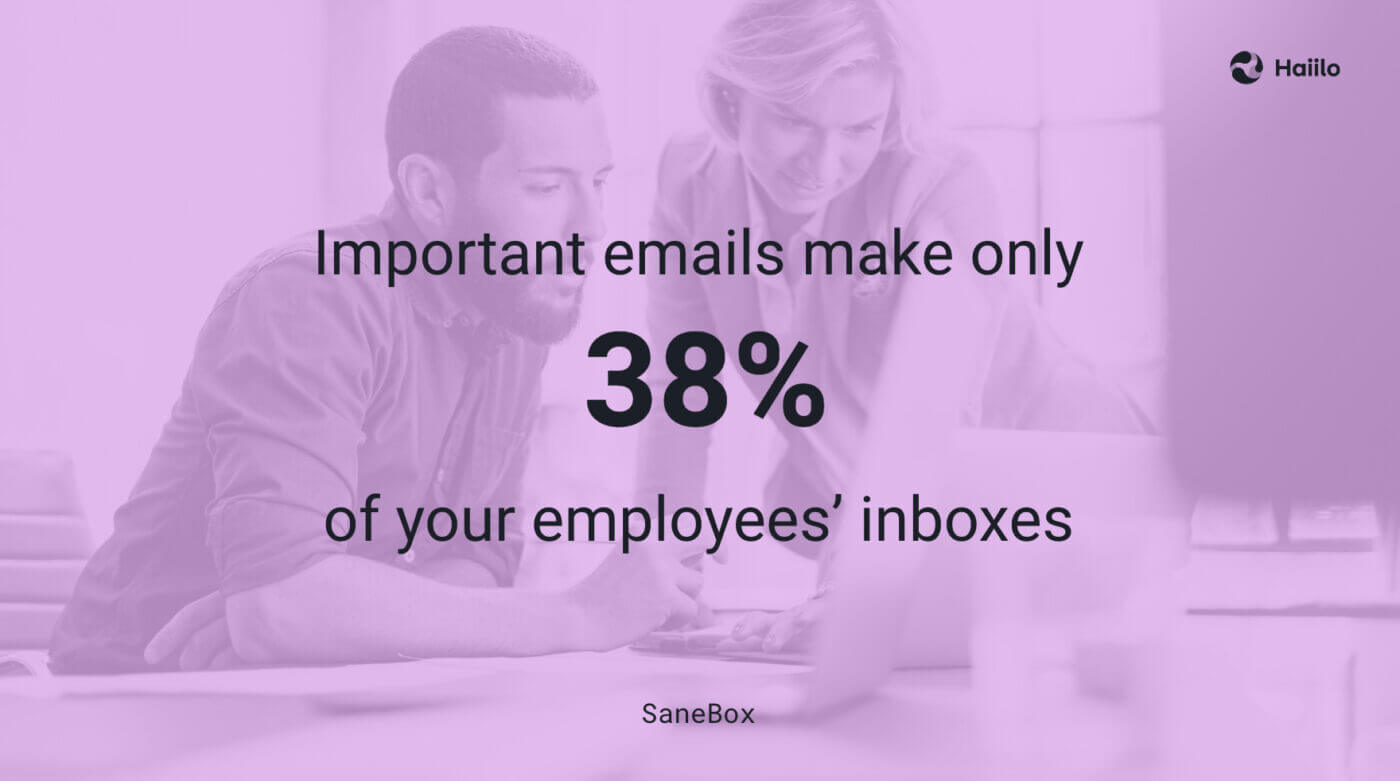
Loss of productivity and difficulty focusing on what actually matters are two key reasons why many teams are rethinking email as their primary internal communication channel. When everything feels urgent, employees often disengage or miss critical updates altogether.
At the same time, email is built for one-to-one or small group exchanges, while most organizations now depend on transparency and collaboration across teams. As a result, relying on email alone makes it harder for internal communication channels to support shared visibility and aligned action.
3. Project management tools
Even though they are not always seen as traditional communication tools, project management platforms play an important role within internal communication channels by making collaboration more visible and structured.
These tools allow employees to create, assign, and track tasks, often organized into boards or workflows. Teams can break work into clear actions, comment directly on tasks, and use calendar views to stay on top of deadlines without constant back-and-forth.
However, while they improve coordination, they are not a replacement for internal communication solutions. They focus on tasks, not broader company context, updates, or culture.
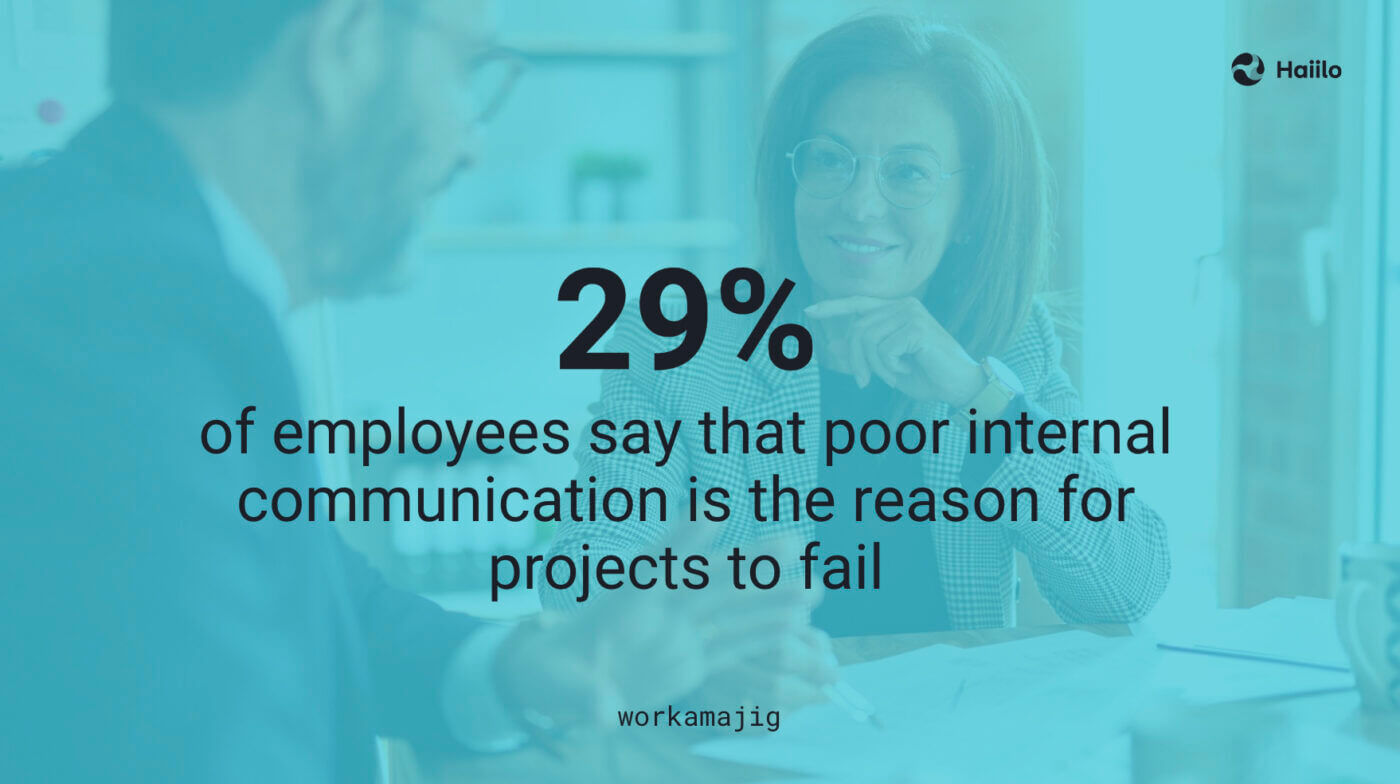
Moreover, 29% of employees say that poor internal communication is the reason projects fail. This highlights a common gap: even with the right tools for execution, many organizations still lack internal communication channels that connect the bigger picture to the day-to-day work.
Project management tools are not designed to keep employees informed about what is happening across the organization. They also do not provide a reliable way to access company-wide updates. For that reason, they should support your internal communication channels, not replace them as the primary source of information.
4. Employee newsletter
Employee newsletters, when used thoughtfully, can play a valuable role within your internal communication channels. They help you bundle key updates into one place and guide employees through what matters most.
With the right structure and a bit of creativity, newsletters can engage employees and keep them informed about relevant topics. You can share company updates, highlight leadership messages, welcome new hires, celebrate achievements, or promote upcoming events. For many employees, this becomes a simple way to stay connected without having to search across multiple tools.
However, newsletters are often distributed via email, which brings familiar challenges. As mentioned earlier, emails are hard to prioritize, especially when inboxes are already overloaded.
More importantly, email newsletters rarely allow for true personalization. Without more advanced internal communication channels, it is difficult to tailor content based on role, location, or language. This means employees may receive information that feels irrelevant, making it more likely they disengage or overlook important updates.
5. Instant messaging tools
Instant messaging tools have become a core part of modern internal communication channels. Most organizations rely on them for both real-time and asynchronous communications, especially as teams work across locations and time zones.
They make it easy to run team discussions and allow employees to connect quickly with colleagues throughout the day. This speed is valuable when decisions need to be made fast or questions need quick answers.
However, instant messaging tools come with clear limitations:
- They rarely support structured conversations around specific content, making it hard to track decisions or revisit important context later.
- While they improve team-level communication, they do not scale well for organization-wide communication. Important updates can get buried in chats or never reach the right audience.
In short, these internal communication channels work well for quick exchanges, but they are not built to keep your entire workforce aligned or informed at scale.
6. Document sharing software
Have you ever spent too long searching for a document you need to do your job? It is a common frustration and a clear sign that your internal communication channels are not working as they should.
Beyond frustration, many organizations underestimate the real cost of searching for information. When employees cannot quickly find the right files, work slows down, decisions are delayed, and duplicated effort becomes more likely. Over time, this creates unnecessary friction that impacts both productivity and employee experience.
This is exactly the reason why document sharing tools have been developed; to structure and organize important documents so that employees can access them in seconds.
However, implementing this type of software is just the first step toward great internal comms. These software allow you to store key documents, but they don’t help you share specific documents or information with the right employees when they need it.
Just consider these stats:
- Employees spend up to 20% of their time searching for information instead of doing focused work (IDC)
- 58% of the workday is spent on coordination tasks like emails and searching for updates (Asana)
Even with the right tools in place, success depends on how well information is structured. Internal communication channels must make it easy to group, organize, and surface content in a way that reflects how employees actually work. If search feels რთ or unintuitive, people will stop using it and fall back on asking colleagues or duplicating work.
7. Video conferencing software
Most organizations now rely on video conferencing as part of their internal communication channels. It reflects a simple shift: teams no longer need to be in the same place to work effectively together.
These tools make it possible to connect remote employees in a more personal way than text alone. They are especially useful for team alignment, workshops, and discussions where nuance matters.
They also reduce travel time and related costs, making collaboration more accessible across locations.
However, video conferencing is built for conversations, not continuous communication. It does not support ongoing updates, knowledge sharing, or scalable engagement across the organization. As a result, it should complement your internal communication channels, not act as the primary one.
8. Internal podcasts
Studies from LinkedIn show that 42% of people aged 18 to 34 listen to podcasts weekly. This shift creates an opportunity for internal communication channels to meet employees in formats they already enjoy.
Podcasts are particularly strong for storytelling. Leaders can share context, explain decisions, and bring a more human voice to company updates.
That said, podcasts are mostly one-way. They work best when combined with other internal communication channels that allow employees to respond, ask questions, or continue the conversation.
9. Internal company blogs
Many organizations are introducing internal blogs as part of their internal communication channels. They give both leaders and employees a space to create content others actually want to read.
Topics can range from company updates and major initiatives like mergers and acquisitions to employee stories, milestones, and achievements.
For example, Google’s re:Work shows how content can reflect company values and shape how people think and work.
But publishing content is not enough. Some employees will actively visit and engage, while others will not. Effective internal communication channels ensure that important content reaches employees directly, instead of expecting them to go looking for it.
10. Employee feedback software
Employee feedback tools may not always be labeled as internal communication channels, but they play a key role in enabling dialogue.
They give employees a structured way to share input, raise concerns, and contribute ideas. This is critical for building trust and improving the employee experience over time.
When used consistently, these tools help organizations create a more positive workplace and strengthen communication between employees and leadership.
11. Internal social media
Internal social media has gained traction as a more dynamic type of internal communication channel. It brings familiar interaction patterns from external platforms into the workplace.
The goal is to increase engagement and participation by making communication more interactive. Employees can react, comment, and share knowledge more openly, which helps connect teams and leadership.
When used well, it supports collaboration and makes communication feel less top-down and more inclusive.
12. Employee survey solutions
If you want to improve your internal communication channels, you need to understand how employees experience them.
Survey tools make it easier to gather feedback at scale and identify gaps in communication, alignment, or engagement.
While surveys do not enable ongoing conversations or provide direct access to information, they are essential for understanding sentiment and making informed improvements.
💡 Learn more about various internal communications tools most organizations use today!
The consequences of using the wrong communication channels
As mentioned earlier, using the wrong internal communication channels can have a direct impact on how employees experience your organization. It affects not only productivity and collaboration, but also trust, clarity, and overall engagement.
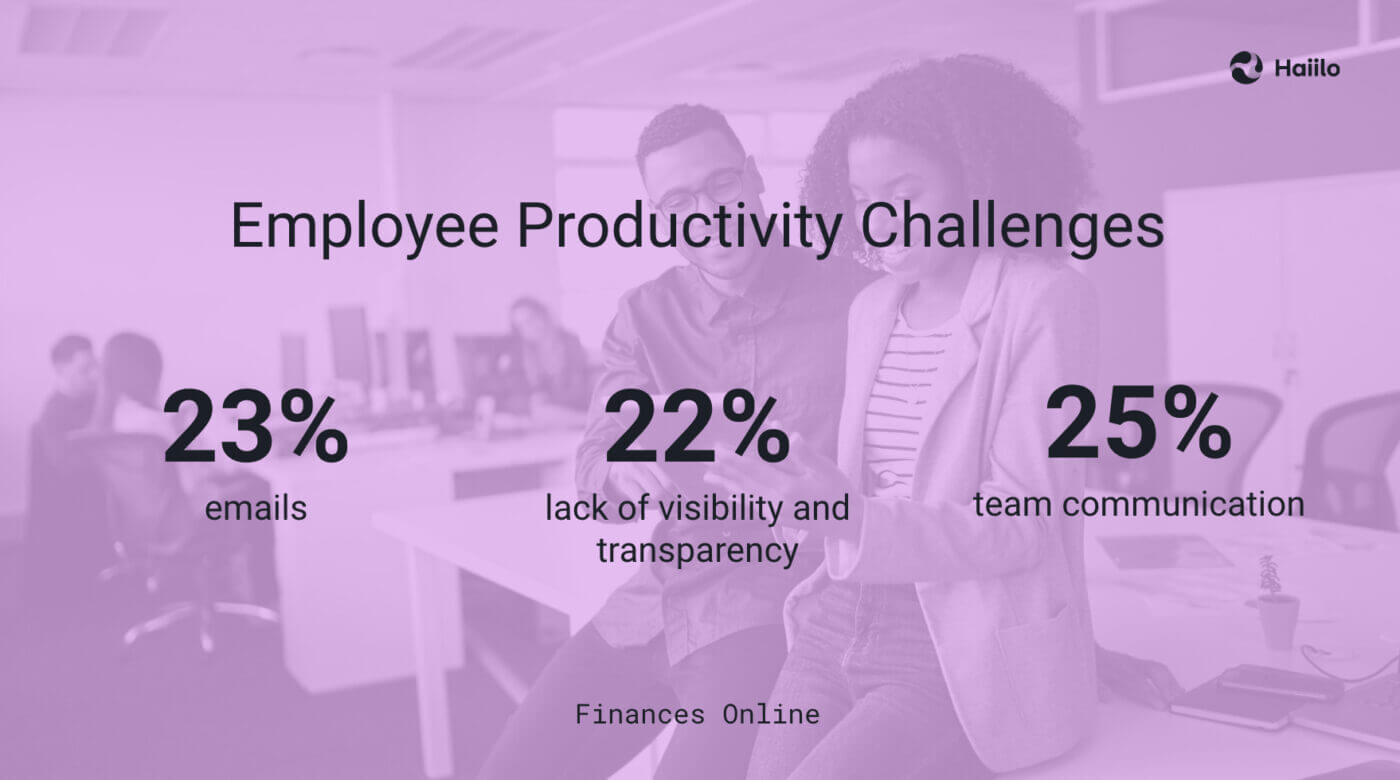
The image above highlights some of the biggest barriers to employee productivity caused by ineffective internal communication channels. When channels are unclear or overloaded, even simple tasks take longer than they should.
Let’s take a closer look at the most common challenges:
- Too many irrelevant emails
- Lack of transparency and visibility in the workplace
- Difficulty maintaining close relationships with peers and managers
- Poor team communication and cross-functional collaboration
- Constant distractions that break focus
- Lack of alignment with business goals
- Slower and more difficult change and crisis management
- Limited agility and delayed decision-making
- Increased misinformation and confusion
- Higher stress levels among employees
This is why choosing the right internal communication channels is not just a technical decision. It directly affects how your employees work, collaborate, and feel on a daily basis.
📚Read on: What is an Employee Engagement App and Why Your Company Needs One.
Key statistics about workplace communications
Having the right internal communication channels in place directly impacts how well your employees stay informed, focused, and engaged. Recent data highlights the gap:
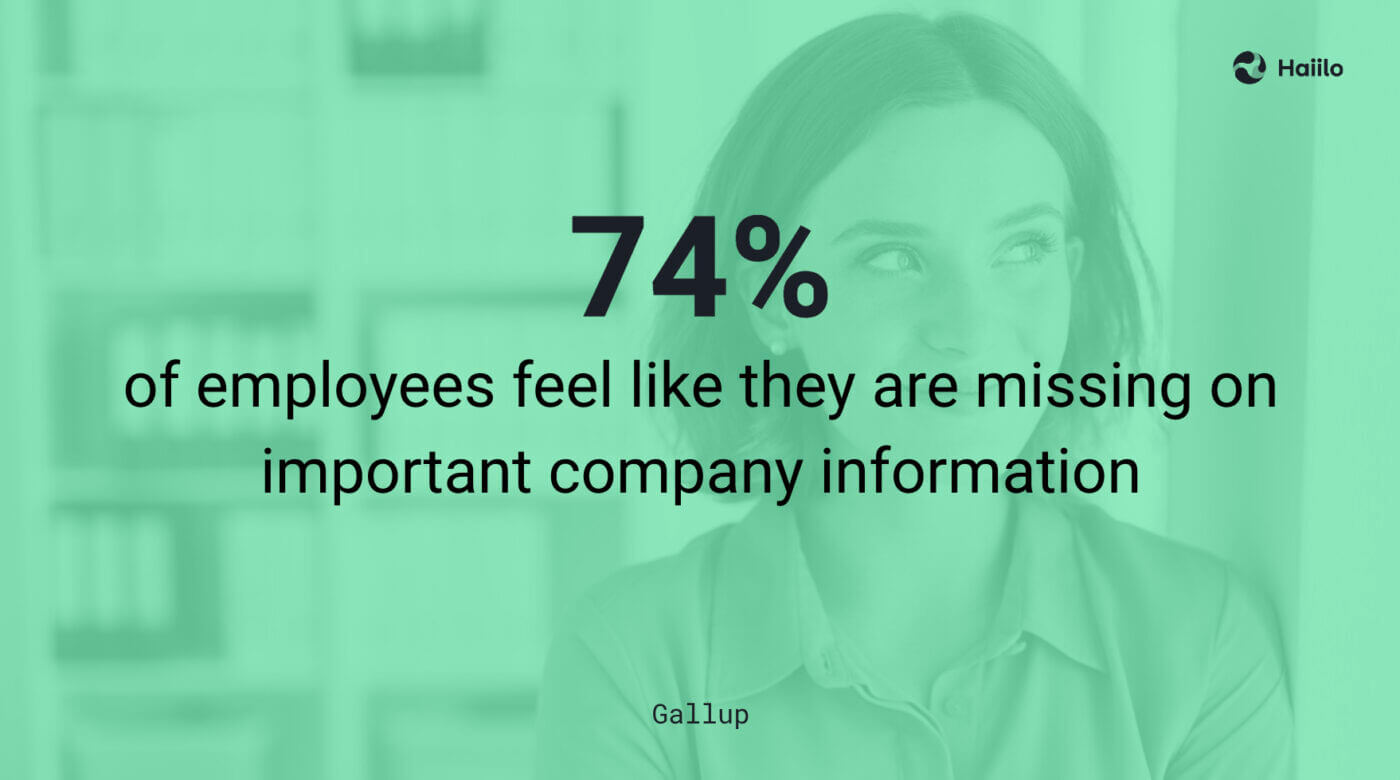
- Only 34% of employees feel well informed about what is happening in their organization (Gallagher)
- 68% of employees say they struggle with too much communication and information (Microsoft Work Trend Index)
- Employees spend 58% of their time on “work about work” like emails and searching for information (Asana)
- Only 23% of employees are engaged globally (Gallup)
Consolidating communication channels into a single platform
Today’s workplace is defined by a growing number of tools, which makes internal communication channels harder to navigate and manage. Employees are expected to switch between platforms, remember where information lives, and decide what matters on their own.
While multichannel communication increases reach, it also increases complexity if not managed carefully.
At the same time, internal communications teams face a constant challenge: how to deliver the right message to the right people at the right time without overwhelming them.
The result is often a lack of personalization in internal communication. Generic, company-wide messages feel distant and irrelevant, which is why they are frequently ignored, even when the content itself is important.
Today, employees may receive company updates via intranet, access documents via a document sharing tool, communicate with managers via emails, get a survey through a survey app and communicate with their peers via a completely different channel.
But is it possible to keep up with all of these updates on a daily basis without losing on productivity?
It’s actually very hard, if not impossible!
Instead of just keep adding new communication channels in order to try to improve communication in the workplace, employers need to take a completely different approach.
Using so many different channels can sometimes send just parts of the message, increasing the risk of miscommunication and information loss in the workplace.
So, what’s next?
The next step for many organizations is not adding more tools, but simplifying their internal communication channels. This means bringing them together into one platform that acts as a central, reliable source of information for every employee, reducing noise and making communication easier to navigate.
That is why we built Haiilo Studio. It helps you reach employees through the internal communication channels they actually use, while giving you clear insight into what works and what does not.
In practice, this means you can:
- Deliver personalized news feeds tailored to roles, locations, and interests so employees only see what matters to them
- Support real-time communication with easy mobile access, especially for remote and deskless employees
- Automatically bring in relevant content from trusted sources to keep communication fresh without extra effort
- Keep every employee connected and informed, no matter where or how they work
- Segment audiences easily to make communication more relevant and targeted
- Create dedicated channels for specific topics, reducing clutter across your internal communication channels
- Enable employees to collaborate more effectively in one place
- Connect your existing tools so employees do not have to switch between platforms
- Track engagement with your internal content so you can continuously improve your communication
Instead of managing disconnected tools, you give your employees a clear, consistent communication experience that helps them stay focused, informed, and aligned.
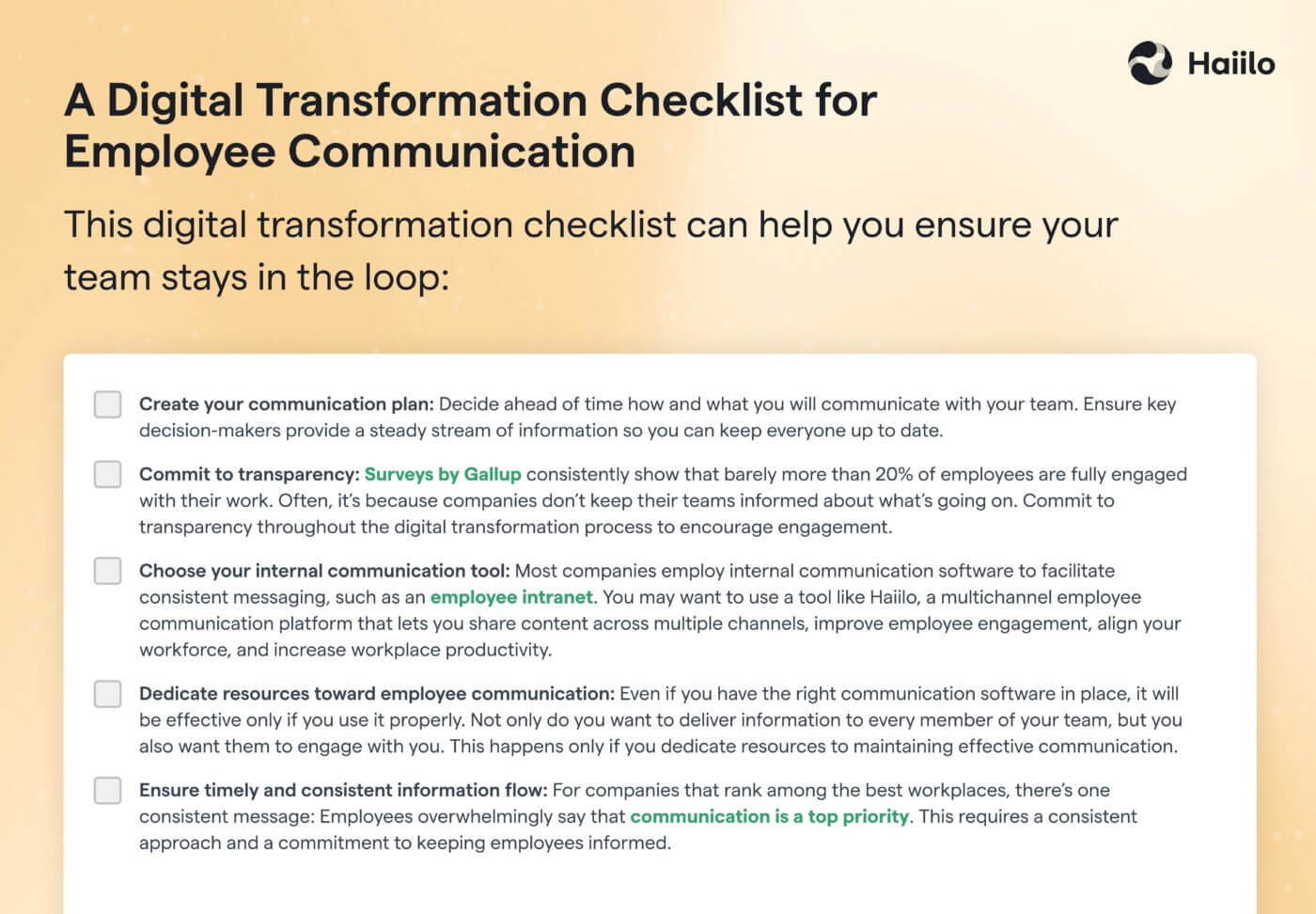
Digital transformation is easy with our simple checklist. Get it now!
Frequently asked questions about internal communication channels
1. What are internal communication channels?
Internal communication channels are the tools and methods your organization uses to share information with employees. This includes everything from email and intranets to messaging apps and face to face meetings. The key is not the number of channels, but how clearly each one is used so employees know where to go for updates, collaboration, or feedback.
2. How do you choose the right internal communication channels?
Start with how your employees actually work. Are they desk based or on the move? Do they need quick updates or deeper context? The best internal communication channels match daily workflows, reduce noise, and make it easy to find relevant information. A simple rule: if employees have to guess where to look, your setup needs adjusting.
3. Why do internal communication channels often fail?
Most issues come from overload and lack of structure. Too many tools, unclear ownership, and inconsistent messaging create confusion. Important updates get buried, while less relevant messages take up attention. Without clear guidelines, internal communication channels turn into noise instead of support.
4. Should you use multiple internal communication channels or one platform?
You will always need a mix of channels, but they should feel connected. The goal is not to replace everything, but to create a central place where employees can access key information and stay aligned. Well integrated internal communication channels reduce tool switching, improve visibility, and make communication easier to manage for everyone.