
Developing great communication skills is essential when it comes to building a successful career. But your communication skills play a key role in your private life too. Learn about the most in-demand communication skills and how to improve them.
🔎 With strong communication skills, you can easily improve communication in the workplace. Check out Top Communication Channels for Your Business and learn how to communicate with the modern employee in today’s digital age.
Great communication: Definition and importance in the workplace
Great communication is not just a single skill. It is the ability to share information clearly, listen actively, understand context and emotion, and adapt messages to different audiences and situations.
In today’s world of hybrid work, digital collaboration, and constant change, great communication matters more than ever – both in the workplace and in everyday life.
When communication works well, people understand each other faster, trust grows more easily, and teams are able to share ideas, solve problems, and make better decisions together. When it breaks down, even small misunderstandings can quickly lead to frustration, conflict, and lost productivity.
Recent research underlines just how critical this has become. According to McKinsey, organisations with effective communication and collaboration practices are significantly more likely to outperform their peers, particularly in fast‑moving and digital environments. Meanwhile, Microsoft’s Work Trend Index continues to show that unclear communication and constant message overload remain two of the biggest blockers to focus and performance at work.
Developing great communication is one of leaders’ top priorities
In the business world, many employers recognise that effective internal communication has a direct impact on employee productivity, engagement, and retention.
Leadership communication plays a critical role here. How leaders explain goals, decisions, and change strongly influences employee motivation and morale. At the same time, CEO communication remains essential for building trust in the workplace and creating organisational alignment, especially in times of uncertainty.
This is even more important in 2026, as teams are more distributed and technology‑driven than ever. Employees now expect communication to be:
- Clear and easy to understand
- Relevant to their role
- Available when they need it
According to Gallup’s ongoing workplace research, employees who feel well‑informed and heard are far more likely to be engaged at work, while poor communication remains one of the most common reasons people disengage or leave organisations.
Despite this, communication is often where things go wrong. While it may seem simple on the surface, great communication is difficult to get right. Messages can be misunderstood, context can be lost, and tone can easily be misread – particularly across digital channels. Over time, these small gaps can turn into larger conflicts or a lack of trust, both professionally and personally.
📹 Check out our Masterclass: How to Create an Internal Comms Strategy
By developing great communication, you can connect more effectively with colleagues, leaders, and teams – while continuously improving communication in the workplace and beyond.
Why You Need to Develop Great Communication
In today’s world of hybrid work, flexible schedules, and always‑on digital tools, we are receiving, sending, and processing more messages than ever before through multiple communication channels.
Slack messages, emails, meetings, intranet updates, video calls, AI‑generated summaries – the volume alone makes communication harder, not easier. This is why developing great communication has become a necessity, not a nice‑to‑have.
Great communication is not just about sharing information. It is about understanding the meaning, intent, and emotion behind that information. Without this understanding, messages are easily misinterpreted, feedback feels personal, and collaboration suffers.
Recent research supports this shift. Microsoft’s Work Trend Index shows that employees spend a significant portion of their day searching for information or clarifying messages, while still feeling under‑informed. At the same time, Gallup continues to report that employees who feel heard and clearly informed are far more likely to be engaged and motivated at work.
Great communication strengthens both professional and personal relationships. At work, it helps teams collaborate more effectively, reduces friction between departments, and improves decision‑making. In everyday life, it helps us better understand people and situations, avoid unnecessary conflict, and build stronger connections.
Developing great communication and leadership skills also plays a critical role in managing change. Clear, honest communication helps people feel included, reduces uncertainty, and enables better compromise when opinions differ. This is especially important in times of transformation, where employees expect transparency, context, and clarity from leaders.
AI has added another layer to this challenge. While AI tools can help draft messages, summarise conversations, and personalise content, they cannot replace human judgement, empathy, or context. In fact, the rise of AI makes great communication even more important – leaders and employees need to ensure messages still feel human, relevant, and trustworthy.
📚 Read: The 2026 guide to good internal comms
Together, these factors explain why organisations are placing renewed focus on great communication. It is one of the most powerful ways to improve clarity, strengthen relationships, and help people do their best work in an increasingly complex environment.
“
Improve internal communications by engaging your workforce
The Power of Great Communication in the Workplace
Great communication has a direct and measurable impact on how organisations perform. When people understand what is expected of them, why decisions are made, and how their work contributes to the bigger picture, they are far more likely to stay engaged and do their best work.
With great communication in place, organisations can impact their business in tangible ways. Teams collaborate more effectively, decisions are made faster, and change is easier to manage. In contrast, unclear or inconsistent communication often leads to confusion, duplicated effort, and disengagement.
Great communicators are often the people who move organisations forward. They bring clarity where there is uncertainty, help teams align around shared goals, and motivate and inspire their colleagues through clear and human messaging.
By improving great communication across the organisation, companies can significantly improve employee engagement, teamwork, decision‑making, and collaboration between departments. This is especially important in hybrid and distributed environments, where informal communication no longer happens naturally.
For this reason, communication continues to rank among the most in‑demand soft capabilities employers look for. But in 2026, the focus is shifting from “communication skills” as a checklist to the ability to deliver clear, timely, and relevant communication in complex environments.
Great communication also enables managers to handle difficult or sensitive conversations without damaging trust. Whether it’s delivering feedback, sharing bad news, or explaining change, the way messages are communicated often matters more than the message itself. When communication is clear and empathetic, employees are more likely to stay motivated and engaged.
📚 Read: 8 Employee Engagement Statistics You Need to Know
Employees today expect to be informed about what is happening across the business and not to miss important information. They expect leaders to communicate goals clearly, explain priorities, and provide regular feedback on performance. They also expect to be able to find the information they need quickly, without having to search across multiple tools.
Organisations that communicate company values and business goals clearly tend to see lower turnover and stronger alignment. When people understand what the organisation stands for and where it is going, they are more likely to feel connected to their work and stay committed over time.
📚 Read: Company Values: Definition, Importance, and Examples
The impact of communication becomes even more visible during periods of change. The way leaders communicate with employees during transformation has a direct effect on morale, productivity, and results. Many digital transformation initiatives still fail not because of technology, but because communication is unclear, inconsistent, or disconnected from employees’ reality.
This is why organisations need a clear strategy for keeping employees informed, involved, and engaged through change.
📚 Read: Change Management: Definition, Best Practices & Examples
While great communication can be learned, it is most effective when it feels natural rather than scripted. Over time, practice helps communication become more confident, spontaneous, and authentic. This human element is especially important in an age where AI can generate content, but cannot replace trust, judgement, or genuine connection.

6 Elements of Great Communication You Can’t Ignore
There are dozens of behaviours and capabilities that influence how we communicate at work. But when it comes to great communication, a small number of core elements consistently make the biggest difference.
The six areas below form the foundation of great communication, regardless of role, seniority, or communication type. Together, they help people connect more clearly, reduce friction, and build trust at work.
1. Listening
Listening is one of the most overlooked parts of great communication. It is not just about hearing words, but about understanding what is being said and how the other person feels.
When people feel genuinely listened to, conversations become more open and productive. Trust grows, misunderstandings decrease, and relationships strengthen. In contrast, poor listening often leads to frustration and repeated conversations that go nowhere.
In modern workplaces, listening also means being present during virtual meetings, reading messages carefully, and resisting the urge to multitask. Creating space for others to speak is a simple but powerful way to improve communication across teams.
2. Straight talking
Great communication is clear and direct. Straight talking means saying what needs to be said in a respectful and human way, without unnecessary complexity or corporate language.
Simple, honest conversations help teams build trust and surface issues early, before they become bigger problems. Even informal conversations with colleagues can strengthen relationships and uncover valuable insights.
Being approachable and open makes communication easier for everyone. When people feel comfortable speaking up, organisations benefit from better ideas, faster problem‑solving, and healthier collaboration.
3. Non‑verbal communication
When we communicate about topics that matter, we send a large number of non‑verbal signals alongside our words.
Non‑verbal communication includes body posture, facial expression, gestures, eye contact, tone of voice, and even how we pause or breathe. In video calls, it also includes camera presence, energy, and attention.
The way we look, listen, react, and gesture often communicates more than words alone. This is why alignment between verbal and non‑verbal communication is essential for trust.
According to Salesforce research, a significant proportion of how messages are perceived is influenced by non‑verbal cues. In a remote and hybrid world, being aware of these signals has become even more important.
4. Stress management
In small amounts, stress can be motivating. But when stress becomes constant, it can seriously undermine great communication.
Under pressure, people are more likely to misinterpret messages, react emotionally, or send unclear signals. This often leads to conversations people later regret.
Developing stress management skills helps you stay calm, communicate more clearly, and respond thoughtfully, even in challenging situations. It also makes it easier to de‑escalate conflict and keep discussions constructive.
5. Emotional awareness and control
Emotions play a central role in how messages are sent and received. Great communication requires an awareness of your own emotions and an understanding of how they influence others.
When emotions are unchecked, communication can quickly turn into misunderstanding or conflict. When emotions are recognised and managed, conversations become more balanced and productive.
Emotional awareness helps you express needs clearly, respond rather than react, and build stronger relationships at work. It is a critical skill for leaders, managers, and anyone working in diverse teams.
6. AI literacy
In 2026, AI has become a regular part of workplace communication. From drafting messages and summarising meetings to personalising content, AI can significantly support communication at scale.
However, great communication still depends on human judgement. AI can assist with clarity and efficiency, but it cannot replace empathy, context, or trust.
Understanding how AI is used in internal communications – and where its limits are – is now an essential part of great communication. Professionals who combine AI support with human insight are better equipped to create clear, engaging, and credible messages.

30+ Stats That Show Why Great Communication Matters
To understand the real impact of great communication, it helps to look at the data. The statistics below highlight how communication influences trust, engagement, productivity, leadership, and business performance in today’s workplace.
- Only 7% of meaning is derived from words alone, while 38% comes from tone and 55% from body language (Haiilo, based on Mehrabian’s communication model)
- Over 80% of employees say clear and honest communication is essential for building trust with their employer (Slideshare)
- 81% of recruiters say interpersonal communication is one of the most important capabilities they assess in candidates (mba.com)
- More than 60% of employers report that applicants lack effective communication, despite meeting technical requirements (Business Time)
- 57% of recruiters expect demand for communication and interpersonal abilities to continue growing over the next five years (mba.com)
- 98% of top sales performers say strong relationships are the most important factor in generating new business (Salesforce)
- More than 90% of employees would rather hear bad news than no communication at all (Jostle)
- 73.4% of employers want candidates with strong written communication (National Association of Colleges and Employers via Inc.)
- Organisations lose an average of $62.4 million per year due to poor communication between employees (SHRM)
- 57% of employees say they are not given clear directions at work (HR Technologist)
- 69% of managers say they are uncomfortable communicating with employees (HR Technologist)
- Only 19% of organisations believe they are very effective at developing leaders, with communication cited as a key gap (Infopro Learning)
- 82% of employees do not trust their manager to communicate honestly (Forbes)
- 85% of employees say they are most motivated when leaders share regular company updates (Trade Press Services)
- 70% of organisational communication still travels informally through the grapevine, rather than official channels (Chron)
- 77% of employers say soft capabilities like communication are just as important as technical skills (Haiilo)
- 41% of leaders say they struggle to gather the information they need quickly, impacting decision‑making (PwC)
- 69% of managers fail to organise communication in a structured way for their teams (Rallyware)
- 37% of managers avoid giving direct feedback because they fear negative reactions (Harvard Business Review)
- 91% of employees say their leaders lack effective communication skills (Interact / Harris Poll via Inc.)
- Nearly 25% of employees say email is a major productivity killer due to overload and unclear messaging (Bluesource)
- 61% of employees link poor communication to low morale, while 31% say it directly causes lost business (HR Magazine)
- 28% of employees say poor communication is the main reason projects fail to meet deadlines (Computing Technology Industry Association)
- According to Microsoft’s Work Trend Index, employees now spend a significant part of their working week clarifying messages or searching for information, despite having more tools than ever
- McKinsey research shows organisations with effective communication and collaboration practices are significantly more likely to outperform peers during periods of change
- Gartner (2025) reports that AI‑supported communication improves speed and consistency, but trust and engagement still depend on human clarity and empathy

Help Your Employees Build Great Communication with Haiilo
To grow and adapt, organisations need more than individual communication skills. They need great communication at scale – communication that is clear, relevant, timely, and easy to access for everyone.
Great communication is the glue that holds an organisation together. Without it, employees struggle to understand priorities, leaders find it harder to motivate teams, and important messages get lost in noise. Over time, this leads to disengagement, frustration, and missed opportunities.
In 2026, the challenge is no longer a lack of channels. It is information overload. Employees use more tools than ever, yet still spend a significant part of their working day searching for the information they need or clarifying messages.
That’s why great communication today is about:
- Delivering the right message to the right people
- At the right time
- Through the channels they actually use
This is exactly why we built Haiilo.
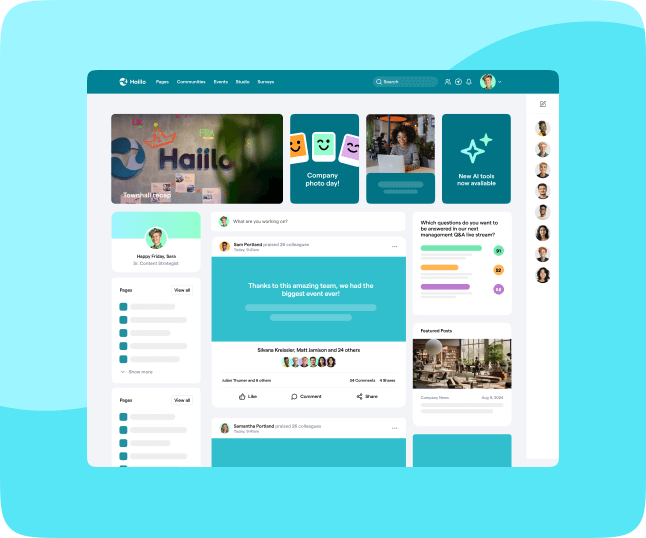
Haiilo helps organisations make great communication part of everyday work. It ensures employees get clear, relevant information without having to search across multiple tools or rely on informal channels.
Remember: employees spend an average of 2.5 hours per day searching for the information they need to do their jobs. Great communication reduces this friction and helps people focus on meaningful work.
Just as importantly, great communication needs to meet employees where they are. When messages are shared through familiar and preferred channels, engagement increases and communication becomes more effective.
Haiilo supports great communication by helping you:
- Share relevant messages that connect the entire workforce
- Build an internal communication strategy adapted to employees’ real needs
- Enable easy content creation. With Haiilo Home, employees can create engaging content in minutes – no design skills required
- Activate employee advocacy. Haiilo Share makes it easy for employees to share insights with their personal networks and build credibility as industry experts
- Use clear analytics to understand what content resonates and where communication can improve
Great communication doesn’t stop inside the organisation.
Employees who feel informed and confident are more likely to become authentic ambassadors for your brand. With Haiilo, it becomes easy for employees to share company news, achievements, and stories externally in a way that feels natural and human.
The result? Employees who feel informed, engaged, and proud to be part of the organisation – and a culture where great communication supports both business performance and employee experience.
Great Communication FAQs
What is great communication?
Great communication is the ability to share information clearly, listen actively, understand context and emotion, and adapt messages to different people and situations. It goes beyond individual skills and focuses on outcomes: clarity, trust, alignment, and action. In the workplace, great communication helps people understand priorities, make better decisions, and work together more effectively.
How is great communication different from communication skills?
Communication skills describe specific abilities, such as writing, presenting, or listening. Great communication is the result of using those abilities well, in the right way and at the right time. It is less about ticking off skills and more about whether messages are understood, trusted, and acted on.
Why is great communication more important now than ever?
In 2026, work is more digital, distributed, and fast‑moving than ever before. Employees use more tools, receive more messages, and face constant change. Great communication helps cut through noise, reduce misunderstandings, and create clarity in complex environments. Without it, information overload quickly leads to disengagement.
What role does AI play in great communication?
AI can support great communication by helping draft messages, summarise conversations, personalise content, and improve speed and consistency. However, AI cannot replace human judgement, empathy, or trust. Great communication happens when AI is used as a support tool, not a substitute for thoughtful, human interaction.
Can great communication be learned?
Yes. While some people may feel more confident communicating naturally, great communication is developed through practice. Listening with empathy, preparing key messages, choosing the right channel, and being open to feedback all help improve communication over time.
How can organisations improve great communication at scale?
Organisations improve great communication by setting clear communication principles, supporting leaders, using the right tools, and making information easy to find. Platforms like Haiilo help ensure employees receive relevant, timely messages through channels they already use, turning communication into a consistent and reliable experience.