
Even though internal communication has a direct impact on employee experience and employee engagement, many organisations still lack a clear, long-term plan. Without a defined direction, communication efforts often become reactive, inconsistent, and difficult to measure. In this blog post, we share a practical, step-by-step guide to help you build a strong and sustainable internal corporate communication strategy.
You’re not alone.
A large number of organisations still operate without a structured approach to communication. Many teams rely on ad hoc updates or disconnected tools, which leads to confusion, missed messages, and low engagement. Without a clear internal corporate communication strategy, it becomes harder to align employees, reinforce company culture, and support business goals.
💡Check out our article about Communication Strategies and How to Create Your Own.
This lack of strategy and planning is alarming, as an internal communication system without a clear direction is unlikely to deliver consistent results. Over time, this can impact productivity, employee trust, and overall performance.
To help you move forward with confidence, here’s a helpful guide to crafting an effective internal communication strategy for your workplace. Let’s get started!
Make executing your communications strategy effortless with the right IC tools
Why You Need an Internal Communication Strategy
A carefully planned strategy can do wonders for your company’s internal communication initiatives. It brings structure, consistency, and purpose to how information flows across your organisation, helping teams stay informed and aligned.
Here’s why:
Creating Organizational Alignment
Business leaders often fail to understand the purpose of internal communication and how it connects to broader business goals. As a result, they may put limited effort into supporting your internal communication initiatives or see them as a low priority.
A clear, documented internal corporate communication strategy helps bridge that gap. It shows how communication drives business outcomes such as productivity, engagement, and retention. This makes it easier to secure leadership buy-in, whether that’s through budget, active participation, or long-term commitment.
When leaders understand the value, they are far more likely to champion communication efforts and lead by example.
Poor communication in the workplace increases employee frustration and disengagement. When messages are unclear, inconsistent, or missing altogether, employees struggle to do their jobs effectively and feel disconnected from the organisation.
Over time, this can lead to lower morale, reduced trust, and higher turnover—making a strong internal corporate communication strategy not just helpful, but essential.

Easier Execution and Higher Employee Productivity
A well-crafted strategy lays out a clear and actionable plan for executing your internal communication initiatives. It defines your goals, identifies the right tools and resources, and outlines how to drive participation across the organisation. It also makes it easier to measure success and adjust your approach based on real data.
With a strong internal corporate communication strategy in place, your team knows exactly what to do, when to do it, and how to do it. This reduces guesswork, avoids duplication of effort, and keeps communication consistent across departments.
Without a clear strategy, all the above will fall flat. Messages become scattered, priorities get lost, and communication efforts fail to deliver real impact.
Related: Internal Communication: Definition, Challenges and Top Reasons Why It’s More Important than Ever
What’s more, effective internal communication has a direct impact on employee productivity. When employees can quickly find the information they need, they spend less time searching and more time focusing on meaningful work.
The secret to improved employee productivity lies in your internal communication strategy. Research from the McKinsey Global Institute shows that productivity can increase by 20–25% in organisations where employees are well connected and communication flows effectively.
However, implementing an effective internal communication strategy is not easy. Many organisations struggle to move from intention to execution. Common challenges include:
- Shifting from top-down-only communication to more transparent, two-way, and cross-functional information flow
- Collecting meaningful employee feedback and acting on it in a timely way
- Engaging employees across different locations, roles, and work environments
- Tracking performance and measuring progress consistently over time

Creating an Effective Internal Communication Strategy in 8 Steps
There are a few key steps to take when building an effective internal communication strategy. Following a structured approach ensures your efforts are focused, measurable, and aligned with business priorities. These steps will help you build a strong internal corporate communication strategy that delivers real value for both employees and the organisation. They will also help you overcome the biggest communication barriers and eliminate the biggest challenges IC professionals face today.
1. Review Your Current Strategy
Before revamping your employee communication strategy, it’s important to take stock of what’s currently in place.
Evaluate your current IC strategy to identify its strengths and weaknesses. Look beyond surface-level observations and assess what is actually working versus what is not. Identify gaps, inconsistencies, and areas where communication is breaking down. Ask yourself questions such as:
- How is your current strategy being implemented across teams and locations?
- What software and channels are you currently using, and are they being adopted effectively?
- How effective is your communication in reaching and engaging employees?
- What impact does it have on company culture and employee experience?
- What are the most common complaints or pain points raised by employees?
Answering these questions will give you a clear baseline to start with. It also helps you make informed decisions, rather than assumptions, when shaping your new internal corporate communication strategy. You can then build on what works and fix what doesn’t.
2. Define Your Audience
Before coming up with a plan for your workplace communication, it’s essential to clearly identify your audience.
Many companies make the mistake of treating employees as one large, homogeneous group. In reality, different teams, roles, and locations have very different communication needs, preferences, and challenges. Ignoring these differences leads to irrelevant messaging and low engagement.
For example, your software development and sales teams will have very different communication priorities, tools, and workflows. Spend time segmenting your audience into meaningful groups based on factors such as role, department, location, or seniority. This makes it much easier to tailor messages, choose the right communication channels, and deliver a more relevant and effective internal corporate communication strategy.

Your content distribution is key when it comes to internal communication.
If you want to engage your employees with your content, you need to deliver the right information at the right time—and through the right channels. Poor timing or irrelevant messaging quickly leads to disengagement.
To make this work, tailor your distribution based on employees’ roles, responsibilities, expertise, and preferred language(s). A targeted approach ensures messages are relevant, easier to understand, and more likely to drive action. This level of precision is essential for any effective internal corporate communication strategy.
3. Set Clear Goals
It’s important to have concrete goals and timelines in place to add structure and direction to your planning process.
Without clear goals, it’s difficult to measure success or understand whether your internal corporate communication strategy is delivering results. Setting defined objectives helps you stay focused and align communication efforts with broader business priorities.
Devise realistic timelines for planning, ideation, and execution. This keeps your initiatives on track and ensures consistent progress over time.
Your goals should clearly outline what you want your internal communication efforts to achieve—whether that’s improving engagement, increasing message reach, or supporting organisational change.
When coming up with goals, it’s essential to follow the SMART formula:
- Specific – your goals need to be clear, focused, and well-defined.
- Measurable – your goals must be quantifiable so you can track progress.
- Attainable – ensure your goals are realistic given your current resources and constraints.
- Relevant – goals must align with your company’s priorities and overall strategy.
- Time-bound – your goals must have deadlines to maintain momentum and accountability.

Measurement and goals go hand in hand. Therefore, at this stage, it’s also important to choose the key metrics you’ll track to evaluate the success of your new IC strategy.
Without clear metrics, it’s impossible to know what’s working and what needs improvement. Tracking the right data helps you make informed decisions and continuously optimise your internal corporate communication strategy.
Related: 4 Smart Ways to Measure Your Internal Communication
It’s important to define your goals early, as these metrics will directly shape your planning approach, content decisions, and channel selection.
4. Define Your New Strategy
Now it’s time to map out your vision for your new internal communication strategy.
This is where everything comes together. Your internal corporate communication strategy should clearly outline how you will communicate, who you will reach, and how you will measure success.
Your new internal communication strategy should include:
- Clear goals that align with business priorities
- Defined audience segmentation
- Relevant and measurable metrics
- Realistic timelines for execution
- Ambassadors or champions to drive adoption
- An internal communication solution that fits your needs
- The right content types for your audience
- An effective content distribution plan
Stakeholders: Who Is Responsible for Your Internal Communication?
You need to clearly determine who is responsible for each part of your internal communication efforts.
Assigning ownership ensures accountability and keeps your internal corporate communication strategy moving forward. Without clear roles, tasks get delayed, and initiatives lose momentum.
You need to assign specific responsibilities to different stakeholders, such as:
- Executive leadership to set direction, communicate priorities, and lead by example
- Influencers and champions across teams who actively participate and encourage engagement
- HR and marketing team members who manage, measure, and continuously improve internal comms
Unless these roles are clearly defined and assigned, your internal communication initiatives are unlikely to be executed successfully.
Related: Who is Responsible for Internal Communication?
What Solution to Use for Your Internal Communication?
What internal communication platform will you choose? What features should you prioritise?
To drive adoption, you need a solution that fits seamlessly into your employees’ daily workflows and makes it easy to stay informed. If accessing information feels like extra work, engagement will drop quickly.
Simply sharing product updates or company news in a monthly newsletter is not enough to engage with your employees. Modern employees expect timely, relevant, and interactive communication.
Instead, make it easy for employees to access updates in real time. Consider features such as mobile access, personalised feeds, and interactive elements. You can also make internal communication more engaging through gamification and recognition.
In a nutshell, the platform you implement should allow you to:
- Encourage employees to stay up to date with company news
- Create a more engaging and interactive communication experience
- Track performance and measure results effectively
What Types of Content Should You Share to Drive Adoption?
You could share industry news, internal updates, leadership messages, employee stories, training materials, and more. The key is to provide content that is relevant, useful, and easy to consume.
Think about who will take ownership of creating and sharing key content. Define how often you will communicate and which formats you will use. A consistent and well-planned content mix will help reinforce your internal corporate communication strategy and keep employees engaged over time.
To drive adoption and engagement, you should also share content that’s directly relevant to your employees’ roles and day-to-day responsibilities.
Generic, one-size-fits-all content rarely performs well. Employees are far more likely to engage with content that helps them do their jobs better or adds value to their work.
For example, for your support team members, share case studies of companies delivering exceptional customer support or practical tips they can apply immediately. Because this content is closely tied to their role, it’s more likely to capture attention and drive interaction. This kind of targeted approach strengthens your internal corporate communication strategy and improves overall engagement.
We’ll discuss more about this in the next section.
5. Optimize Your Content Distribution
Most employees feel overwhelmed by information overload. Too many messages, sent through too many channels, can quickly lead to disengagement. The challenge is to reduce noise while still making sure employees receive the information they need.
How do you minimize overload while ensuring that each employee gets the right information at the right time?
Related: Why Your Employees Are Missing Out on Important Information
In step 2, you defined and segmented your audience. This makes it much easier to distribute content effectively and avoid overwhelming employees with irrelevant updates.
A strong internal corporate communication strategy focuses on relevance, timing, and channel selection. Instead of broadcasting everything to everyone, tailor your messaging based on audience needs and priorities.
To get your content distribution right, it’s important to be clear about what action you want employees to take after consuming your content.
This will help you create more targeted and purposeful communication that aligns with both employee needs and business goals.
Ask yourself questions like:
- What type of content is strictly for internal consumption?
- What content should employees share on their own social networks? This is where employee advocacy becomes an extension of your internal communication efforts.
- What types of content should spark discussion, feedback, or collaboration? These may require active promotion from internal influencers.
6. Identify Your Ambassadors
It’s important to establish key stakeholders in your organisation who will act as promoters for your new internal comms strategy.
Passive, company-wide mandates rarely work. If you want your internal corporate communication strategy to succeed, you need active participation from employees at all levels.
Identify individuals with influence who can champion your initiatives, encourage adoption, and model the behaviours you want to see. These ambassadors help build trust and make communication feel more authentic and relatable.
They don’t have to be senior leaders. Employees who are well-connected, respected, and engaged can be just as effective—regardless of their role or seniority. Their involvement can significantly speed up adoption and improve engagement.
7. Measure Your Progress
Once you’ve started implementing your new strategy, use the metrics you defined earlier to evaluate whether your IC strategy meets the goals you established.
Regular measurement allows you to identify what’s working, what isn’t, and where you need to adjust your approach. A data-driven internal corporate communication strategy is far more effective than one based on assumptions.
Ask questions such as: Has engagement increased? Are employees interacting more with content? Have referrals or participation rates improved? Are employees more informed and aligned?
Some common metrics to track could be:
Engagement metrics
There are many ways to measure engagement.
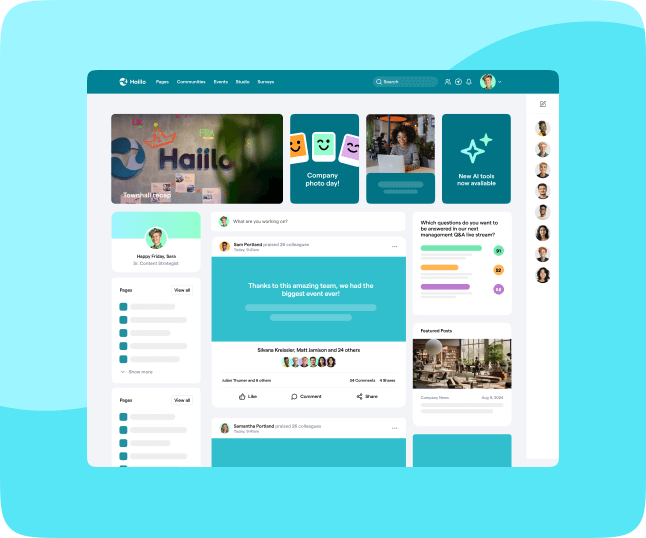
A simple and effective method is tracking likes, comments, and shares on your internal communication platform, such as Haiilo. These interactions provide a clear signal of how relevant and valuable your content is to employees.
Employee Referrals
Employee referrals are another useful indicator of how well your internal communication and employee advocacy efforts are working together. Compare referral rates before and after implementing your strategy to measure impact.
Productivity and Employee Engagement
Better internal communication should lead to higher employee productivity and stronger engagement. When employees have easy access to the information they need, they can work more efficiently and feel more connected to the organisation—key outcomes of a successful internal corporate communication strategy.

Social Shares
Employee advocacy programs are closely connected to internal communication.
Measure the total number of company-related social shares over a set period of time. This helps you understand how willing employees are to promote your organisation externally.
Higher social shares typically indicate that you are sharing relevant, high-quality content internally—content that employees feel confident and excited to share with their own networks. This is a strong signal that your internal corporate communication strategy is resonating.
Remember to consistently track your metrics. What doesn’t get measured won’t improve, and without clear data, it’s difficult to optimise your approach over time.
8. Review Your Strategy on a Regular Basis
When it comes to internal communication, consistency is key.
Your internal corporate communication strategy should never be static. Business priorities, employee expectations, and communication tools evolve quickly, so your strategy needs to adapt as well.
Conduct regular reviews to ensure your approach remains effective and aligned with your goals. Look at performance data, engagement trends, and feedback to identify what’s working and what needs to change.
What worked a few years ago—or even a few months ago—may no longer be relevant. Don’t hesitate to refine your messaging, channels, or content strategy as needed.
Conduct regular feedback surveys to understand how employees perceive your internal communication. Their input will help you adjust your strategy to better meet their needs and expectations, making your communication more effective and meaningful.
💡 Related: Learn about the top 5 communications skills!
Conclusion
An internal communication strategy is an essential part of your overall communication ecosystem. Without a clear plan, communication efforts can quickly become inconsistent and ineffective.
Use these eight steps to build a structured and impactful internal corporate communication strategy. By doing so, you’ll create a more informed, engaged, and aligned workforce—helping your employees stay productive and connected to your organisation’s goals.
FAQs about internal corporate communication strategy
What is an internal corporate communication strategy?
An internal corporate communication strategy is a structured plan that defines how information is shared within an organisation. It outlines your goals, target audiences, channels, and key messages. Instead of sending ad hoc updates, it ensures communication is consistent, relevant, and aligned with business objectives. A strong strategy helps employees stay informed, connected, and engaged in their work.
Why is an internal corporate communication strategy important?
Without a clear strategy, communication quickly becomes inconsistent and ineffective. Employees may miss important updates, feel disconnected, or struggle to find the information they need. A well-defined internal corporate communication strategy improves alignment, boosts engagement, and supports productivity. It also helps leadership communicate more clearly and build trust across the organisation.
What are the key components of an effective strategy?
An effective internal corporate communication strategy includes clear goals, defined audiences, the right communication channels, and measurable metrics. It should also cover content planning, distribution, and feedback loops. Just as important is assigning ownership—so everyone knows who is responsible for creating, sharing, and evaluating communication. When all these elements work together, communication becomes more focused and impactful.
How do you measure the success of your internal communication?
Success can be measured using a mix of engagement and performance metrics. Common indicators include message reach, employee engagement (likes, comments, shares), feedback survey results, and participation rates. You can also look at broader outcomes like productivity, retention, and employee advocacy. Tracking these metrics regularly via an employee experience platform helps you refine your internal corporate communication strategy and improve results over time.
Digital transformation is easy with our simple checklist. Get it now!