
Internal communications is a crucial function in every organization. It helps companies keep employees informed, aligned, and engaged with what’s happening across the business—from strategy and goals to day-to-day updates.
When internal communications are done well, employees understand their role in the bigger picture and feel more connected to their work. When they’re not, confusion, disengagement, and silos quickly follow.
In this blog, you’ll learn why internal communications matter, who is responsible for internal comms, and how to build a clear, effective IC strategy that actually works.
Get a proper internal comms platform to support your IC department
What are Internal Communications (IC)
According to Wikipedia, internal communications (IC) is the function responsible for effective communication among participants within an organization.
In practice, internal communications go far beyond simply sharing information. It ensures that employees understand company priorities, stay aligned with business goals, and have the context they need to do their jobs well.
The scope of work within internal communications teams varies by organization and maturity. IC professionals may be responsible for producing and delivering messages and campaigns on behalf of executives and managers, ensuring those messages are clear, consistent, and timely.
They also play a key role in facilitating two-way dialogue, giving employees a voice and creating feedback loops that help leaders understand what’s really happening across the organization.
In addition, internal communications teams often focus on developing the communication skills of employees and leaders, helping them communicate more effectively across teams, departments, and locations.
Ultimately, strong internal communications bring people, information, and strategy together—making sure everyone is informed, heard, and moving in the same direction.
14 Reasons Why Internal Communications are Important
Most large organizations have internal communications departments. As companies grow, keeping everyone aligned becomes more complex. With thousands of employees, communication among employees can quickly become fragmented and inefficient. Information gets lost, messages become inconsistent, and teams operate in silos.
This is where internal communications play a critical role. IC professionals help streamline communication, ensure the right messages reach the right people, and create a more connected and informed workforce.
Here are a few main reasons why you should have an internal communications department.
1. Employee engagement
According to Gallup’s State of the Global Workplace 2025 report, only about 21% of employees worldwide feel engaged at work — one of the lowest levels recorded — indicating that many leaders still struggle to improve engagement effectively.
Internal communications have a direct impact on engagement. When employees receive clear, relevant, and timely information, they are more likely to feel involved and motivated. Poor communication, on the other hand, creates uncertainty and disconnect.
This is how you can improve employee communications to drive better employee engagement include:
- Set clear employee expectations so people know what success looks like.
- Keep your employees informed with regular, transparent updates.
- Make it easy for employees to find important information when they need it.
- Encourage open communication to identify obstacles and resolve issues early.
- Focus on employee feedback and recognition to build trust and motivation.
- Encourage discussion and sharing of ideas across teams.
2. Employee satisfaction
Employee engagement is closely linked to employee satisfaction. In general, less engaged employees tend to be less satisfied with their jobs. One of the most common reasons for this is poor internal communications.
When employees don’t receive clear updates, don’t understand company decisions, or feel unheard, frustration builds quickly. Strong internal communications help create transparency, reduce uncertainty, and build a sense of trust across the organization.
According to Deloitte’s 2025 Human Capital Trends research, many organisations continue to face challenges in fully engaging and satisfying employees, underscoring the impact that leadership behaviours — including internal communication — have on employee experience and organisational performance.
3. Employee productivity
Good employee satisfaction and engagement boost employee productivity. Organizations with effective internal communications tend to operate more efficiently because employees spend less time searching for information or clarifying tasks.
Clear communication reduces misunderstandings, aligns priorities, and helps teams focus on the work that matters most. It also enables faster decision-making and smoother collaboration across departments.
Research shows that organisations with high levels of employee engagement saw a 20.1 % revenue growth over three years, which was 2.3 times higher than the average growth rate of 8.9 % among other organisations.
If your employees clearly understand their goals, stay informed about company developments, and receive regular feedback, they are far more likely to stay focused and perform at a higher level.
Check out these 5 ways how better communication can boost employee productivity.

4. Change management
One of the main duties of every internal communications professional is to communicate changes within the company. Whether it’s a new strategy, system, or organizational shift, employees need clear and timely information to adapt successfully.
Prosci’s Best Practices in Change Management research shows that projects with excellent change management are far more likely to succeed — with about 88% of those projects meeting or exceeding objectives. This highlights how critical internal communications are in driving successful change.
In today’s fast-moving, agile work environment, organizations need a clear and structured approach to change management. Without it, confusion, resistance, and delays are almost guaranteed.
Most changes related to your company’s products, services, structure, or people need to be clearly communicated. Employees want to understand what’s changing, why it matters, and how it will affect them.
Here are a few tips on how to communicate for effective change management.
- Communicate consistently and frequently to avoid uncertainty.
- Use multiple channels such as speaking, writing, video, training, focus groups, bulletin boards, and internal communications tools.
- Communicate early so employees have time to prepare for the change.
- Share all relevant information clearly and transparently.
- Explain how the change will impact the organization and individual roles.
- Be honest about both the benefits and challenges of the change.
- Involve employees and ask for their input where possible.
- Encourage two-way communication and open dialogue.
- Organize one-on-one or group meetings for those most affected.
- Listen carefully and respond to employee questions and concerns quickly.
- Run interactive forums or workshops to support understanding.
- Make it easy for employees to communicate with each other during the transition.
- Track progress and adjust your communication approach if needed.
- Recognize and reward employees who successfully adopt changes.
5. Teamwork
Internal communications are essential when it comes to teamwork encouragement and facilitation. Without clear communication, collaboration quickly breaks down.
Most roles today require cross-team collaboration. For that to work, employees and managers need simple, reliable ways to share information, align on goals, and coordinate their efforts.
Strong internal communications reduce silos, improve transparency, and make collaboration smoother. As a result, teams can work faster, solve problems more effectively, and deliver better outcomes.
That’s why organizations that invest in internal communications are far more likely to build high-performing, connected teams.
6. Employee advocacy
When employees are informed, engaged, and motivated, they are much more likely to become brand ambassadors.
Employee advocacy doesn’t happen by accident. It starts with strong internal communications that keep people aligned with the company’s mission and values.
Identify employees who are passionate about your brand, involve them in employee advocacy or social selling programs, and recognize their contributions. When done right, it becomes a win-win for both employers and employees—employees build their personal brand while companies expand their reach.
7. Brand awareness
With employee advocacy comes higher brand awareness. Employees have their own networks, often far beyond what corporate channels can reach.
In fact, employee networks can significantly amplify your message, helping your brand reach more people in a more authentic way than traditional marketing alone.
Ultimately, there’s no better promotion for your brand than employees who genuinely believe in what your company does and are willing to share it.
Here are a few more benefits of employee advocacy.

8. Employee retention
Employee communications and relationships have a big impact on employee retention. When people feel uninformed, disconnected, or unclear about their role, they are far more likely to look for opportunities elsewhere.
Poor internal communications often lead to frustration and disengagement—two of the main drivers of employee turnover. On the other hand, clear and consistent communication builds trust and helps employees feel valued and included.
Companies with disengaged employees often experience significantly higher turnover rates, which increases hiring costs and disrupts team performance. Improving internal communications can help reduce this risk and create a more stable workforce.
Millennials and younger generations, in particular, expect ongoing conversations, transparency, and regular feedback. If you want to retain them, you need to improve your internal comms strategy and make communication part of everyday work—not just occasional updates.
9. Employee empowerment
If you want to empower your employees, you need to communicate with them effectively. Clear expectations, regular updates, and open feedback loops are essential for confident decision-making.
Giving employees autonomy and responsibility to make decisions is key to both motivation and retention. But autonomy only works when employees have the right information at the right time.
Internal communications provide that foundation. When employees understand goals, priorities, and context, they feel more confident taking ownership of their work.
Research consistently shows that empowered employees are more engaged and more likely to stay. However, many organizations still struggle with how to empower their employees in practice.
Trust plays a crucial role in successful employee empowerment. Managers who communicate openly and regularly build that trust—and are more comfortable giving employees greater ownership.
10. Company culture
Whether you’re trying to attract or retain talent, employees need to understand what your company stands for. That includes your mission, vision, and day-to-day behaviors.
Internal communications help turn those values into something employees can actually see and experience. It reinforces what matters and shows how people are expected to work together.
Without strong internal communications, culture becomes inconsistent across teams. With it, organizations can create a more aligned and positive work environment.
A well-functioning internal communications system—and the healthy work environment it creates—gives your organization a real advantage in a competitive market.
11. Innovation and creativity
Innovation is essential for gaining a competitive edge. But it doesn’t just come from dedicated teams or budgets—it comes from how people share ideas and collaborate.
Your internal communications and knowledge-sharing system play a key role in enabling that. When employees can easily exchange ideas, ask questions, and learn from each other, innovation becomes part of everyday work.
Strong internal communications break down silos and encourage cross-functional thinking. This creates an environment where new ideas are more likely to surface and grow.
To build a culture of innovation, communication needs to be open, accessible, and encouraged at every level of the organization.
12. Customer satisfaction
Internal communications have a direct impact on customer experience. When employees are informed and aligned, they can deliver more consistent and reliable service.
For example, inefficient change management caused by poor communication can have a devastating impact on customer satisfaction.
If employees don’t understand a change, they can’t explain it clearly to customers. This leads to confusion, delays, and frustration.
Continuous and clear communication ensures that everyone is prepared, aligned, and able to support customers effectively—even during periods of change.
13. Employer Branding
We have already talked about how employee advocacy can help you build brand awareness. The same applies to employer branding.
Informed and engaged employees are more likely to actively support your company’s Employer Branding and Social Media recruiting efforts.
However, this only works when employees have the right information and guidance. Internal communications must provide clear instructions and a steady flow of relevant content so employees can confidently represent the company.
14. Knowledge sharing
Organizations with strong internal communications tend to have more effective knowledge sharing. Information flows more freely, and employees can learn from each other more easily.
Creating a knowledge sharing culture is essential for company growth and long-term success.
This requires more than just tools—it requires an open communication environment where people feel comfortable sharing what they know.
Internal communications help remove silos between teams, departments, and individuals. When communication flows freely, knowledge becomes a shared asset rather than something locked away.
Eliminating these barriers is one of the most important steps in building a more agile, informed, and high-performing organization.
Who is Responsible for Internal Communications
Many companies that haven’t yet established internal communications teams often ask who is responsible for internal communications.
The reality is that internal communications is a shared responsibility. While some roles lead the effort, effective communication depends on multiple stakeholders working together.
In most organizations, these 3 groups should always be involved.
1. Top Management
Absence of the top leadership’s support is one of the main reasons internal communications fail.
Internal communications are about creating alignment and conversation. Leaders play a key role in setting the tone. They need to communicate regularly, share direction, and invite feedback.
For example, your company’s CEO could record weekly or monthly video updates to share priorities and progress. These can be published on an internal communication platform like Haiilo, where employees can comment, ask questions, and stay engaged.
2. Human Resources
Most HR departments aim to create a positive employee experience. They understand that engagement and satisfaction are closely tied to how communication is handled.
That’s why HR teams now play a much broader role in internal communications than in the past.
Traditionally focused on administrative updates and policies, HR is now heavily involved in employee relations, culture-building, and engagement initiatives—all of which rely on strong communication.
3. Team Managers
For internal communications to work, it needs to happen at both a strategic and day-to-day level.
Top management and HR can set the framework and direction, but managers and team leads bring communication to life within their teams.
They translate company-wide messages into relevant context, provide feedback, and ensure that communication is consistent and actionable at the team level.
4. Internal Comms Professionals
Larger organizations often have dedicated internal communications teams. Their role is to design, manage, and continuously improve communication across the business.
These professionals ensure that messages are clear, channels are effective, and employees can easily access important information when they need it.
They also measure performance, gather feedback, and optimize internal communications strategies over time.
16 Steps of a Successful Internal Communications Strategy
Here are the 16 steps that companies with successful internal communications strategies follow:
1. Reflect on your company culture and mission
Your internal communication strategy needs to align with your overall business strategy, objectives, and company values.
This alignment ensures that internal communications support real business outcomes—not just information sharing.
For example, if trust is one of your core values, your internal communications should reflect transparency, honesty, and openness. Employees should be able to see those values in action, not just in words.
2. Review your business goals
An internal communications strategy should always support business priorities. It should have clear goals that connect directly to what the organization is trying to achieve.
For example, if your goal is to improve productivity, your internal communications might focus on increasing employee engagement and strengthening employee relations.
This makes your communication efforts more focused, measurable, and impactful.
3. Evaluate your current internal comms strategy
If you already have an internal communications strategy, start by understanding what’s working and what isn’t.
There’s no point improving something without identifying the gaps first. Look at where communication breaks down and why.
For example, how long does it take employees to find the information they need? Are messages consistent across channels? Do employees feel informed?
Answering these questions will help you identify bottlenecks and prioritize improvements.
Here is a shocking stat.

So if this is the case in your company as well, you have work to do!
4. Identify challenges
Address a specific business problem as part of your internal communications plan. This is especially important when you are trying to get executive buy-in for investing in internal communications.
Treat your internal communications plan like a business case. Focus on measurable outcomes and real impact. For example, show how better internal communications can speed up response times to customer issues, reduce errors, or improve employee engagement and company culture.
The clearer the problem and the expected outcome, the easier it is to gain support from leadership.
5. Talk to your employees
The best way to identify communication challenges is to talk to your employees directly.
Run interviews, surveys, or focus groups to understand what’s working and what isn’t. Ask employees what information they struggle to find, how they prefer to communicate, and how they feel about leadership communication.
These insights are invaluable. They help you uncover gaps that aren’t always visible from the top. Many common issues—like unclear expectations or lack of feedback—are directly linked to poor internal communications.
By listening first, you can build a strategy that actually solves real problems.
6. Set clear and SMART goals if possible
You’ve likely heard about SMART goals—but applying them to internal communications makes a big difference.
Every internal communications strategy should clearly define what business outcome it supports. Vague goals like “increase engagement” or “improve communication” are not enough.
SMART goals are Specific, Measurable, Attainable, Relevant, and Time-based.
Here is an example of a SMART internal communications goal:
Increase customer retention from 80 to 90% by improving employee engagement by 20% within the next two quarters.
Communication goals can be hard to define because they often influence behavior and mindset. That’s why it’s important to link them to measurable outcomes wherever possible.
Clear goals make it easier to track progress, prove value, and continuously improve your internal communications efforts.
7. Identify the key people
One size doesn’t fit all. A strong internal communications strategy clearly defines who you are communicating with.
Segment your audience based on roles, locations, or needs. The better you understand your audiences, the easier it is to tailor messages that are relevant and useful.
You should also identify key stakeholders—people who influence or support communication efforts. This may include leadership, managers, HR teams, or even external groups such as customers or partners.
Creating targeted communication for each group ensures your internal communications are more effective and better received.
8. Engage your employees
A successful internal communications strategy cannot happen without employee participation.
Engage employees early and involve them in the process. When people feel included, they are more likely to contribute, share feedback, and support new initiatives.
Like in any other area, employee engagement is key to success. Without it, even the best internal communications plans will struggle to deliver results.
Encourage participation through discussions, feedback loops, and interactive formats—not just one-way messaging.
However, there are tools to help with that.
9. Choose the right tools
The right tools can significantly improve internal communications by making information easier to access and share.
Modern platforms help centralize communication, reduce noise, and ensure employees receive relevant updates without searching for them.
Companies across the world use tools like Haiilo to deliver the right message to the right employees at the right time.
This approach—often described as delivering content instead of making employees search for it—helps save time, reduce frustration, and improve overall productivity.
Choosing the right internal communications tools ensures your strategy is not only well-designed but also easy to execute at scale.

Important: It is extremely important not to use too many tools. Using too many platforms can create confusion, duplicate information, and fragmented communication. This often leads to frustration and can significantly increase the employee stress index. Instead, focus on one central internal communications tool that is easy to use, well अपनित across the organization, and genuinely helpful in employees’ daily work.
10. Make it easy for your employees
Modern tools have made internal communications much easier and more productive—but only if they are simple and intuitive to use.
Employees today, especially Millennials and younger generations, expect communication to be fast, accessible, and seamless. They want to stay informed, collaborate easily, and access important information without friction.
If your internal communications feel complicated or time-consuming, adoption will suffer. Focus on reducing effort and making communication part of everyday workflows.
Check out our 2026 Guide to Building Good Internal Communications.
11. Be consistent
Strong internal communications strategies are consistent over time. Once you define your goals, messaging, and channels, you need to stick with them.
Frequent changes in direction, tone, or priorities can confuse employees and reduce trust. Consistency helps people know where to find information and what to expect.
This doesn’t mean your strategy can’t evolve—but changes should be intentional, clearly communicated, and aligned with business needs.
12. Be transparent
Transparency is crucial for internal communications to work effectively. Employees expect honest, timely communication—especially during periods of change or uncertainty.
Transparency builds trust, reduces speculation, and helps employees feel more secure and included. Even when the news isn’t positive, clear communication is always better than silence.
In addition, transparency helps employee engagement by making employees feel informed and respected.
14. Create and share interesting content
Creating relevant and engaging content is essential to boost employee engagement.
Not all content will resonate with every employee. That’s why internal communications should focus on tailoring messages to different audiences and making them useful in context.
Use a mix of formats—such as short updates, videos, or visuals—to keep communication fresh and easy to consume. If content feels irrelevant or repetitive, employees will quickly disengage.
Engaging content keeps employees informed, interested, and more likely to take action.
15. Don’t overwhelm
More communication is not always better. Sharing too much content can overwhelm employees and reduce engagement.
Internal communications should be focused and purposeful. Every message should have a clear goal and audience.
Also, not everything needs to be shared with everyone. Use segmentation to deliver relevant information to the right people at the right time.
This helps reduce noise and ensures important messages don’t get lost.
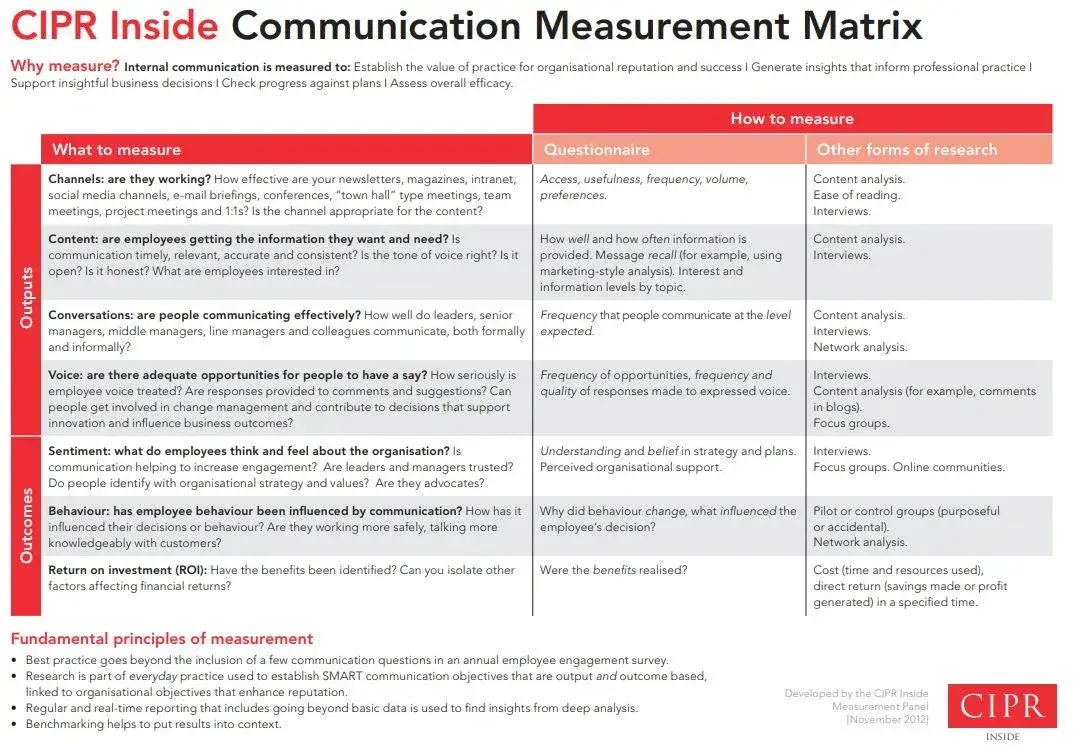
16. Measure
One of the first steps of a strong internal communications strategy is setting clear goals. Once those goals are defined, they need to be measured consistently.
Track metrics such as engagement rates, content reach, feedback, and employee sentiment to understand what’s working.
Measurement helps you prove the value of internal communications and identify areas for improvement.
Here is a great example of the Communication Measurement Matrix by CIPR.
Top 5 Internal Communications Quotes
Internal communications departments are getting much more attention than they used to. As organizations recognise the direct link between communication, engagement, and performance, they are investing more in strengthening their internal communications strategies.
Strong internal communications are no longer seen as a “nice to have.” They are a core business function that supports alignment, culture, and productivity. Companies that communicate well internally are better equipped to adapt, innovate, and retain talent.
Here are a few powerful quotes from experts on internal communications that highlight why it matters so much.
1. Peter F. Drucker, management consultant, educator, and author

2. Bill Gates, founder of Microsoft Corporation, business magnate, investor, author and humanitarian

3. Seth W. Godin, American author and former dot com business executive.

4. Ryan Holmes, founder of Hoosuite, computer programmer and internet entrepreneur

5. Joseph L. Badaracco, American author and a professor at Harvard Business School

Frequently Asked Questions About Internal Communications (IC)
- What is internal communications in an organization?
Internal communications (IC) is the function responsible for sharing information, aligning employees with company goals, and facilitating two-way dialogue within an organization. It ensures that employees understand the company’s mission, changes, expectations, and performance updates while creating opportunities for feedback and collaboration. - Why is internal communications important?
Effective internal communications improves employee engagement, satisfaction, productivity, and retention. When employees are well-informed and feel heard, they are more motivated and aligned with business goals. Strong IC also supports change management, teamwork, innovation, and company culture—ultimately impacting customer satisfaction and revenue growth. - Who is responsible for internal communications?
Internal communications is a shared responsibility. While larger organizations often have dedicated internal comms professionals, top management, HR teams, and team managers all play critical roles. Leadership sets the tone, HR supports employee experience initiatives, and managers ensure consistent communication at the team level. - What makes an internal communications strategy successful?
A successful IC strategy aligns with business goals, reflects company values, and includes clear, measurable objectives. It requires understanding employee needs, choosing the right communication tools, delivering relevant content, encouraging feedback, and consistently measuring results. Transparency and consistency are key to building trust. - What tools are best for internal communications?
Modern internal communications platforms help centralize information, segment audiences, and deliver the right message at the right time. The best tools make communication easy, engaging, and accessible—reducing information overload while improving collaboration and knowledge sharing. - How can companies measure internal communications effectiveness?
Organizations can measure IC success through engagement metrics, employee surveys, feedback participation rates, productivity indicators, retention rates, and goal achievement. Regular evaluation ensures continuous improvement and alignment with evolving business objectives.
Bring your Internal Communications Strategy to the Next Level
Haiilo has helped thousands of organizations improve their internal communications, boosting employee engagement and productivity.
Curious to learn more? Read about 10 principles of modern employee communications