

Should employees use social media in the workplace? What are the pros and cons of it? How to get the most out of employees’ engagement on social media?
If you are looking for ways to better leverage social media usage in the workplace or if you are looking to build an employee advocacy program, this article is for you!
As more organisations experiment with different work social media platforms, these questions are becoming increasingly relevant. Many employers struggle to balance openness with control, and engagement with productivity. Without a clear approach, workplace social media can easily turn into scattered channels, inconsistent messaging, or low participation.
This guide helps employers understand where social media genuinely adds value at work, where it introduces risk or distraction, and how to set clear expectations. The goal is not more tools, but better communication, stronger alignment, and more meaningful employee participation.
📚 Later in this article, you will learn that social media can boost employee engagement in the workplace. So before we move forward, get our brand new Employee Engagement Report 2022!
Get the most out of social media in the workplace with the right EA tools

Furthermore, employees themselves point to clear benefits when using social media at work. Earlier research suggests that 82% of employees believe social media can improve work relationships, while 60% say it supports decision-making processes. These findings helped shift the conversation away from distraction and towards collaboration, visibility, and faster knowledge sharing.
Employees who already use social media for work (around three out of four employees) have also highlighted several practical benefits that remain relevant today:
- 71% – staying in touch with others in the same field
- 56% – connecting with experts
- 51% – getting to know co‑workers on a more personal level
Despite this, many employers remain unaware that employees are already sharing company-related content on their personal profiles. As a result, organisations often lack visibility into both the benefits and downsides that social media in the workplace can create — from stronger employer branding to compliance and reputational risks.
This gap is where more intentional approaches and clearly defined work social media platforms become critical. Instead of unmanaged activity, employers can provide structure, guidance, and purpose.
Let’s now take a look at some of them.
💡 Before we move forward, learn about the latest social media trends for 2022!
2. It can increase your company’s profits and sales
Research shows that many organisations already recognise the commercial value of employee activity on social media. For example, 33% of employers actively encourage employees to use social media to share company news and information. This kind of encouragement often translates into stronger sales performance, particularly when employees share expertise, insights, and product knowledge in a credible, human way.
Employees who are supported to build visibility and credibility online are also more likely to influence buying decisions earlier in the customer journey. Structured employee advocacy helps organisations move from ad‑hoc sharing to repeatable impact, especially when supported by clear guidance and dedicated work social media platforms.
💡 Before we move forward, don’t forget to explore how to build a sustainable employee advocacy approach that supports both marketing and sales outcomes.
3. It can increase your employees’ engagement
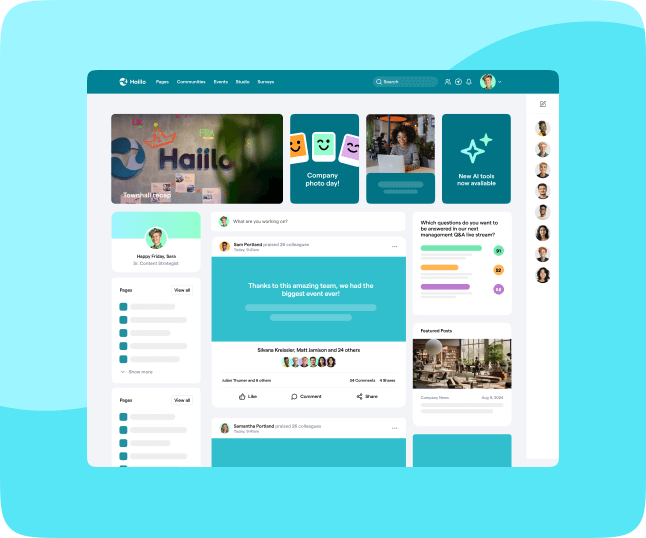
More and more companies are implementing social‑media‑like tools inside the workplace to improve internal communication in their organisations. These platforms mirror familiar social media features and are designed to keep employees connected, informed, and involved — especially in hybrid and distributed environments.
Personalised news feeds ensure employees never miss important company information, while collaboration features make it easier for teams to share updates, feedback, and ideas across locations and departments.
At the same time, external advocacy tools can increase motivation by giving employees an easy way to share approved content, contribute to campaigns, and feel part of the organisation’s wider story. When engagement is supported by structure and purpose, participation becomes more consistent and meaningful.
💡 Check out our ultimate guide for boosting employee engagement!
4. It can improve customer experience
Today, providing customer support on social media is no longer optional. Customers expect fast, visible responses, which makes social channels a critical part of the overall service experience.
Both happy and unhappy customers actively use social media to mention brands, recommend products, or raise issues. These conversations often happen publicly, whether organisations are ready for them or not.
To deliver a consistently strong customer experience, companies need to be present on social media and able to respond quickly and appropriately. Empowering the right employees with clear guidelines and tools ensures issues are addressed professionally, while positive interactions help reinforce trust and credibility.

💡 Check our guide for boosting engagement on social media!
5. It can help you attract new talent
A strong employer brand is one of the most valuable outcomes of social media in the workplace. Candidates increasingly research companies long before they apply, and social channels often provide their first, most unfiltered impression.
According to LinkedIn data, 69% of unemployed candidates won’t apply to a company if its social media presence feels unattractive or inauthentic. This makes employees’ everyday engagement especially powerful, as it offers a credible window into culture, values, and working life.
When employees share workplace moments, achievements, and experiences, they help humanise the organisation and reinforce trust. This visibility plays a direct role in strengthening your employer brand and supporting long‑term hiring goals.
As a result, organisations that actively support employee advocacy are 58% more likely to attract top talent. Purpose‑built work social media platforms make this easier by giving employees clear guidance, shareable content, and confidence to participate.
So if you want to attract the right people, allow employees to use social media — and empower them to share authentic stories that reflect what it’s really like to work at your organisation.
💡 If you’re interested in hiring through social channels, check out our social media recruitment guide!

So social media can both make and break your company’s reputation. Inappropriate posts or comments can spread quickly and damage your company’s brand — often before organisations have time to react. What makes this risk more complex is that employees don’t always intend harm; many posts are shared casually, without understanding potential legal, reputational, or compliance implications.
The most effective way to reduce this risk isn’t blanket restrictions, but ongoing employee communication and training. Clear guidelines, real examples, and regular reminders help employees understand how to represent the organisation responsibly online. Supported by structured work social media platforms, organisations can provide clarity on tone, boundaries, and accountability while still encouraging authentic participation.
💡 If LinkedIn plays a key role in your B2B strategy, it’s especially important to align employee activity with brand messaging and goals. Clear internal guidance ensures consistency without removing personal voice.
It can cause security issues
Security is another major concern. Online hackers, phishing attempts, and social engineering attacks are increasingly sophisticated, and many originate on social media platforms. Without proper awareness and safeguards, accessing social media at work can expose organisations to unnecessary risk.
At a minimum, companies should educate employees on secure behaviours such as using strong, unique passwords and enabling two‑factor authentication. Clear policies around data sharing, account access, and suspicious activity reporting also help reduce the likelihood of breaches or accidental data leaks.
When combined with the right tools and training, organisations can significantly lower security risks while still enabling employees to use social media in a controlled, responsible way.

If you want your employees to be active on social media and act as brand advocates, it’s essential to help them clearly understand acceptable behaviours online. Many employees hesitate to post about their employer not because they’re disengaged, but because they’re unsure about what they should and shouldn’t post about. Clear guidance removes that uncertainty and gives employees the confidence to participate responsibly.
A well-defined policy should go beyond do’s and don’ts. It should explain tone, disclosure, confidentiality, and how personal opinions intersect with professional identity. This clarity is especially important when organisations rely on work social media platforms to amplify employee voices in a consistent, compliant way.
💡 If your organisation still doesn’t have a social media policy, we’ve prepared the ultimate social media policy guide!
Implement a social intranet
Even if you don’t allow employees to use public social networks like Facebook or Instagram during work hours, you should still encourage social interaction within your digital workplace. This is why many organisations introduce social‑media‑like technologies that support communication, knowledge sharing, and collaboration in a controlled environment.
This approach is particularly valuable for fully remote and hybrid workplaces, where informal conversations don’t happen naturally. Without intentional spaces for interaction, employees can quickly feel disconnected or out of the loop.
Digital workplace platforms such as social intranets support social collaboration by providing a centralised platform to communicate and collaborate. Features like personalised news feeds, shared knowledge hubs, and discussion spaces help employees stay informed, aligned, and connected — without relying on external social networks.
Introduce an employee advocacy program
Employee advocacy becomes significantly more effective when it’s structured. Research shows that 58.8% of employees in a formal employee advocacy program spend more than five hours per week on social media for business use. By comparison, only 31.8% of employees without a formal programme spend the same amount of time.
Formal programmes provide employees with ready‑to‑share content, clear guidelines, and a sense of purpose. As a result, 79% of firms report increased online visibility after implementing an employee advocacy programme.
Supported by dedicated work social media platforms, advocacy programmes help organisations scale employee participation while maintaining consistency, governance, and measurable impact.

Frequently asked questions about work social media platforms
What are work social media platforms?
Work social media platforms are digital tools designed specifically for internal communication and employee participation. They use familiar social features — such as news feeds, comments, reactions, and sharing — but apply them in a professional, governed environment. Unlike public networks, these platforms give organisations control over access, tone, and data, while still encouraging open dialogue and collaboration across teams.
How are work social media platforms different from public social networks?
The biggest difference is purpose. Public social networks are built for personal expression and external audiences. Work social media platforms are built for alignment, clarity, and internal engagement. They reduce reliance on email, prevent information silos, and make sure everyone — including frontline and remote employees — has access to the same updates and conversations.
Do work social media platforms hurt productivity?
They can, if they’re introduced without structure. But when organisations are clear about why the platform exists and how it should be used, productivity often improves. Employees spend less time searching for information, fewer updates get lost in inboxes, and communication becomes more transparent. The key is relevance, not volume.
How do work social media platforms support employee advocacy?
Many employees already talk about their employer online, but often without guidance. Work social media platforms make advocacy easier by providing context, approved content, and clear boundaries. Employees know what’s appropriate to share, and organisations gain more consistent reach, stronger employer branding, and better insight into what resonates externally.
Frequently asked questions about work social media platforms
What are work social media platforms?
Work social media platforms are tools that bring familiar social media features — such as feeds, comments, reactions, and sharing — into a professional environment. They’re designed specifically for internal communication, collaboration, and advocacy, with clear governance and security in place. Unlike public social networks, these platforms help organisations keep communication focused on work while still encouraging participation and dialogue.
Are work social media platforms a distraction for employees?
They can be if they’re introduced without purpose or guidance. The problem usually isn’t the platform itself, but unclear expectations. When organisations use work social media platforms to replace scattered emails, reduce information silos, and share relevant updates, productivity often improves. Employees spend less time searching for information and more time engaging with content that actually matters to their role.
How do work social media platforms support employee advocacy?
Many employees already talk about their employer online, but often without structure or confidence. Work social media platforms make advocacy easier by providing approved content, context, and clear boundaries around what’s appropriate to share. This allows employees to participate authentically, while organisations benefit from more consistent messaging, wider reach, and reduced reputational risk.
Who benefits most from using work social media platforms?
They’re especially valuable for organisations with hybrid, remote, or frontline teams. When people don’t share the same physical space, informal communication quickly breaks down. Work social media platforms provide a central place where everyone can access the same updates, join conversations, and feel connected to the wider organisation — regardless of location or working pattern.
Learn how to choose the best employee advocacy software with our simple checklist!


About Social Media In the Workplace
A few years back, many employers were prohibiting employees from using social media in the workplace. Many human resources professionals and managers considered social media a major productivity killer, associating it with distraction, information overload, and blurred professional boundaries.
Is this still the case? Has this perception changed today?
In reality, outright restrictions have become increasingly difficult to enforce. Not allowing employees to use social media at work is almost impossible when nearly 98% of employees use social media for personal purposes. Moreover, 80% of employees admit that they use social media in the workplace, and 50% of them already post about their employer on social media.
This shift has forced organisations to rethink their approach. Instead of blanket bans, many are exploring more intentional strategies built around clear guidelines, trust, and purpose. When supported by the right policies and tools, work social media platforms can help employees stay informed, share knowledge, and participate in conversations that shape culture — without undermining focus or accountability.