
According to PwC’s Global Crisis and Resilience Survey 2023, many organizations still lack the foundations they need to respond well under pressure. While 70% of respondents said they feel confident in their ability to handle disruption, the same research shows that many still miss core building blocks such as clear ownership, joined up planning, and the systems needed to act fast.
In practice, that gap shows up when teams do not have a defined playbook for likely scenarios. Without one, decisions slow down, updates become inconsistent, and people are left guessing. That is where crisis communication tools make a real difference. They help teams share accurate updates quickly, coordinate responses, and reach employees across locations and channels.
📚Check out our article about Communication Strategies and How to Create Your Own.
Organizations that are trying to excel in their crisis management strategies need to address crisis with a more strategic approach. That means planning ahead, assigning clear responsibilities, and making sure the right crisis communication tools are in place before a crisis begins.
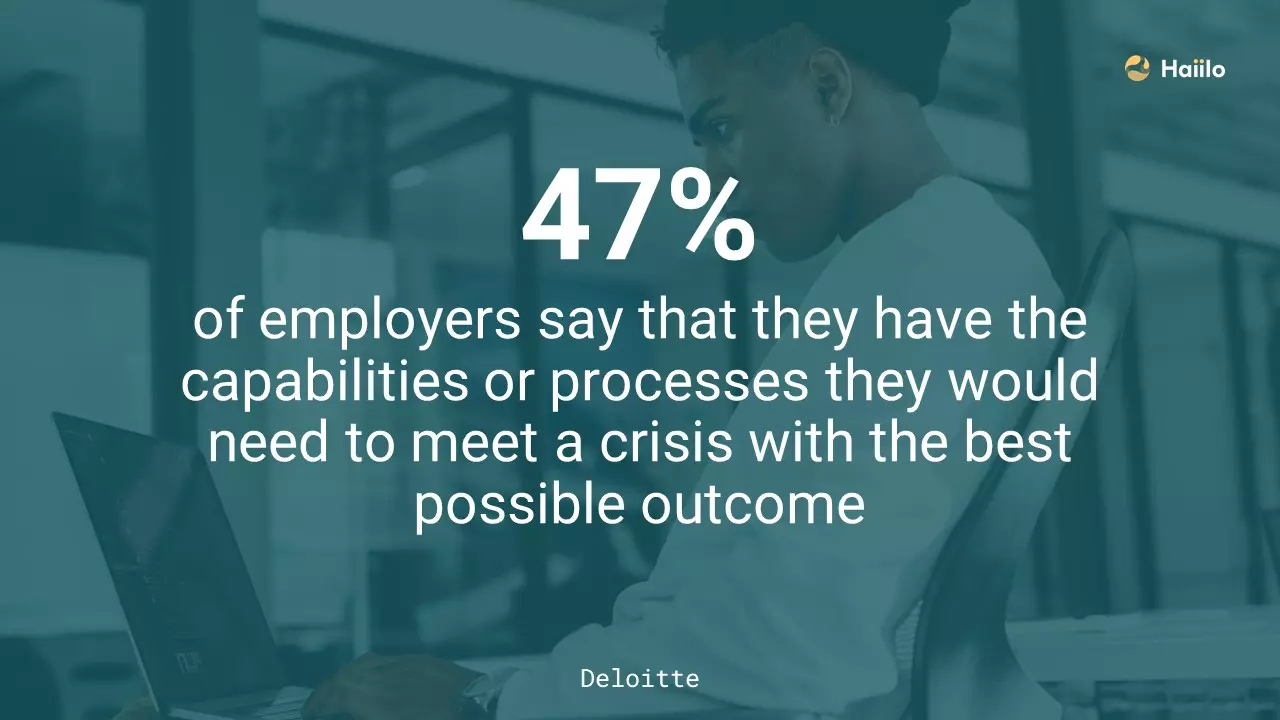
Source: Deloitte
Therefore, we have written a guide that helps you strengthen how your organization prepares for and handles crises in the workplace. It focuses on what actually works when pressure is high and time is limited.
What is Crisis Communication?
The main goal of every workplace crisis communication strategy is to enable clear, fast, and reliable communication during a crisis across your organization.
In critical moments, employees need more than updates. They need clarity on what is happening, what it means for them, and what they should do next. That is why messages used in crisis communication are designed to give employees the knowledge and direction they need to make confident decisions under pressure.
Common situations where crisis communication is essential include product recalls, data breaches, workplace injuries, financial uncertainty, or sensitive internal issues such as misconduct. In each case, delays or unclear messaging can quickly lead to confusion, mistrust, and risk.
To manage this, leadership, internal communications, and PR teams rely on crisis communication tools to share timely updates, align messaging, and reach employees wherever they are working.
As organizations navigate the realities of digital workplaces, crisis communication becomes more complex. Teams must reach desk based and frontline employees, cut through information overload, and respond to situations that evolve quickly and often unexpectedly.
Having the right crisis communication tools in place is a critical first step. They help you monitor conversations, detect issues early, and ensure that the right messages reach the right people before problems escalate.
A crisis is stressful, but crisis communication doesn’t have to be! Let us show you how
5 Pillars of Successful Crisis Communication
There are certain rules crisis communicators should follow when speaking to their audience. These pillars eliminate the challenges organizations face when managing the crisis and communicating their strategy to employees and customers.
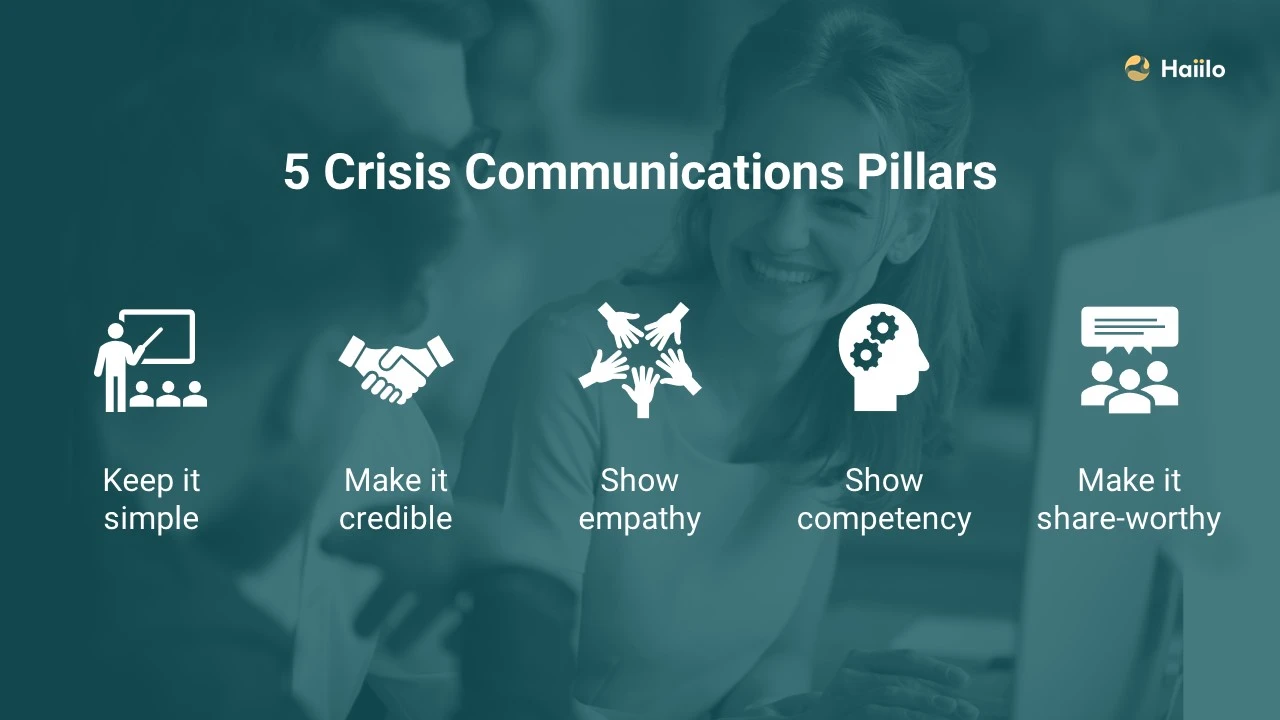
- Keep it simple – keep your crisis communications simple and easy to consume for everyone. In high stress moments, people scan, not read. Use short sentences, clear structure, and plain language. Ensure your message has a clear objective, and make it relevant and tailored to your target audience. Crisis communication tools can help you deliver consistent messages across channels without adding complexity.
- Make it credible – Do you and your crisis communication team have credibility? Does your audience trust you? Trust is built through consistency and transparency. Make sure your delivery matches your message, and share verified information only. When possible, back up your statements with facts or clear next steps so employees know what to expect.
- Show empathy – showing empathy during a crisis is crucial. People want to feel heard and understood, not just informed. The best way to show empathy is through active listening and encouraging bottom-up feedback. Give employees space to ask questions and acknowledge their concerns directly.
- Show competency – In times of crisis and change, highlighting your organization’s competency is important. Employees look for reassurance that leadership is in control. Make it clear that you have the skills, knowledge, and resources to act. Share what is being done, who is responsible, and how you are moving forward.
- Make it share-worthy – make your crisis communications easy to share and understand. Clear visuals, short summaries, and key takeaways help your message travel faster. Crisis communication tools can support this by making updates accessible across devices and channels, so employees can quickly pass on accurate information when needed.
Setting up an Effective Crisis Communication Strategy
Even though many employers are aware of the importance of crisis communication, many still lack a clear, actionable plan for what to do when a crisis happens. This often leads to delayed responses, mixed messages, and confusion across teams.
Let’s go over the 13-step crisis management strategy to help you prepare with more confidence and clarity.
📹 Before we move forward, check out our Masterclass about how to set internal communication goals for your organization.
1. Create a crisis communication plan
Like any other workplace strategy, crisis communication needs a clear plan and defined objectives. Without it, teams react instead of respond. This makes it harder to follow company guidelines and align employees with the overall strategy.
Your crisis communication plan should outline key scenarios, responsibilities, and communication flows. It should also define which crisis communication tools you will use to reach employees quickly and reliably.
More about how to develop a successful strategy in the following steps.
2. Appoint your crisis communication team and spokesperson
Choosing and appointing the right people who will be in your crisis communication team is extremely important. While the CEO plays a key role, effective crisis communication requires input from across the organization. This includes managers, HR, operations, internal communications, and PR.
The person you assign as the spokesperson should be trained and experienced in handling crisis situations. They need to communicate clearly with employees, respond quickly, and stay composed under pressure. Employees will look to them for clarity and reassurance.
3. Train communicators and help them develop good communication skills
As with many roles in an organization, training and continuous skill development are essential for crisis communicators. Preparation reduces uncertainty and helps teams act faster when it matters most.
Beyond formal training, it is critical that these individuals have strong communication skills. They need to simplify complex information, address concerns, and keep messages consistent across channels.
Strong communication skills are often the difference between confusion and clarity. They help build trust, keep employees engaged, and ensure everyone moves in the same direction during a crisis.
4. Bring the board members on board
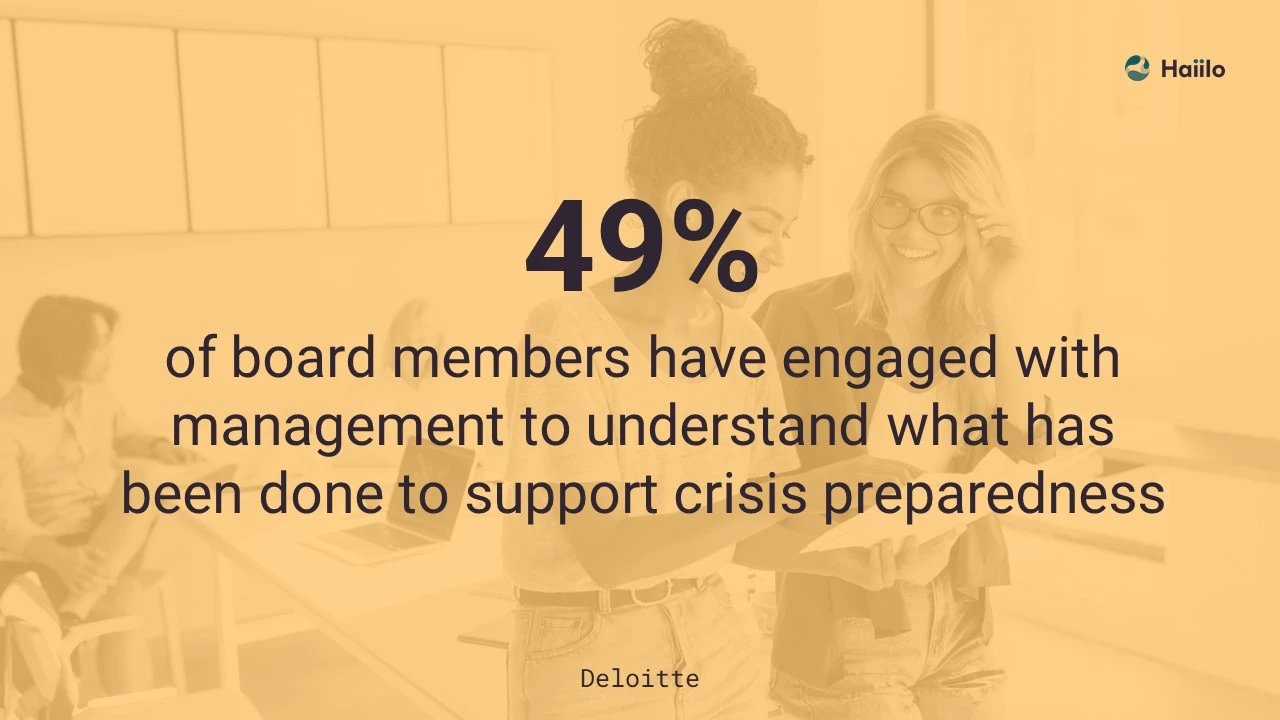
Board members should be aware of the company’s crisis management strategy and aligned with leadership and communication teams. Their involvement ensures faster decision making and clearer direction when a crisis unfolds.
However, many organizations still struggle with this alignment. Instead of relying on outdated figures, the key takeaway is simple: without active board engagement, crisis response becomes slower and less coordinated. Regular briefings, scenario planning, and clear roles can help close this gap.
📚 Also, read about the top leadership skills that make great leaders.
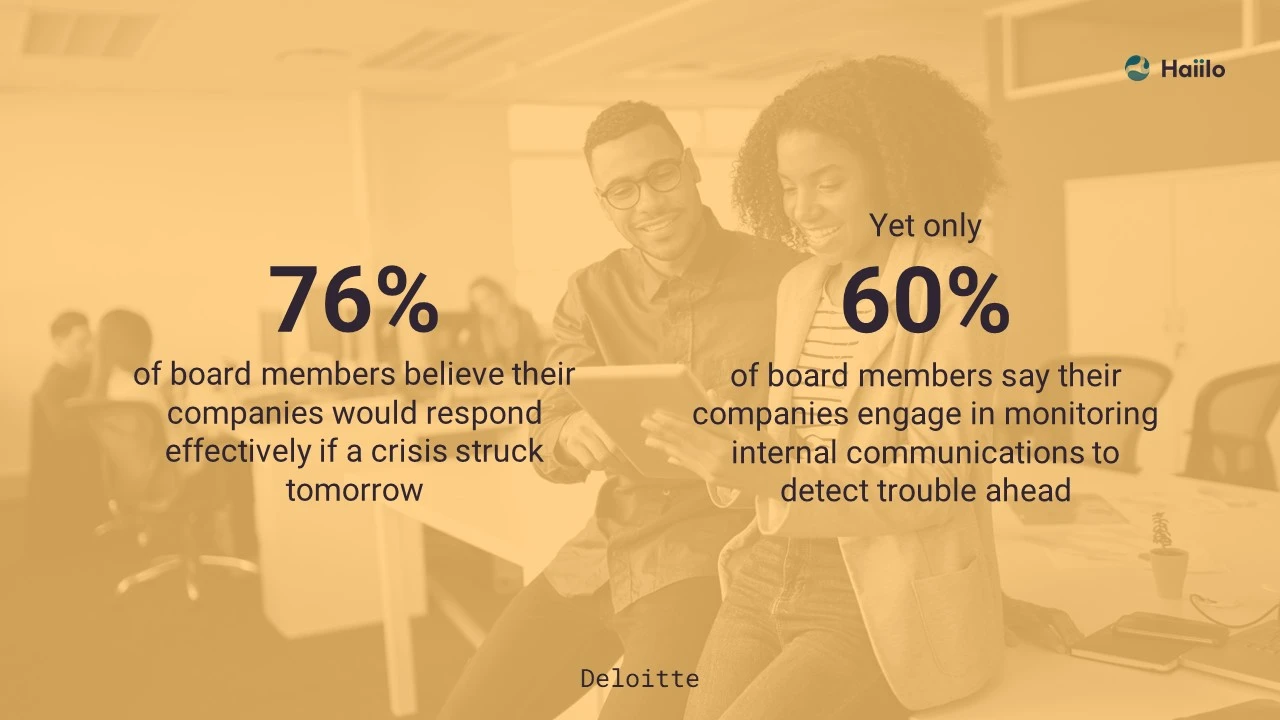
5. Close the gap between “feeling ready” vs. “being ready”
Many organizations believe they are prepared for a crisis, but that confidence does not always reflect reality. There is often a clear gap between feeling ready and actually being ready to respond when something goes wrong.
Leaders may assume plans will work, but without testing and the right systems in place, those plans can fall short under pressure. For example, teams might not know where to find updates, who is responsible for decisions, or how to reach employees quickly across locations.
This gap often shows up in three areas:
- Lack of visibility – organizations are not actively monitoring internal signals that could point to emerging issues.
- Limited practice – crisis scenarios are rarely tested, which means teams are unprepared for real situations.
- Disconnected communication – without the right crisis communication tools, messages become slow, inconsistent, or miss key audiences entirely.
Closing this gap requires more than confidence. It means putting the right processes, training, and crisis communication tools in place so your team can act quickly, stay aligned, and communicate with clarity when it matters most.
📚 As change management is crucial for successful crisis management, also read about the top 5 change management models.
6. Understand your audiences
Same as in any communication strategy such as marketing communications, workplace crisis communicators need to have a very good understanding of their audience.
In most situations, there will be multiple audiences a spokesperson needs to reach. These can include desk based employees, frontline workers, managers, and external stakeholders. Each group has different needs, concerns, and access to information. Therefore, the ability to segment audiences properly and adjust your approach is crucial for successful crisis communication.
Not every message is relevant to everyone. Depending on the situation, some employees may need detailed instructions, while others only need high level updates. What matters is that every message is clear, targeted, and easy to act on.
Timely communication is critical because the worst thing that can happen is for employees to hear about the crisis from an external source first. This quickly erodes trust and creates confusion that is hard to fix.
At the same time, many organizations still lack the right crisis communication tools to effectively reach and understand their workforce. This is especially challenging in diverse environments where employees differ in role, location, and communication preferences. For example, managing a multigenerational workforce requires different formats, channels, and tone of voice.
Crisis communication tools help solve this by enabling better targeting, faster delivery, and clearer visibility into who has received and understood your messages.
7. Deliver messages that matter to your defined audiences
Once you manage to define your audiences, adjusting the internal crisis communication content is the next important step.
Remember that not every employee should receive every message during an emergency as this approach just slows down employees’ response time by overwhelming them with irrelevant information.
Ideally, your internal communication solution should be able to target specific individuals and departments to ensure the most pertinent information gets to those who need it most.
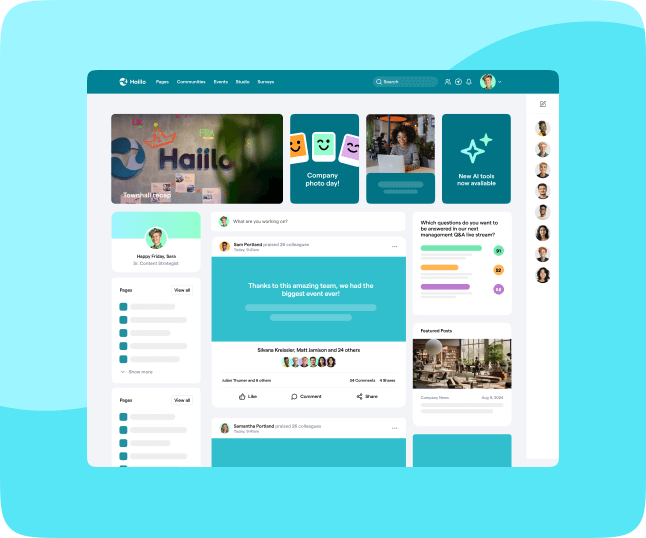
Luckily, there are mobile-first employee communication solutions such as Haiilo that enable employers to deliver real-time communication to relevant audiences in any location. Members of your leadership, internal communication, HR, or crisis management teams can instantaneously deliver relevant information updating appropriate team members as needed.

Employers that manage to adopt these best crisis communication practices are more likely to equip people with the right information at the right time, improve employee experience, streamline emergency response, protect people, keep physical and digital assets safe, and reduce productivity loss and revenue impact.
When supported by the right crisis communication tools, these outcomes become easier to achieve. Teams can coordinate faster, avoid duplicated efforts, and ensure that everyone is working from the same, up to date information.
8. Implement a two-way crisis communication
It is very important to understand that, during a crisis, employees are a valuable asset because they are the voice of the company and can become your strongest advocates.
However, communication should not be one way. Employees on the ground often have the most accurate view of what is happening. Giving them a way to share feedback, report issues, and ask questions helps you respond faster and make better decisions.
Two way communication also builds trust. When employees feel heard, they are more likely to stay engaged, follow guidance, and support the organization through the crisis.
Crisis communication tools play a key role here by enabling feedback loops, pulse surveys, and direct channels where employees can respond in real time. This turns communication from a broadcast into a conversation, which is essential when situations are evolving quickly.

For that reason, crisis communication should not go one way. Crisis communication should enable employees to join the two-way conversations, raise concerns, and ask questions in real time.
Yet many employers still rely on newsletters or static updates that don’t enable employees to share their voice or contribute feedback. This creates a gap between what leadership communicates and what employees actually experience on the ground.
Crisis communication tools help close that gap by giving employees clear channels to respond, report issues, and stay involved. This leads to faster insights, better decisions, and stronger trust across the organization.
9. Communicate in real-time using the right communication channels
Earlier, we talked about the negative impacts of information overload on the workplace.
In companies that rely heavily on email or scattered messaging apps, it is common for employees to miss important updates. Messages get buried, overlooked, or arrive too late. During a crisis, this is a risk most organizations cannot afford.
Real time communication is essential. Employees need timely, clear updates they can trust and act on immediately. Choosing the right channels matters just as much as the message itself.
Crisis communication tools support this by centralizing communication, prioritizing urgent messages, and ensuring they reach employees wherever they are working. This reduces noise, improves visibility, and helps your organization respond faster when every second counts.
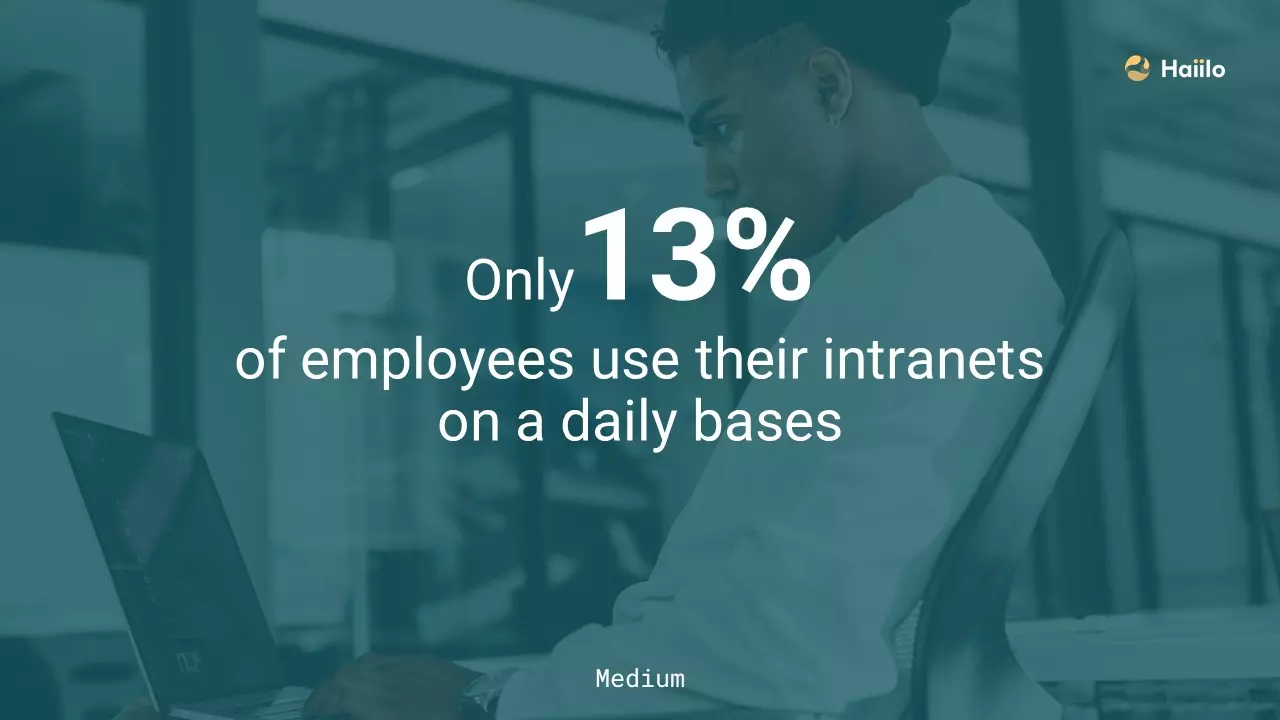
Therefore, employers need to make sure to use the right internal communication channels that employees trust and turn to as their main source of information during a crisis. This reduces confusion and ensures that critical updates are not missed or ignored.
10. Give special attention to your non-wired employees
Emails can be very inefficient when it comes to reaching non-wired employees, remote employees, or anyone away from their desks. In many cases, these employees either do not have regular access to email or do not check it frequently enough during fast moving situations. Emails are also unreliable during disruptions such as power outages or system failures.
That is why reaching employees where they are is critical in a crisis. Mobile first communication ensures that updates are delivered instantly, no matter the location or role. This is especially important for frontline teams who need clear instructions in real time.
Crisis communication tools with strong mobile capabilities make this possible. They allow you to send urgent alerts, confirm message delivery, and ensure that every employee stays informed, even in unpredictable situations.
Haiilo’s mobile-first approach to crisis communication is one of the reasons why organizations use it as a central employee communication channel. It helps you reach every employee quickly, keep messages consistent, and maintain control when it matters most.
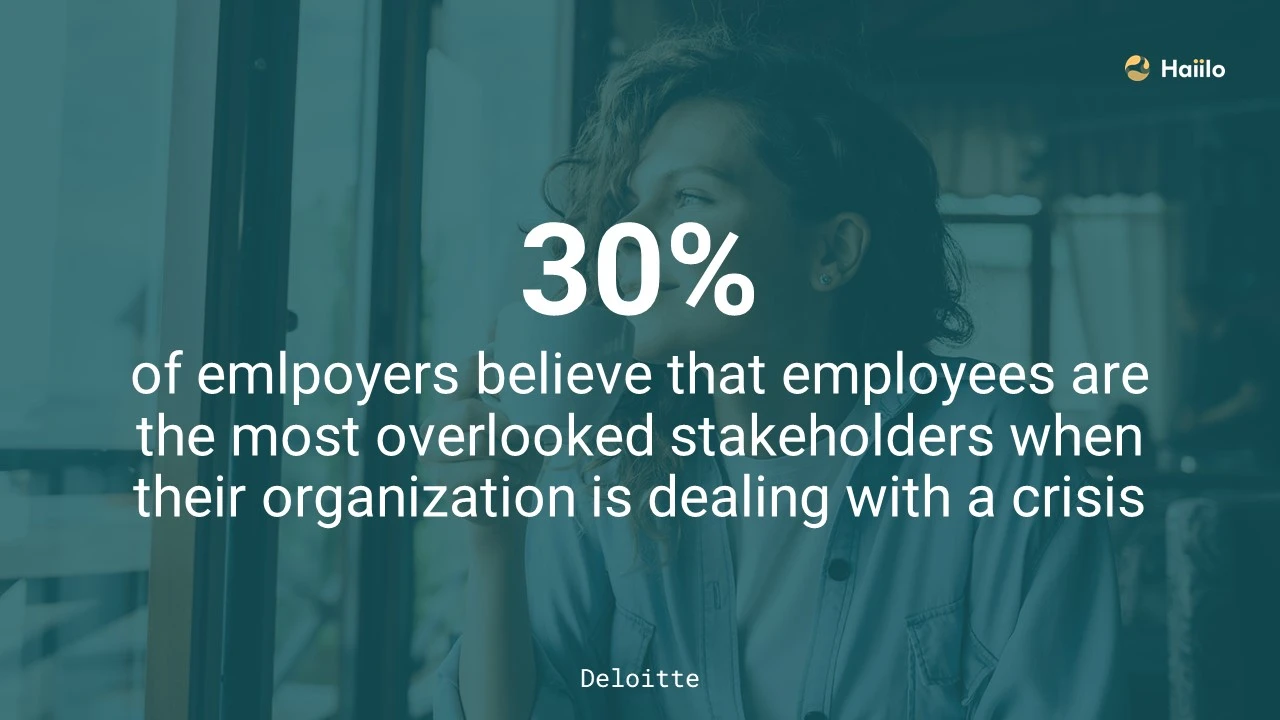
11. Make sure your messages are accurate and consistent
During a crisis, companies are under close scrutiny from employees, media, and the public. When communicating internally, it is critical to share accurate information, even if that sometimes means saying “I don’t know yet” and committing to follow up.
Sharing incorrect or unclear information can quickly lead to misinformation spreading across the organization. This can damage trust and have a negative impact on employee motivation and engagement.
Consistency is just as important as accuracy. Messages must align across all communication channels and between internal and external stakeholders. If employees hear conflicting updates, confusion and uncertainty grow fast.
Some organizations make the mistake of staying silent during a crisis. However, if you don’t communicate, others will fill the gap. Clear, transparent, and regular updates are essential to stay in control of the narrative.
Crisis communication tools support this by centralizing messaging, reducing inconsistencies, and ensuring everyone receives the same, verified information at the same time.
12. Monitor communication and employees’ behaviors and react in a timely manner
Unfortunately, many employers lack visibility into how employees engage with crisis related communication. This creates uncertainty and risk, as teams do not know whether important updates have been received, understood, or acted upon.
With the right crisis communication tools, communicators can track reach, engagement, and response in real time. This allows teams to quickly identify gaps, follow up where needed, and adjust messaging based on employee feedback.
Haiilo enables crisis communicators to get a real time view of content performance and employee engagement. This makes it easier to understand what is working, where attention is dropping, and how to improve communication on the go.
As we understand the importance of measuring the effectiveness and outcomes of internal communications, having clear data helps you prove impact and improve future responses.
13. Perform a post-crisis analysis
When the crisis is over, employers should ask: “What did we learn from this?” Even difficult situations offer valuable insights that can strengthen future responses.
A structured review helps you identify what worked, what did not, and where improvements are needed. Crisis communication tools can support this by providing data and feedback to guide your evaluation.
The 5 key questions every organization should address after a crisis include:
- What did we do right?
- What did we do wrong?
- How can we improve crisis communication next time?
- Which elements had the biggest impact on how the crisis was handled?
- How can we better prepare our crisis communications team?
Also, check what crisis experts have to say about building an effective crisis management strategy.
15 Communication Challenges in Crisis Response
Creating an effective crisis management plan is one of the most demanding tasks for internal communications teams. Not only because the stakes are high, but also because crises are unpredictable and often evolve quickly.
Therefore, making communication more flexible and agile, and improving cross team collaboration is essential. However, this is not always easy to achieve, especially in complex organizations with many stakeholders.
As a result, communication challenges during crisis response can be significant. Crisis communication tools can help reduce these challenges by improving visibility, speed, and alignment.
Let’s take a look at some of the challenges that both communicators and employees face during crisis.
- Too much irrelevant information (information overload)
- Too little information
- Infrequent or delayed updates
- No reliable contact data
- Unpredictable and fast changing situations
- Lack of visibility and transparency in the workplace
- Lack of support or direction from leadership
- Low situation awareness among employees
- Wrong communication paths and channels
- Inability to access important information and documents from any location
- Unclear messaging or wrong format of communication
- Limited ability to communicate via smartphones
- No way for employees to provide feedback
- Managers struggling to stay connected with their teams
- Difficulty sending urgent push notifications when needed
Here is another great research on the challenges with communication in response to crisis.
Situations in Which Crisis Communication Plans are Crucial
Earlier, we mentioned a few crisis situations that can happen in the workplace, but the reality is that the range is much broader. From operational disruptions to reputational risks, organizations need to be prepared for different scenarios.
When organizations feel unprepared, the sense of risk increases. In other words, a lack of preparedness leads to a wider vulnerability gap, making it harder to respond effectively when a crisis hits.
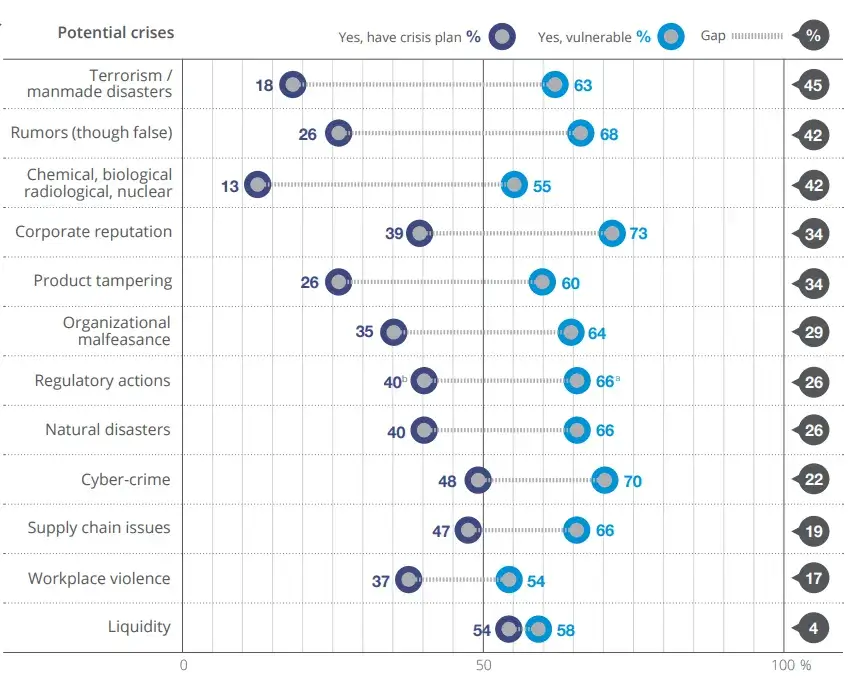
Here are some of the workplace situations when crisis communication is extremely important:
- Terrorism/manmade disasters
- Rumors
- Chemical, biological radiological crises
- Corporate reputation risks
- Product tampering
- Organizational misconduct
- Regulatory actions
- Natural disasters
- Cybercrime and data breaches
- Supply chain disruptions
- Workplace violence
- Liquidity and financial instability
Also check this great CEO’s Guide to Preparing for the Next Crisis.
The Importance of Crisis Communication
When a crisis hits the workplace, certain risks tend to surface more often than others. Common pressure points include reputation damage, cyber incidents, misinformation, and operational disruptions. These risks can escalate quickly if communication is slow or unclear.
That is why effective crisis communication plays a critical role in how well your organization responds and recovers. With the right approach and the right crisis communication tools, you can stay in control, reduce uncertainty, and guide employees through difficult situations.
Proper crisis communication in the workplace helps you:
- Protect your employees and other stakeholders during a crisis
- Build and maintain trust across the organization
- Prevent the spread of misinformation
- Reduce panic and help employees feel informed and secure
- Limit the impact on your organization’s strategy, reputation, and operations
- Align employees with the crisis management strategy and next steps
- Keep internal and external messaging consistent
- Maintain customer confidence and loyalty
- Strengthen your reputation as a reliable employer
Optimize Your Crisis Communication Strategy with the Right Technology
Haiilo is a leading employee communication solution used by organizations across the world. It helps you improve employee productivity, experience, and engagement while giving you the structure you need during critical moments.
With the right crisis communication tools in place, you can reach every employee quickly, share clear and consistent updates, and keep everyone aligned. Haiilo supports this by centralizing communication, enabling real time updates, and making it easier to connect with employees across locations and roles.
This means you are not just reacting to crises. You are prepared to handle them with clarity, speed, and confidence.
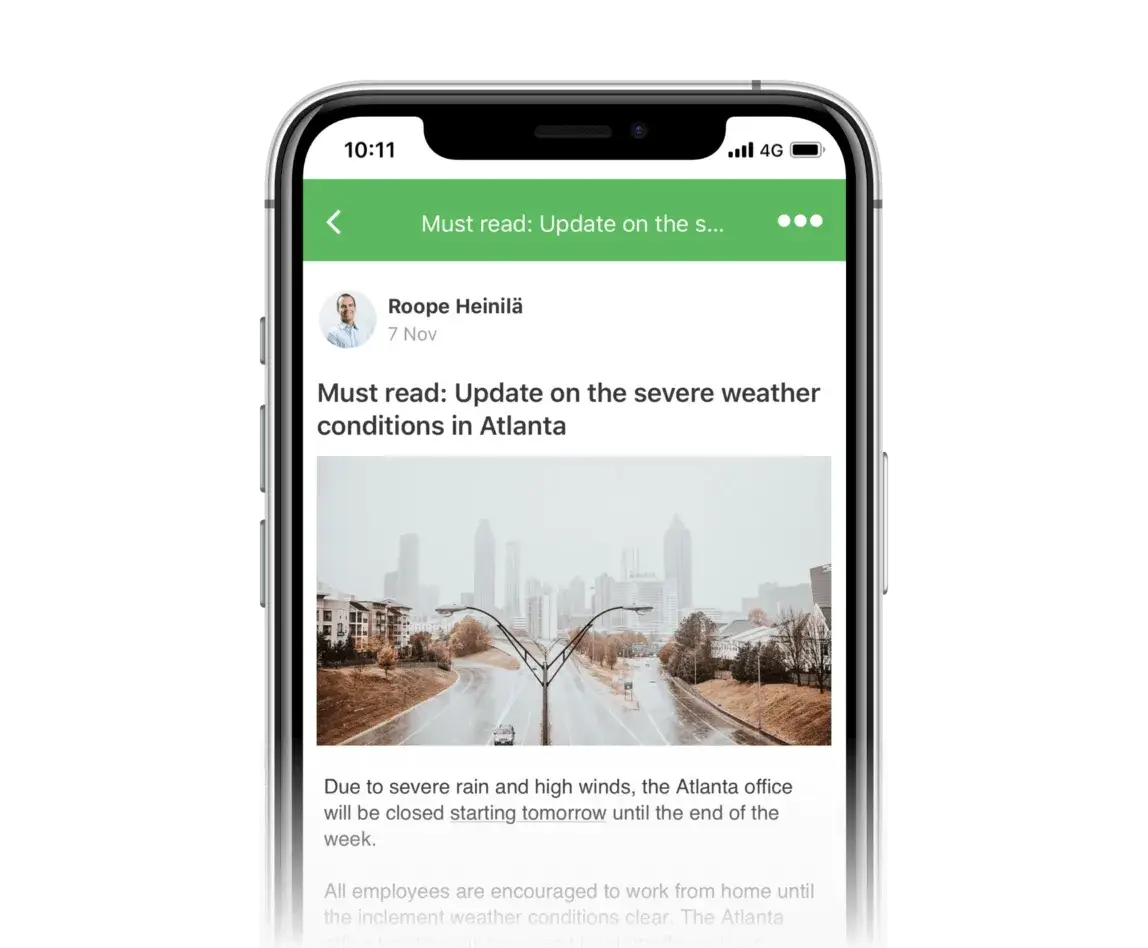
As learned earlier, proper employee communication is one of the most important prerequisites for managing a crisis. Without clear communication, even the best plans fall apart.
With Haiilo, employers can create targeted audiences based on role, location, or needs. This ensures that the right people receive the right information at the right time. Teams can engage employees in two way conversations, deliver personalized news feeds, and track how employees interact with important updates.
These capabilities are powered by modern crisis communication tools that help you stay responsive and aligned, even in fast changing situations.
Haiilo’s mobile-first approach and focus on relevant content lead to higher adoption and engagement compared to traditional channels like email. This is critical, as organizations cannot afford for employees to miss important updates during a crisis.
Are you ready to take control of your crisis communication strategy? Schedule a Haiilo demo to see how it can support your team when it matters most.
Curious to learn more? Check out our report on IC trends in 2023