
Most employers already know that proper workplace technology is a critical driver of organizational success. It shapes how people communicate, collaborate, and get work done every day. When the right tools are in place, teams move faster, stay aligned, and deliver better results.
According to recent research, global spending on digital transformation is expected to surpass $3 trillion by 2025, highlighting just how central technology has become to business strategy. At the same time, employees increasingly expect seamless, intuitive tools that support how they actually work—not systems that slow them down or create friction.
The biggest challenge for organizations is choosing the right solutions and integrating them into a true digital workplace where employees can strive and achieve their best. Too often, companies invest in disconnected tools that create silos, duplicate work, and frustrate users. Without a clear strategy, even the best workplace tech can fail to deliver value.
In this blog, we will discuss the importance of workplace technology, highlight the must-have tools modern organizations rely on, and share a practical buyer’s guide to help you choose solutions that actually work together. The goal is simple: help you build a workplace tech stack that supports your people—not the other way around.
💡 Related: 14 Reasons Why the Future of Work Is Happening Now
Workplace Tech: The New Employee Experience Imperative
Digital transformation in the workplace is not an option anymore. It’s a must. With the emergence of remote and hybrid work, many companies that were lagging in DX had to adjust to the market in order to ensure business continuity.
In the past few years, most businesses discovered that they could not function while their employees worked from home. Consequently, they have increased investment in digital software that facilitates virtual communication and collaboration.
According to a study by Ultimate Software, 92% of workers said having technology that makes their jobs easier impacts their happiness with their jobs.
Because how employees communicate, collaborate, and connect are fundamental qualities of the employee experience, and it’s critical that employers facilitate these interactions with technology.
As nicely put in an article by Harvard Business Review:
“As this trend persists, the technology experiences that employers provide will more or less define the employee experience — technology and workplace tools are, for all intents and purposes, the new workplace. As such, they’re becoming central in attracting and retaining new talent, fostering workplace culture, creating productivity, and more.”
Companies also need to understand that we are just entering a new era of technology in the workplace.
For example, many companies are now starting to shift toward everything as a service (XaaS) — meaning all their offerings are available as cloud-based subscription services.
📹 To help your digital workplace communicate better, you need a proper internal communications technology and strategy in place. Watch our Masterclass to learn about how to implement a successful IC strategy.
How Workplace Technology Impacts Your Business’ Success
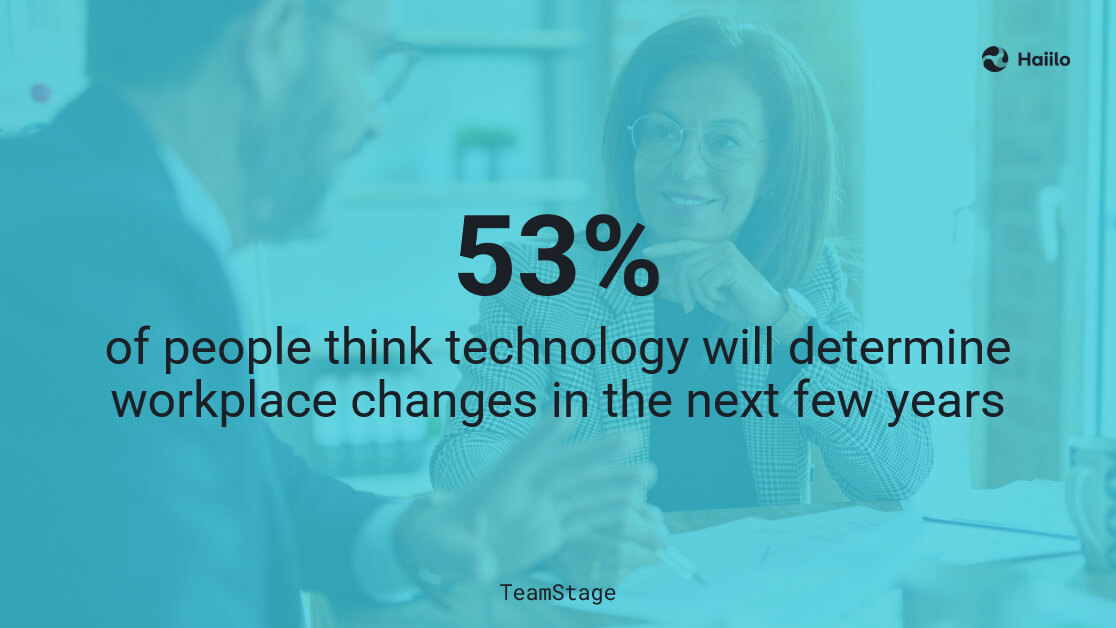
Based on research, 90% of C-suite executives believe their company pays attention to people’s needs when introducing new technology, but only about half (53%) of staff say the same. This gap highlights a disconnect between leadership intent and the real employee experience with workplace tech.
This is a big problem because if you exclude your employees from the process, your new project is much more likely to fail. Adoption drops, workarounds increase, and tools become shelfware. And you won’t see the true impact of workplace technology on:
1. Employee experience and engagement
In Qualtrics research only 30% of employees said their experience with their company’s technology exceeds their expectations. That means most employees are still working with tools that feel slow, fragmented, or hard to use.
The same research showed that when employees are satisfied with their IT services and technology experience they are 158% more engaged at work. Engagement improves because good workplace tech removes friction, simplifies tasks, and helps people focus on meaningful work instead of chasing information.
Focusing on digital employee experience is critical for driving technology usage and employee efficiency. When tools are intuitive and connected, employees are more likely to adopt them and use them consistently. So companies need to pay closer attention to which solutions are most likely to provide higher ROIs and long-term value.
💡 Related: What is an Employee Experience Platform and Why Your Company Needs One
2. Productivity and efficiency
Higher employee engagement almost always results in higher employee productivity. Moreover, some workplace technology directly impacts employee efficiency. These tools are designed to eliminate manual processes, reduce duplication, and allow employees to devote more time to critical thinking and innovation.
When business apps are easy to access and work well together, employees spend less time switching between systems or searching for information. This leads to faster decisions, smoother workflows, and fewer delays across teams.
Furthermore, workplace software can go a long way in improving accuracy as it reduces the likelihood of human error and provides real-time data and analytics through insightful dashboards and reporting. With better visibility, teams can act quickly, track performance, and continuously improve how work gets done.

3. Employee retention
Proper workplace technology can also have a positive impact on employee retention. When tools are easy to use and actually help people do their jobs, frustration drops and satisfaction improves. Employees are less likely to feel blocked by poor systems or outdated processes.
When workplace tech supports productivity and flexibility, it also signals that the company is investing in its people. This matters, especially in competitive talent markets where employees expect modern, seamless digital experiences at work.
To be more precise, employees have a 61% higher intent to stay with their employers if they feel they have the technology that supports them at work. This shows how closely retention is tied to everyday digital experience—not just salary or benefits.
4. Communication and team collaboration
With the emergence of remote and hybrid work, many organizations have started investing in workplace solutions that improve virtual communication and team collaboration. Teams are no longer in the same place or working at the same time, so communication needs to be more intentional and better supported by technology.
Asynchronous communication has become a new normal, but it takes the right technology to make it efficient. Without clear channels and accessible information, messages get lost and collaboration slows down.
When workplace tech is well integrated, teams can share updates, find information quickly, and stay aligned without constant meetings. This reduces noise and helps people focus on meaningful work.
The two must-have categories in this space are social employee intranets and instant messaging platforms. Together, they create a central hub for communication while enabling fast, real-time collaboration across teams and locations.
Boost your employee engagement with Haiilo communications platform!
5. Security
Remote work has also raised new security concerns for most companies. When employees work remotely, they use a range of various devices and tools, which can result in significant security risks for employers.
One research found that as many as 42% of workers use business-related mobile applications and employee apps daily, and that number is expected to increase. Conversely, 83% of CIOs think mobile security threats are a major problem. It is important that companies implement workplace tech that enables them to verify the devices, applications, users and networks before allowing access.
On the bright side, one of the primary positive effects of technology in the workplace is that data privacy laws will protect 65% of the world by 2023.
7 Must-Have Workplace Technologies
Today, there are dozens of different workplace tools for organizations to consider. However, some of them should be on top of your list of priorities if you want your workplace tech to actually support how people work. Here is the list.
1. Modern intranet
Poor communication remains one of the biggest barriers to productivity and employee satisfaction. When information is scattered across emails, chats, and disconnected tools, employees waste time searching and often miss critical updates. This creates frustration, slows down work, and leads to misalignment across teams.
Social intranets should be a part of every organization’s tech stack. These platforms serve as a digital home for employees because they can consolidate all the important company information in one place, significantly reducing the time employees spend searching for information.
A modern intranet also goes beyond static content. It enables two-way communication, supports knowledge sharing, and connects employees across locations and departments. When designed well, it becomes the central hub of your workplace tech—bringing together news, resources, tools, and conversations in one seamless experience.
This not only improves access to information but also helps build a stronger sense of connection and alignment across the organization. Employees know where to go, what’s happening, and how their work fits into the bigger picture.
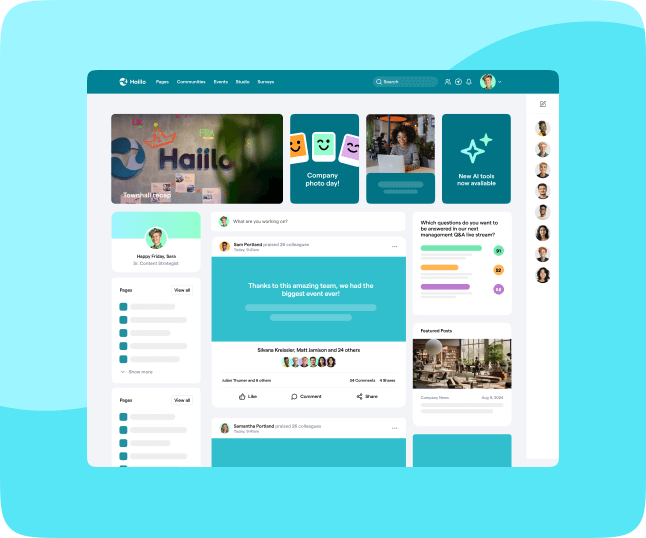
Modern intranets have a social-media-like look and feel which most people are familiar with. Their personalized news feed can significantly increase employee readership and engagement in the workplace.
2. Instant messaging software
Most companies have already implemented business instant messaging platforms such as Slack and Microsoft Teams.
These solutions usually serve as a main channel for synchronous employee communication. Furthermore, they can be integrated with other workplace technology, and that’s when they become powerful productivity tools as well.
3. Workplace productivity and project management tools
According to research, from 2021 to 2028, the market for productivity management software is anticipated to grow at a CAGR of 14.2%.
There are many different productivity tools available on the market. From project management solutions Such as Asana and Jira to CRMs such as HubSpot and Salesforce, productivity solutions fall under one of the most popular software categories on the market.
💡 Related: What is an Employee Engagement App and Why Your Company Needs One
4. Survey solutions
Consistently measuring the pulse of your workforce can go a long way in improving employee engagement, productivity, and retention.
Employee surveys are the easiest and most efficient way to get insights about the current state of your workplace and get valuable recommendations for improvement.
They can also enable managers to become better leaders by regularly getting bottom-up feedback from their teams.
💡 Related: Top 5 Employee Surveys to Implement [50 Questions Included]
5. Document management system
A document management system (DMS) is a system or process used to capture, track and store electronic documents such as PDFs, word processing files, and digital images.
Some of the most popular solutions include Google Drive and Dropbox. When choosing a document management software, it is important to evaluate its integration capabilities. For example, it is of utmost importance that your DMS can be integrated with your social intranet.
💡 Related: 14 Reasons Why the Future of Work Is Happening Now
6. HR software
Human resources departments have been undergoing significant digitalization aiming to improve various people-related processes and procedures.
Consequently, the HR tech market has been skyrocketing. Under this category, we can find solutions for compensation and benefits, talent acquisition, leave and time off management, employee scheduling, and many more.
7. QR codes
QR codes can be attached to equipment and inventory for easy tracking and management through scanning, simplifying the inventory process. Additionally, QR codes on machinery can link to maintenance logs, repair histories, and instructional videos, ensuring that all necessary information is readily accessible.
In the realm of workplace communication, you can turn PDFs to QR codes and use them to share contact information, project details, and meeting locations quickly among employees, enhancing efficiency and collaboration. They can also be included in emails or on bulletin boards to allow employees to quickly RSVP to events or access event details, streamlining the event planning process.
How to Choose and Implement the Right Workplace Technology
When choosing and implementing a new workplace tech, make sure to evaluate the following:
1. User-friendliness
When introducing a new workplace technology, one of the biggest challenges organizations face is low user adoption. This is very common among outdated, unintuitive software solutions, which tend to become productivity killers, not boosters.
According to research, nearly half of the employers in a supervisory role (46%) say they feel overwhelmed by technology at work, while 61% say they spend more time getting technology to work than they’d like.
So whichever workplace tech you decide to implement, make sure that you evaluate its user-friendliness.
Ideally, the vendor allows you to test the solution before you commit to a long-term contract.
2. Ease of implementation
Implementation of your workplace technology shouldn’t take months. If this is the case, the software may be too complicated. Look for a sophisticated solution that is scalable and can grow together with your company.
In cases where you need multiple customizations to meet your company’s specific needs, the implementation may take a little longer than usual.
3. Integrations
Now that we are at the peak of the DX era, some experts believe that we are entering the era of digital integrations.
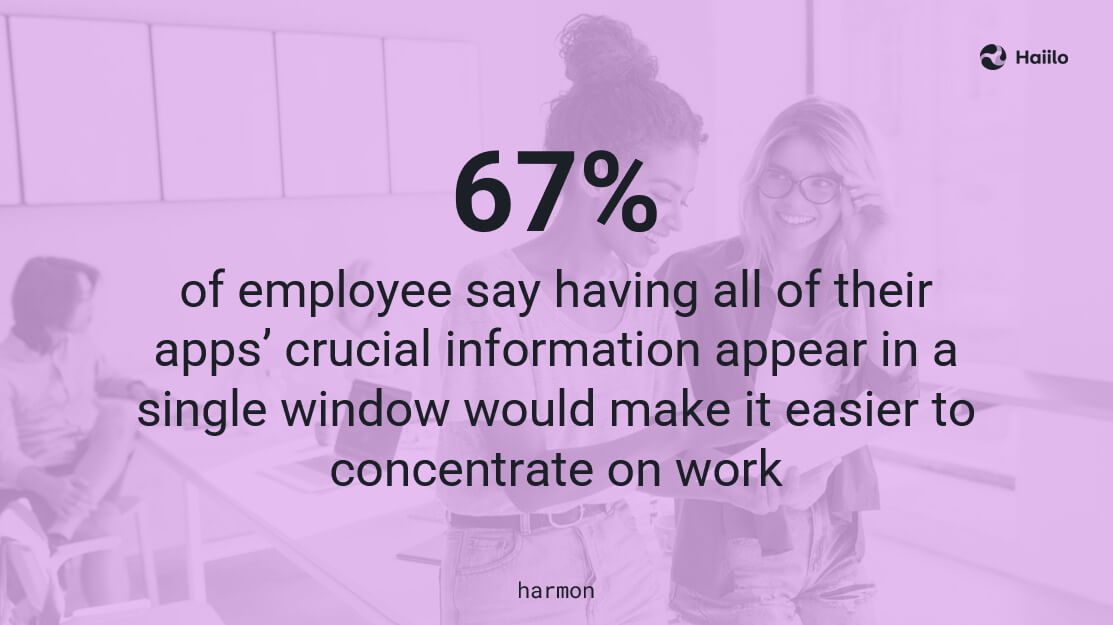
U.S. employees change through an average of 13 apps 30 times per day, according to Asana’s Anatomy of Work Index 2021 report. And 26% of surveyed employees say app overload makes them less efficient at work. Furthermore, with more of their daily workflows happening on digital platforms, employees who switch between apps find they’re also more likely to need help with prioritizing tasks.
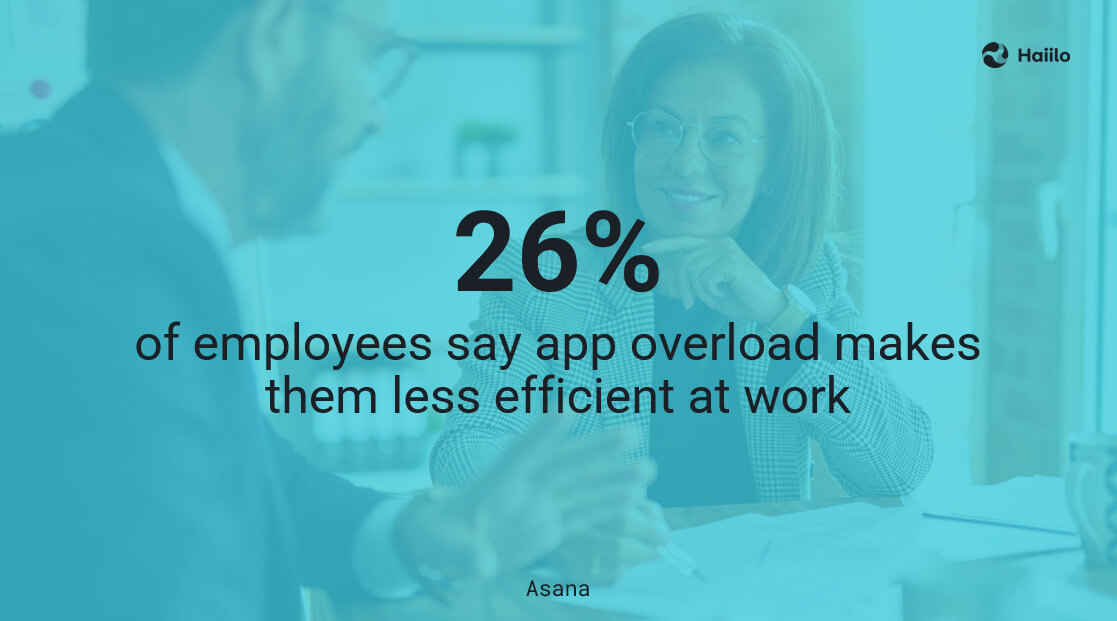
So make sure that your workplace tech is well integrated so that you eliminate the downsides of app-switching.
4. White labeling
Many organizations want their workplace tech to have the same look and feel as their company’s brand.
If this is important to you, make sure that the vendor offers white-labeling options with which you can implement branded employee apps.
5. Security
When evaluating new software for your company, security should never be overlooked. Make sure that you look for a platform with ISO certifications, and validate whether it complies with privacy regulations such as GDPR, HIPAA, and others.
6. Hosting
Even though some organizations may still prefer (or are required to use) software hosted on-premises, cloud solutions are becoming increasingly popular.
Providing real-time access to systems and data from a variety of devices regardless of location and with guaranteed up-time of 99%, the cloud software providers are becoming the number one choice for many businesses.
7. Analytics
Whichever workplace tool you are implementing, make sure that it offers powerful analytics. You can only make the best use of your workplace technology when you know how your employees use it.
Don’t settle just for raw data, but insights. Many vendors today use AI to make their analytics and reporting more valuable to the buyer. So choose a platform that gives you valuable and actionable recommendations for improvement, engaging dashboards and reports.
More Interesting Facts About Technology In the Workplace
Technology in the workplace plays a critical role in enabling employees for success and driving higher employee productivity. Because of that, employers have been investing more resources in workplace tech over the past decade, focusing on tools that improve flexibility, communication, and efficiency.
Here are some additional interesting facts about technology in the workplace.
- About 60% of employees say automation has improved how they work, helping reduce repetitive tasks and freeing up time for more valuable work.
- Many organizations report measurable gains in productivity when employees use digital tools that streamline workflows and reduce manual work.
- More than half of employees expect workplace tech to significantly shape how they work over the next few years, especially with the rise of AI and automation.
- Knowledge workers spend a large portion of their day managing communication across email, chat, and collaboration tools, often switching between platforms multiple times.
- According to the latest digital workplace research from Gartner, improving the digital employee experience remains a top priority for most organizations.
- Despite ongoing investment, many companies still struggle with fragmented systems, with only a small percentage describing their digital workplace as fully optimized.
- Large enterprises often rely on dozens of workplace applications, which can create complexity and make it harder for employees to find the tools and information they need.
- Research shows that many employees still report a better digital experience in their personal lives than at work, highlighting a clear gap in workplace tech expectations.
- The global digital workplace market continues to grow steadily as organizations prioritize modernization and better employee experiences.
- Employees spend hours each week dealing with miscommunication, often caused by unclear processes or disconnected tools.
- Many organizations accelerated their adoption of workplace tech during the pandemic and continue to build on those investments today.
- Around half of employees say mobile apps and accessible tools help improve business processes and overall productivity.
Curious to learn more? Check out our report on IC trends in 2023


Frequently asked questions about workplace tech
1. What is workplace tech and why does it matter?
Workplace tech refers to the tools and platforms employees use to communicate, collaborate, and get work done. It matters because it directly shapes productivity, engagement, and overall employee experience. When tools are disconnected or hard to use, work slows down and frustration builds. But when your workplace tech is intuitive and integrated, teams stay aligned and move faster. That’s why many companies invest in solutions like a social intranet to centralise communication and knowledge in one place.
2. How do I know if my workplace tech is actually working?
A simple way to tell is by looking at adoption and feedback. Are employees using the tools daily? Do they find information quickly? Are workflows smooth or full of workarounds? If people rely on email chains, duplicate tools, or manual processes, your setup likely needs improvement. You can also explore signs of weak internal communication in this guide on internal communication challenges.
3. What are the most important workplace tech tools to invest in?
The essentials usually include a central communication hub, collaboration tools, and mobile access. For example, a mobile employee app ensures frontline and remote teams stay connected, while an intranet brings everything together. If advocacy is a priority, tools like employee advocacy platforms help amplify your brand through employees. The key is choosing tools that integrate well and solve real problems.
4. Why do many workplace tech projects fail?
Most failures come down to poor adoption—not the technology itself. If employees aren’t involved early, tools won’t match how they work. Another common issue is relying on systems that weren’t built for internal communication, as explained in this article on why Microsoft 365 isn’t your intranet. Successful workplace tech focuses on user experience, clear use cases, and ongoing support—not just implementation.