
Building a knowledge-sharing culture in your organization is essential if you want knowledge sharing in the workplace to become second nature—not something employees have to be reminded to do. It’s about creating an environment where sharing insights, lessons learned, and expertise feels easy, valuable, and expected.
Right now, most organizations still fall short. Employees spend an average of 1.8 hours every day searching for information, often because knowledge is scattered or locked in silos. Meanwhile, nearly half of professionals report spending up to five hours a day trying to find the right information to do their job. That’s not just frustrating—it’s a direct hit on productivity, innovation, and employee experience.
To fix this, companies need to do more than tell employees to “share more.” They need to actively enable and motivate knowledge sharing in the workplace. That means removing friction, rewarding contributions, and making it obvious where and how to share what you know. When done right, organizations can see productivity improvements of 20–25% and significantly faster decision-making.
This becomes even more critical in remote and hybrid workplaces. Today, 74% of organizations operate with hybrid models, meaning employees often miss out on the informal, in-person knowledge exchanges that used to happen naturally. Without intentional systems in place, knowledge simply doesn’t flow.
That’s why having a proper workplace tech stack is no longer a nice-to-have—it’s foundational. The right tools don’t just store information; they make it discoverable, accessible, and usable in the moments employees actually need it.
So how do you turn knowledge sharing from an afterthought into a real competitive advantage? There are clear steps and best practices that can help employers optimize knowledge sharing in the workplace and make it genuinely impactful. In this blog, we’ll cover 9 essential steps for building, maintaining, and scaling a knowledge-sharing culture that actually works.
Build a knowledge-sharing culture in your company with Haiilo!
- 1. Communicate the Benefits of Knowledge-Sharing Culture
- 2. Regularly Share Best Knowledge-Sharing Practices
- 3. Create a Central Knowledge-Sharing Hub
- 4. Improve the Overall Internal Communications
- 5. Practice Multichannel Communications
- 6. Motivate Employees to Participate
- 7. Give Frequent Feedback and Recognition
- 8. Don’t Leave Your Frontline Employees Out
- 9. Implement Technology that Enables Knowledge Sharing Culture
- What Is Knowledge-Sharing Culture
- What Are the Characteristics of a Knowledge-Sharing Culture
- Why Knowledge-Sharing Culture Is Important
1. Communicate the benefits of a knowledge-sharing culture
One of the best ways to motivate employees to embrace knowledge sharing in the workplace is to clearly show what’s in it for them—and for the organization as a whole. When the benefits are tangible, knowledge sharing stops feeling like “extra work” and starts feeling like common sense.
Less time spent searching for information
When knowledge and information are not shared efficiently employees spend much more time searching for relevant and important information. In fact, information search is considered one of the biggest productivity killers in organizations.
According to a McKinsey report, employees spend 1.8 hours every day—9.3 hours per week, on average—searching and gathering information.
What’s often overlooked is the knock-on effect: slow decisions, duplicated work, and frustrated teams. Organizations that improve knowledge sharing can reduce time spent searching by up to 35%, freeing employees to focus on more meaningful, higher-value tasks.

Less duplicate work
Career growth and development
Knowledge workers who actively contribute and share expertise often become go-to resources within their organizations. That visibility matters. Research shows that employees who share knowledge regularly are more likely to be recognized by leadership, strengthening their reputation and opening up opportunities for promotion and career progression.
Improved cross-functional collaboration
Building a knowledge-sharing culture can help companies break down departmental silos and improve overall team collaboration.
According to research, employees now spend about 50% more time engaged in collaborative work, and it is critical that teams regularly share their knowledge, experiences, findings, and other insights relevant to their jobs. In doing so, organizations can improve collaboration efficiency by up to 40%, leading to faster problem-solving and better outcomes.
Reduced knowledge and skill gap
2. Regularly share best knowledge-sharing practices
If you are just starting to build a knowledge-sharing culture in your company, think of ways to make the process more structured and easier for employees. Without clear guidance, even the best tools go unused—and knowledge sharing in the workplace becomes inconsistent or fragmented.
You can set rules for creating various channels and discussions about certain topics or projects. You can define preferred means of communication to make knowledge more accessible to everyone.
For example, instant messaging solutions which employees mostly use to communicate synchronously can’t be the place to store knowledge and information. The lifespan of these messages is short and not easily accessible at any given moment.
To store knowledge in a more efficient way and make it easy to find, you need to create a central knowledge-sharing hub—the single source of truth for every employee.
But structure alone isn’t enough. You also need to actively promote best practices: show examples of well-documented knowledge, standardize naming conventions, and encourage teams to capture learnings after projects. When done well, this reduces fragmentation—something over half of organizations still struggle with due to multiple disconnected tools.
3. Create a central knowledge-sharing hub
Today, many remote employees communicate asynchronously, which is why information, documents, and data can live in many different places. These include instant messaging platforms, document management solutions, project management tools, social intranet software, and many others.
This often results in extensive app-switching and productivity loss. Asana’s Anatomy of Work Index found that, with excessive app switching 27% of messages and actions are missed. The same research found that knowledge workers switch between 10 apps 25 times per day.
The problem isn’t just distraction—it’s fragmentation. When knowledge is spread across tools, employees simply don’t know where to look. In fact, 50% of employees say they don’t know where to find critical information when they need it.
A central hub changes that. By bringing knowledge into one searchable, structured space, you reduce tool-switching, improve visibility, and ensure employees can find what they need—exactly when they need it.

As a consequence, knowledge that would otherwise be absorbed by employees gets lost.
To avoid this obstacle and enable a knowledge-sharing culture, it’s important that organizations integrate various platforms into a single source of truth.
Most organizations choose to implement social employee intranets into which they integrate tools such as Microsoft 365, Google Workspace, email, Slack, Trello, and other relevant solutions.
4. Improve the overall internal communications
Unfortunately, one study showed that 60% of employees feel less-than-enthusiastic about internal communications in their organisations. 44% say that their business’ internal communications are stagnant, with nothing having changed in recent years.
Poor workplace communication is one of the biggest reasons why a knowledge-sharing culture fails. And the consequences of the lack of knowledge sharing can be significant. According to research, only 25% of senior executives say their organisations are effective at sharing knowledge. The other 75% are taking a financial hit: Fortune 500 companies reportedly lose an estimated $31.5 billion per year because they don’t have effective strategies in place to encourage knowledge sharing across teams.
Companies with strong internal communications are far better at delivering targeted and timely messages, ensuring that valuable knowledge actually reaches the people who need it. This is critical—because when communication works, collaboration improves too. Research shows that 86% of employees and executives cite poor communication as a primary cause of workplace failure, highlighting just how closely communication and performance are linked.
On the other hand, internal communications departments that don’t have the ability to segment their audiences and send relevant information create too much noise and information overload. As a consequence, employees get overwhelmed rather than empowered with new knowledge, and important updates are more likely to be ignored or missed.
5. Practice multichannel communications
Multichannel communication is a term used to describe a workplace communication strategy in which multiple channels are used to deliver important company news and updates. This approach is critical for enhancing knowledge sharing in the workplace and ensuring employees can access information in ways that suit how they work.
Unfortunately, the biggest challenge internal communicators face today is the inability to reach the right audience with the right message at the right time.
Some departments rely on email, others on Slack or Microsoft Teams—making consistency difficult. So how can IC and HR teams ensure information lands where it should?
Multichannel communication allows organizations to use each channel more intentionally. Rather than broadcasting everything everywhere, messages are tailored based on urgency, audience, and format. This matters, because ineffective communication is already a major issue—86% of employees and executives cite it as a key cause of workplace failure.
Ultimately, multichannel communication increases the likelihood of better reach and improved employee engagement, while supporting more consistent and effective knowledge sharing across the organization.
6. Motivate employees to participate
Sharing knowledge should be one of the core values of every organization because it helps break down organizational silos. Because it takes years for someone to become an expert in a field, for businesses it is priceless to build such a culture.
Continuously reinforcing knowledge-sharing behaviors is critical for maintaining momentum. Without consistent encouragement, even the best initiatives fade, and employees revert to keeping knowledge to themselves.
To give extra motivation to your people, you can consider launching a designated employee recognition program that will celebrate and reinforce knowledge-sharing behaviors and encourage others to do the same. For example, leadership teams can nominate top contributors, followed by a company-wide vote to increase visibility and participation.
Adding a little bit of gamification to your workplace initiatives can go a long way in making them more successful and engaging. Points, leaderboards, or simple shoutouts can make knowledge sharing feel less like a task and more like something employees genuinely want to be part of—especially when recognition is tied to real outcomes like growth, visibility, or career progression.
💡Read: The 2026 guide to building good company culture
7. Ask your employees for feedback
The best way to start improving knowledge sharing in your company is by asking your employees about it and by listening to your employees. They’re the ones experiencing the gaps, frustrations, and workarounds every day—so their input is critical.
You can set up a simple employee survey to understand the current state of knowledge sharing and gather suggestions for improvement. Here are a few simple questions that can help you get started:
- I can easily find the information I need to do my job.
- I feel like I am continuously acquiring new knowledge at work.
- I can easily share knowledge with my colleagues.
- My organization does a good job of enabling knowledge sharing.
- Do you have any suggestions for improving our knowledge-sharing culture?
Beyond surveys, it’s worth creating ongoing feedback loops—through pulse checks, community discussions, or open comment spaces. This matters because 35% of employees cite difficulty finding relevant information as a key barrier to using knowledge systems, meaning issues often go unaddressed unless you actively ask.
8. Don’t leave your frontline employees out
When it comes to organizational communication and knowledge sharing, frontline workers are often left in the dark. The biggest reason for that is the limitations of the technology they use on a daily basis. One study found that over 83% of frontline workers don’t even have a corporate email address, and 45% don’t have access to the company intranet while at work.
This creates a major blind spot for knowledge sharing in the workplace. If frontline employees can’t easily access or contribute knowledge, critical insights from customer-facing or operational roles are lost. To fix this, organizations need mobile-first, simple tools that meet employees where they are—whether that’s on a shop floor, in the field, or on the move—so knowledge flows both ways, not just from the top down.

As a consequence, frontline workers don’t have an easy way to gain and share knowledge with their peers and they often miss out on important company information.
Mobile-friendly communication tools are the most critical prerequisite for better involving blue-collar employees in the overall knowledge-sharing culture.
9. Implement technology that enables a knowledge-sharing culture
As mentioned earlier, workplace technology plays a critical role in building, maintaining, and nurturing a successful knowledge-sharing culture in any organization. Without the right tools, even the best intentions fall flat, and knowledge sharing in the workplace becomes inconsistent or difficult to scale.
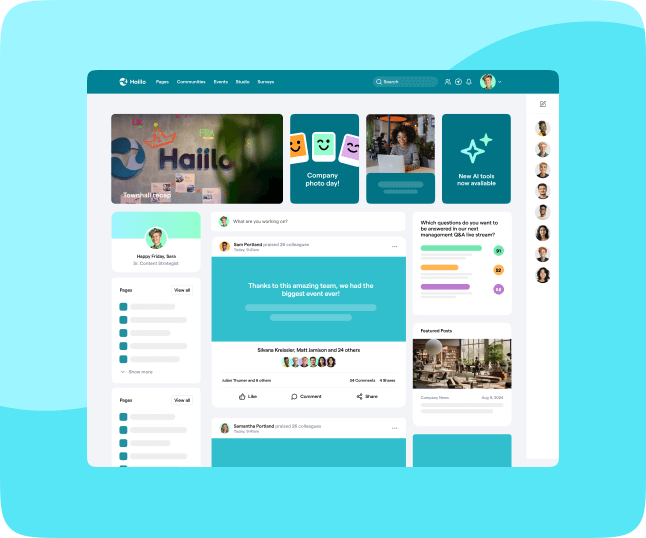
While there are many different solutions that enable workplace communications, intranets have the reputation of go-to solutions for ensuring that knowledge is efficiently stored and distributed within an organization.
In fact, the intranet’s main job is to serve as a repository of all the important information, documents, people, and tools that employees need on a daily basis. It is considered a digital home for every employee, regardless of their location and the nature of their jobs.
Furthermore, these platforms are great for keeping people connected and ensuring a seamless flow of information between and among peers and departments.
Their ability to integrate critical workplace tech stacks into a single solution is extremely valuable, especially for complex enterprises with complex organizational structures. This matters even more when you consider that 54% of organizations rely on five or more platforms to share information, which often leads to fragmentation and confusion. Integrating these systems into one unified experience makes knowledge easier to access—and far more likely to be used.
What is knowledge-sharing culture?
A culture of knowledge sharing refers to an organizational environment where individuals actively exchange information, insights, expertise, and experiences with one another. This type of culture fosters collaboration and communication, encouraging employees to share what they know for the benefit of others and the organization as a whole.
A culture of knowledge sharing can’t be built overnight. It is a mindset and a core company value that needs to be embedded into every employee. It requires consistent reinforcement through leadership behavior, clear processes, and the right tools—otherwise, knowledge sharing in the workplace remains informal and unreliable.
In practice, this means moving from a “knowledge is power” mindset to one where knowledge is openly shared and accessible. Organizations that succeed in doing this are more innovative and collaborative—companies that prioritize knowledge sharing are up to 52% more likely to be innovative. [wifitalents.com]
Related: What is corporate culture, why It matters, and how to build It
The characteristics of a knowledge-sharing culture
Key characteristics of a knowledge-sharing culture include:
- Open Communication: Employees feel safe and encouraged to openly share ideas, best practices, and constructive feedback without fear of judgment or competition.
- Collaboration Over Competition: The focus is on team success rather than individual achievements, promoting collective problem-solving and innovation.
- Access to Knowledge: The organization ensures that knowledge (documents, databases, expertise) is easily accessible to all, through platforms like intranets, wikis, or knowledge management systems.
- Leadership Support: Leaders actively promote and model knowledge-sharing behaviors, ensuring it is a priority for the organization.
- Rewarding Knowledge Sharing: The company acknowledges and rewards employees who contribute by sharing their knowledge, whether through formal mechanisms (awards, recognition) or informal praise.
- Continuous Learning: A focus on learning from peers, projects, and external sources, with opportunities for ongoing education and training.
- Cross-Departmental Interaction: Knowledge is shared not just within teams, but across different departments, creating a more integrated and informed organization.
In essence, a culture of knowledge-sharing empowers employees to leverage collective intelligence, enhancing innovation, problem-solving, and efficiency.
Why knowledge-sharing culture is so important
Cultures that nurture knowledge sharing have many benefits. Here are some of them:
- Organizations with effective knowledge-sharing cultures report a 21% increase in productivity.
- Businesses that prioritize knowledge sharing are 25% more likely to retain top talent, reducing turnover costs significantly. (Vorecol)
- In the U.S. alone, Fortune 500 companies lose an estimated $31.5 billion annually by failing to share knowledge effectively. (SHRM)
- 87% of employees want employers to provide more opportunities for collaboration and knowledge sharing. (Starmind)
- Companies with knowledge-sharing practices in place can make decisions up to 40% faster.
- 82% of executives believe that fostering a culture of knowledge sharing directly improves organizational innovation.
FAQs about knowledge sharing in the workplace
What is knowledge sharing in the workplace?
Knowledge sharing in the workplace is the process of exchanging information, skills, and expertise between employees. It turns individual know-how into shared organizational knowledge, enabling better collaboration, faster decision-making, and stronger overall performance. [textexpander.com]
Why is knowledge sharing important for organizations?
Knowledge sharing helps organizations reduce duplication, break down silos, and improve productivity. When employees can easily access what others already know, they spend less time searching and more time delivering value. In fact, employees can lose up to 20% of their workweek searching for information when knowledge isn’t shared effectively.
What are the biggest barriers to knowledge sharing?
Common challenges include lack of time, unclear processes, and fragmented technology. Many employees struggle to find relevant information or don’t know where to share it. Cultural barriers—like fear of losing ownership or lack of recognition—can also prevent people from contributing.
How can organizations improve knowledge sharing?
Start by creating a clear structure—such as a central knowledge hub—and define how and where knowledge should be shared. Combine this with leadership support, employee recognition, and multichannel communication to encourage consistent participation across teams.
What tools support knowledge sharing?
Knowledge-sharing platforms like intranets, knowledge bases, and collaboration tools help store, organize, and distribute information. When integrated effectively, these tools reduce friction and make it easier for employees to find and share knowledge within their daily workflows.
How does knowledge sharing impact business performance?
Organizations that prioritize knowledge sharing see measurable benefits, including faster problem-solving, improved innovation, and higher productivity. Some research shows companies with mature knowledge practices can achieve up to a 20–30% productivity increase, making it a clear competitive advantage.