
Business transformation remains difficult to execute successfully. Business transformation remains difficult to execute successfully. Gartner research shows that only 48% of enterprise digital initiatives meet or exceed their business outcome targets—highlighting how challenging large-scale organizational change can be.
Even today, the transformation of business remains one of the most difficult initiatives organizations attempt. Recent global research continues to show that many transformation programs fail to deliver lasting results. While companies invest heavily in technology, restructuring, and new strategies, success often hinges on whether employees understand the purpose of the change and how it affects their day-to-day work. Without that clarity, even well-funded initiatives struggle to move beyond the planning phase and translate into measurable business impact.
Moreover, research continues to show how difficult transformation can be. Moreover, transformation remains hard to sustain. McKinsey has long estimated that around 70% of digital transformation initiatives fail to reach their intended goals—often because of organizational and execution challenges rather than technology itself. More recent industry research shows a similar pattern: many organizations report short-term gains from digital initiatives, but fewer manage to embed those improvements into long-term operating models.
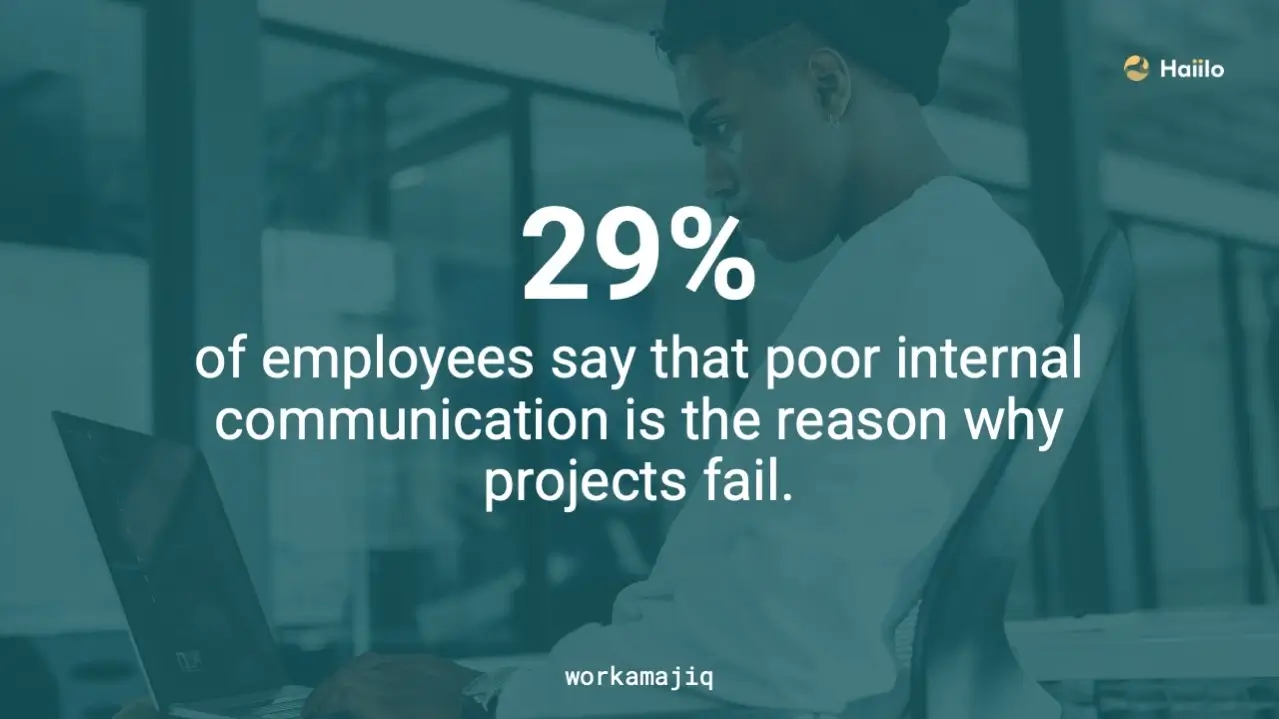
Often, lack of employee communication, engagement, and alignment with the new goals are the main reasons for such a high failure rate. When leaders fail to clearly explain the “why” behind major changes, employees may resist new processes, ignore new tools, or revert to old habits. This makes internal communication one of the most critical drivers of successful transformation of business initiatives. Companies that prioritize transparent leadership communication, cross-department alignment, and real-time feedback loops are far more likely to sustain transformation efforts over time.
Modern organizations increasingly rely on digital workplace platforms to support this process. Solutions like an internal communications platform help leadership communicate strategy clearly, connect distributed teams, and ensure employees understand their role in transformation initiatives. When information flows effectively across the organization, teams are better equipped to adapt quickly and support new ways of working.
📚Check out our article on the Drivers of Employee Engagement to Start Implementing Today!
In this blog, we will go over some of the best practices for implementing business transformation successfully in 2024 and beyond. From aligning leadership communication to enabling employees with the right digital tools, these strategies can help organizations move from isolated change initiatives toward a sustainable transformation of business that delivers measurable results.
Make business transformation effortless with the right IC platform
The Definition of Business Transformation
Business transformation is all about identifying techniques, new processes, and technologies that aren’t being used to their maximum capacity. It requires understanding how alternate solutions can be applied to further gain market share, increase revenue and customer satisfaction or reduce operating costs. In practice, the transformation of business often involves rethinking how teams collaborate, how decisions are made, and how digital tools support everyday work. It’s not simply about introducing new technology — it’s about ensuring that people, processes, and platforms evolve together to support long-term strategic goals.
Organizations undertake business transformations to create additional value. This may mean unlocking the potential of employees, harnessing intellectual property and proprietary technology for additional purposes, or becoming more efficient to maximize the company’s potential. For example, many organizations modernize their digital workplace to improve collaboration across departments and locations. Platforms such as a social intranet platform help centralize information, enable knowledge sharing, and connect employees to leadership updates—making it easier to align teams around transformation initiatives.
In many cases, the transformation of business also requires companies to break down long-standing silos between departments. Marketing, HR, operations, and IT increasingly need to work together to implement new systems, share data effectively, and support customer-focused strategies. When these departments collaborate closely, organizations can adapt more quickly to shifting market conditions and customer expectations.
The goal of every business transformation project should be to ensure that the best processes and systems are being implemented within an organization. This includes evaluating existing workflows, identifying inefficiencies, and equipping employees with tools that allow them to work more effectively. Organizations that successfully transform tend to focus not just on operational improvements, but also on empowering employees with the resources and clarity they need to support change.
For many organizations, this is not a simple process, particularly within organizations that have a mindset that fears change. Cultural resistance, unclear leadership messaging, and lack of transparency can quickly derail transformation initiatives. Therefore, how you deal and communicate with employees dictates how successful the transformation will be. Clear communication channels, consistent leadership messaging, and accessible information hubs are essential to helping employees understand their role in the transformation of business and actively support new ways of working.
6 Main Dimensions of Business Transformation
It is very important for organizations to focus on the main business capabilities that have a direct impact on how successful business transformation will be. Many organizations attempt large-scale change by addressing dozens of initiatives at once, but the transformation of business is far more effective when leaders prioritize the capabilities that directly influence performance, innovation, and customer experience.
In reality, only a small number of total capabilities play a critical role in helping the organization find new ways to differentiate, gain a competitive advantage and compete. Focusing on those critical capabilities can help deliver greater value and help the organization realize its business transformation ambition. Organizations that clearly define these capabilities can better align strategy, operations, and employee communication around the same transformation goals.
The Deloitte Capability Hexagon provides a comprehensive approach to defining and designing enterprise capabilities across six dimensions. This framework is particularly useful when organizations want to structure the transformation of business in a way that connects strategic ambition with operational execution:
- Mission. The purpose of a capability, how it will operate, and what value it will deliver. The mission is derived directly from—and supports—the company’s strategy.
- Insights. The decision flow, information, and analytics drive informed and timely decision-making. Organizations increasingly rely on real-time data and analytics to guide transformation initiatives.
- Integration. Clear roles, decision rights, and policies that facilitate integration within and across other capabilities, functions, and partnerships.
- Processes. An integrated and efficient set of processes designed to achieve the desired outcomes. This often requires revisiting outdated workflows and simplifying how teams collaborate.
- Technology. The software, hardware, and tools required to enable the capability. Many organizations invest in digital workplace platforms such as an employee communications platform to ensure information flows efficiently during transformation initiatives.
- Talent. The competencies, skills, talent infrastructure, and workforce planning enable an optimal talent base to execute the capability. This broader viewpoint allows organizations to frame and link execution to the value defined in the transformation ambition.
When these six dimensions are aligned, organizations are better equipped to manage change across departments, support employees through transitions, and sustain the transformation of business over the long term.
14 Steps to Succeed in Business Transformation
As many business transformation initiatives fail, we have put together the 14 main steps organizations should follow before and during their business transformation efforts. These steps focus not only on technology and strategy, but also on leadership communication, employee engagement, and organizational culture—factors that often determine whether transformation succeeds or stalls.
One of the most important drivers of a successful business transformation strategy is employee engagement. Research consistently shows that engaged employees are more likely to adopt new tools, embrace change, and contribute ideas that improve business processes. Younger generations such as Gen Z and Millennials are having a big impact on DX initiatives in every organization, pushing companies to adopt more flexible, digital-first ways of working.
Let’s take a look into the steps for a successful digital transformation strategy and how they support the broader transformation of business.
1. Evaluate your existing business situation
Before going into a business transformation project to tackle challenges, you need a clear view of how extensive those challenges really are. Without a realistic understanding of current performance, organizations risk investing in solutions that fail to address the root causes of inefficiencies.
Depending on the scope of your business transformation project, it may be necessary to evaluate all of the current workflows, procedures, policies, and practices used by the various functions, business units, divisions, or departments you’re looking to transform. Many organizations conduct internal audits, employee surveys, and data analysis to identify the biggest productivity barriers.
Only after you have a clear picture of your current processes and bottlenecks can you better understand how new technologies and processes can eliminate the biggest business challenges. This stage often reveals communication gaps, knowledge silos, and outdated tools that limit collaboration across teams.
2. Get executive buy-in
Because of their complexity and the resources needed, business transformation initiatives can be a hard sell to upper management. However, leadership support is one of the most critical factors in ensuring that transformation efforts receive the funding, visibility, and long-term commitment required for success.
Because the C-Suite plays a pivotal role in defining the company culture, core values, and goals, it is crucial to prove the long-term benefits of the business transformation. Leaders who clearly communicate the purpose and strategic value of transformation initiatives help create organizational alignment and reduce resistance to change.
Once they are convinced about the benefits, they are much more likely to be a powerful ally in communicating the role of business transformation in setting and reaching organizational goals across the organization. Consistent leadership messaging can help employees understand how their work contributes to the broader transformation of business.
3. Get employees’ buy-in
After you get the executive buy-in, the next crucial step is to get your employees’ buy-in. In order for employees to collaborate in the process and align with your business goals, they need to understand the benefits of your business transformation efforts.
Employees need to understand why those changes are good for them and for the business. Only then can you expect employees to work towards the same goals. Clear communication about how transformation initiatives affect daily workflows, career development, and collaboration can significantly increase adoption.
Proper internal communication is extremely important here. Employees need to feel informed and well aware of how the changes will influence their jobs and lives. Organizations increasingly rely on tools such as an employee communications platform to deliver leadership updates, share transformation milestones, and provide employees with a transparent view of the company’s progress toward the transformation of business.

4. Engage all employees in daily conversations
In order for business transformation to succeed, employees need to understand what is going on in the organization before, during, and after the changes are being implemented. Transparency throughout the transformation of business is essential because uncertainty often leads to resistance, misinformation, and reduced engagement. When employees are regularly informed about progress, goals, and challenges, they are far more likely to support new initiatives and adapt their work accordingly.
The best way to do so is by engaging your whole workplace in daily company conversations. This doesn’t mean sending a newsletter announcement to all of your employees. This means creating dialogues and two-way conversations where employees can freely express themselves and share their thoughts. Open discussions allow leaders to gather valuable feedback from teams on the front lines while also helping employees feel that their perspectives matter during the transformation process.
Organizations that encourage this type of dialogue often create digital spaces where employees can comment, ask questions, and collaborate with colleagues across departments. This helps break down silos and enables leadership to respond quickly to concerns or ideas that may arise during the transformation of business initiatives.
Even though this may seem easy to achieve, many organizations are struggling to create such a culture, and the biggest culprit for that is the use of wrong internal communication technology such as emails. Email is typically one-directional, difficult to track, and rarely encourages meaningful interaction between employees and leadership.
Modern organizations increasingly rely on digital workplace tools that enable conversation rather than just information distribution. Platforms such as an employee communication software solution allow organizations to centralize company updates, enable comments and discussions, and make leadership communication visible across the entire workforce. By supporting open dialogue and collaboration, these tools help organizations build the engagement needed to sustain long-term transformation of business efforts.

On the other side, the implementation of new employee communication technologies that ensure easy access to important information and support two-way employee communication can make your business transformation efforts more streamlined and successful. When employees can easily find company updates, strategic priorities, and project milestones, they are better equipped to adapt to new processes and contribute to the transformation of business initiatives. Modern digital workplaces are increasingly designed to centralize communication, making it easier for leadership to share updates and for employees to collaborate, provide feedback, and stay aligned with evolving business goals.
Platforms such as a modern internal communications platform allow organizations to distribute important announcements, create discussion spaces, and ensure that employees across departments and locations remain informed throughout transformation initiatives. By reducing information silos and enabling open dialogue, these platforms help organizations build the transparency and engagement required for lasting change.
5. Focus on your communication strategy
As cited in Purchase Control article,
“Digital technologies are powerful tools, but they require human intelligence—and enthusiasm—to be used effectively. Without informed and engaged team members across the organization and a long-term digital roadmap built on supporting company ambitions in the digital world, even the most ambitious digital transformation strategy will fail.”
Therefore, from its inception, any business transformation project should be founded on clear and constant communication between the project team, management at all levels, and the organization as a whole. The transformation of business requires alignment across leadership, departments, and frontline employees, and communication is the mechanism that ensures everyone understands the strategy, progress, and expected outcomes.
Efficient communication ensures everyone is in the loop and helps employees understand their specific roles and the availability of resources to help them achieve their goals. When teams clearly understand the direction of the organization and how their work contributes to it, they are far more likely to adopt new tools, processes, and behaviors required for successful transformation.
In addition, continuous communication helps build a spirit of collaboration, encourages employees’ voice, and ensures everyone has the information they need to address any frustrations, roadblocks, or other challenges that may occur. This kind of transparency helps leaders identify issues early and adjust transformation strategies before they negatively impact business performance.
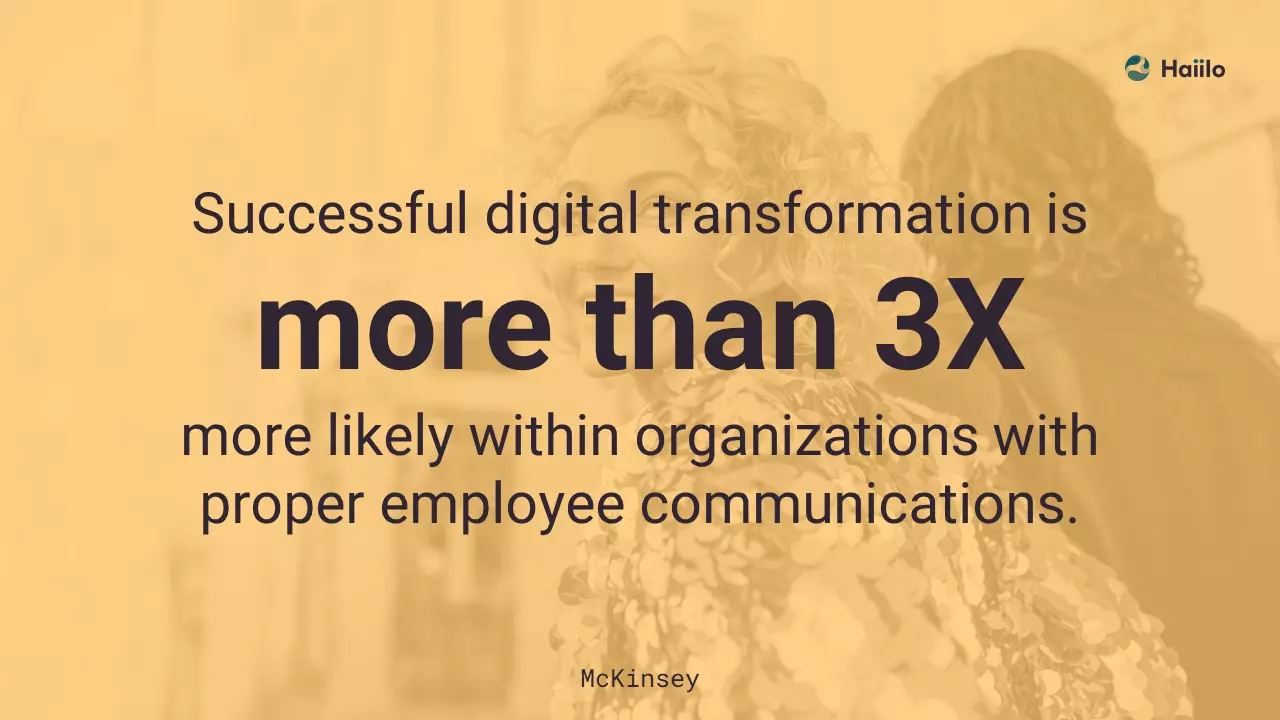
Therefore, clear communication is critical during business transformation. Moreover, statistics say that in organizations that follow this practice, successful transformation is more than three times more likely. Organizations that combine strong leadership communication with digital collaboration tools and employee feedback mechanisms significantly increase their chances of sustaining the transformation of business over the long term.
6. Build an efficient change management process
Business transformation means changes within the organization. Therefore, effective change management is crucial during these projects. Without a structured approach to managing change, even well-planned transformation initiatives can stall due to confusion, resistance, or lack of coordination across teams.
Effective change management allows you to track, measure, and analyze the changes being implemented and understand how they are affecting the whole workplace. Organizations that successfully manage the transformation of business often establish clear frameworks that include communication plans, employee training, feedback loops, and measurable success metrics. These frameworks help leaders identify potential barriers early and adjust their strategies before issues escalate.
Remember that the teams responsible for change implementation have to be very good communicators. Leading a successful change without ensuring that the right information reaches the right employees at the right time is impossible. Leaders and change managers must continuously explain why changes are happening, how they affect daily work, and what employees can expect during each stage of the transformation.
Many organizations now support change initiatives through digital communication platforms that centralize updates, documentation, and employee feedback. Tools such as an employee communications solution can help ensure that employees receive timely updates, access training materials, and remain aligned throughout the transformation of business initiatives.
💡 Also, take a look at these 5 change management models to consider.
7. Set clear short and long-term goals
Setting clear goals and communicating them to the employees is very important during business transformation. Employees need to understand the goals they are supposed to achieve and how they’re going to achieve them. Without clearly defined objectives, transformation initiatives can easily lose momentum or become disconnected from the organization’s broader strategy.
Successful organizations typically break transformation initiatives into measurable phases. Short-term goals help teams focus on achievable milestones, while long-term objectives ensure that every step contributes to the overall transformation of business. This approach allows leaders to monitor progress, identify improvements, and maintain motivation across the workforce.
Set smaller short-term goals to motivate your employees, and a few long-term goals or milestones to celebrate with the whole organization. Recognizing achievements along the way reinforces engagement and helps employees see tangible results from their efforts, making them more committed to supporting ongoing transformation initiatives.
8. Foster a sense of urgency
Without a sense of urgency, it is hard to motivate and engage employees and other stakeholders to take action and participate in the transformation process. When change initiatives are perceived as optional or distant, employees may continue relying on existing processes rather than adopting new ways of working.
Therefore, for business transformation projects to get implemented, senior leaders should foster a sense of urgency for making those changes. This involves clearly communicating market pressures, competitive challenges, and strategic opportunities that make transformation necessary. When employees understand the external factors driving change, they are more likely to support the transformation of business initiatives.
This is the practice where good leadership communication is crucial. Leaders who communicate regularly, share progress updates, and openly address concerns help build trust and reinforce the importance of transformation efforts.
9. Eliminate fear in the workplace
Business transformation efforts within organizations can develop emotions of uncertainty and fear. Changes to workflows, technology, or organizational structures may create anxiety about job security, new expectations, or unfamiliar tools. If these concerns are not addressed early, they can significantly slow down the transformation process.
Internal communicators and managers play a key role in helping employees navigate these challenges. Transparent communication, opportunities for feedback, and access to training resources can help reduce uncertainty and build confidence among employees. Creating an environment where employees feel comfortable asking questions and sharing concerns is essential for sustaining the transformation of business initiatives.
Research on workplace change also highlights the importance of addressing psychological barriers to transformation. For example, a study referenced by Forbes notes that many people naturally resist leaving their comfort zones, which can make organizational change difficult. Leaders who acknowledge these challenges and provide support during transitions can significantly improve employee confidence and participation during business transformation efforts.

In addition, many employees think that business transformation projects may eliminate the need for their skills and expertise. This mainly happens during digital transformation efforts where people are convinced that new technology will replace them. When organizations introduce automation, AI tools, or new digital workflows, employees may worry that their roles will become obsolete rather than evolve.
However, more recent workforce research suggests that technology-driven transformation often reshapes jobs rather than eliminates them. According to research, many organizations report that technological disruption has a neutral-to-positive impact on job creation, with a significant share seeing entirely new roles emerge as businesses adopt digital tools. In practice, the transformation of business frequently creates demand for new skills in areas such as digital collaboration, data analysis, and cross-functional project management.
Therefore, with the proper employee communication strategy, employers need to ensure that their employees feel safe. Leaders should clearly explain how new technologies will support employees rather than replace them, and provide access to training, upskilling programs, and resources that help teams adapt to new ways of working.
10. Enable cross-departmental collaboration
Business transformation is the process in which many different departments contribute and, therefore, they must be able to collaborate and communicate with ease. Transformation initiatives rarely succeed when departments operate in silos. Instead, marketing, HR, IT, finance, and operations must work together to implement new strategies, technologies, and workflows.
Having everyone on board and informed before and during your business transformation process may be a challenge. This is especially true for large organizations with various offices and departments across the world. Therefore, global and interdepartmental communication has to become a priority. When teams across locations can share insights, coordinate projects, and exchange feedback easily, the transformation of business initiatives becomes far more efficient.
In order to achieve such cross-departmental synergy, you must make sure that your organization has the right communication technology in place. A centralized digital workplace, such as a social intranet platform, enables employees to collaborate across teams, access shared knowledge, and stay aligned with transformation goals regardless of their department or location.
11. Choose carefully the communication channels you’re about to implement
If you are a part of a large organization, you are probably using multiple internal communication channels. Slack, Microsoft Teams, email, document sharing, and project management solutions—you name them!
These are all various means of communication within an organization. However, the complexity of this communication ecosystem often makes it difficult to ensure that employees receive the right information at the right time. Important updates may get lost in overflowing inboxes or fragmented across different tools, making it harder for employees to stay aligned during transformation initiatives.
This fragmentation can slow down the transformation of business efforts, particularly when teams rely on different platforms for updates, documentation, and collaboration. Consolidating communication into a central hub can help organizations reduce information silos and improve transparency across the workforce.
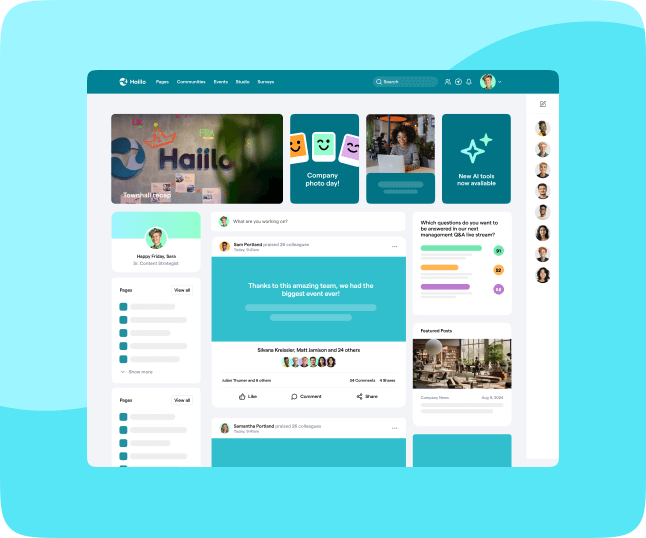
Haiilo, our employee communication solution, is designed to help companies eliminate this growing challenge. It connects all of your communication channels into a single platform where employees can instantly access, share, or comment on important updates. By centralizing communication, organizations can ensure that employees remain informed and engaged throughout the transformation process.
12. Be agile and encourage new ideas
Organizations that are not agile are almost destined to fail in their business transformation efforts. In rapidly evolving markets, companies must be able to adapt quickly to changing customer expectations, emerging technologies, and new competitive pressures.
Companies that are most advanced in their transformation efforts managed to turn their company culture into an internal accelerator of innovation and transformation. They encourage employees at all levels to share ideas, experiment with new approaches, and continuously improve existing processes.
Creating such a culture requires open communication channels, leadership support, and an environment where employees feel empowered to contribute ideas. When organizations actively encourage innovation and collaboration, employees become active participants in the transformation of business rather than passive observers of change.
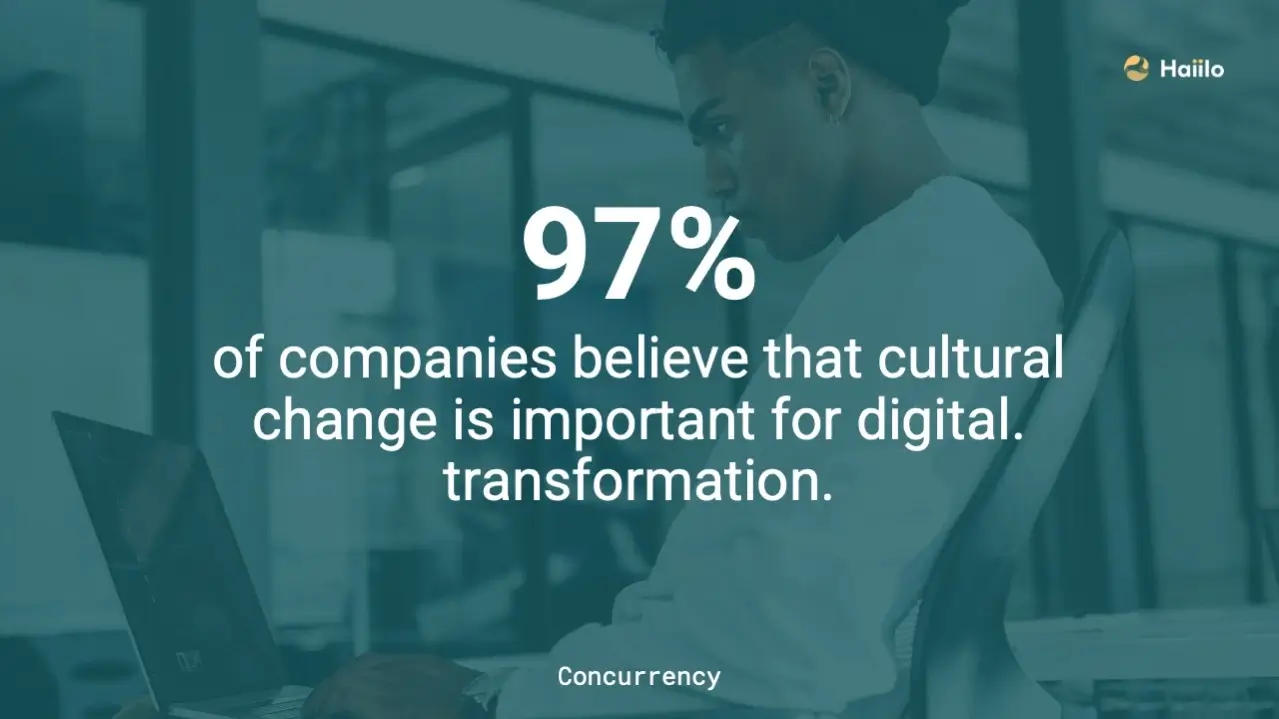
Organizations increasingly recognize the strategic importance of transformation. Recent data shows that 74% of companies now consider digital transformation a top business priority, reinforcing the need to build cultures that support innovation and continuous change.
However, it can be extremely hard to embed new behaviors within organizations. Changing long-standing habits, decision-making processes, and communication patterns takes time and consistent reinforcement. For the transformation of business to succeed, employees need to understand not only what is changing, but also how they can contribute to the innovation process.
To achieve that, employees need to feel free to share their voice and their ideas. Organizations that successfully foster innovation create environments where employees can suggest improvements, experiment with new approaches, and collaborate across teams. Leaders and internal communicators play a key role in encouraging these behaviors by recognizing contributions, sharing success stories, and making employee ideas visible across the organization.
It is the leaders’ and other internal communicators’ job to drive those behaviors through efficient, consistent, and continuous communication with employees. Transparent communication helps reinforce innovation as a shared responsibility and supports the long-term transformation of business initiatives.
13. Close the skill gap at your organization
Closing the skill gap before and during business transformation efforts is something that most organizations struggle with. As companies adopt new digital tools, automation technologies, and data-driven processes, the demand for updated skills across the workforce continues to grow.
According to research, a significant share of jobs increasingly require digital competencies. At the same time, many employees still lack foundational digital skills needed to effectively use modern workplace technologies. This gap can slow down the transformation of business initiatives if employees are not properly trained to work with new systems.
Therefore, investment in people and new skill development is crucial for business transformation. Organizations that prioritize employee training programs, internal knowledge sharing, and digital literacy initiatives are better positioned to implement new technologies successfully.
Being aware of this challenge, skill gaps can quietly slow transformation. The World Economic Forum’s Future of Jobs Report 2025 finds that 63% of employers see skills gaps as the biggest barrier to business transformation—and that 50% of the workforce has already completed training as part of long-term learning strategies. That makes upskilling plans a core pillar of transformation of business, not a “nice to have.”. Providing learning resources, mentoring opportunities, and accessible knowledge hubs can help employees build the capabilities needed to support the ongoing transformation of business.
14. Measure your employees’ engagement
By now, you have probably understood how important effective business communication is for successful business transformation.
However, a communication strategy without goals may not bring so much value to your organization. Communicators need to understand the effectiveness and outcomes of internal messages delivered to employees. Measuring communication performance helps organizations identify what resonates with employees and which areas require improvement.
They need to understand and measure which messages are the most effective, which channels are the best to deliver those messages, and which employees engage more than the others. These insights allow leaders to refine communication strategies and ensure that employees remain aligned with transformation goals.
Tracking such data is very powerful when it comes to understanding your employees’ alignment and engagement with your business transformation efforts. In the past, gathering these insights required manual surveys and fragmented reporting.
Today, however, internal communication tools like Haiilo’s employee communications platform track employees’ engagement with internal content in real time. These analytics allow organizations to monitor how messages are received, identify communication gaps, and improve how leaders communicate throughout the transformation of business.
5 Main Types of Business Transformation
Business transformation can mean a lot of things. However, there are 5 main categories of business transformation that organizations typically focus on. Understanding these categories can help leaders prioritize the areas that require change and design a structured roadmap for the transformation of business.
- Business process transformation: This type of business transformation focuses on how things are done within an organization. It usually involves optimization and automation of repetitive processes and procedures. For example, automating invoice processing frees up your employees to focus on more strategic tasks while reducing operational inefficiencies.
- Information/data/digital transformation: This type of business transformation focuses on implementing and using new technology to unlock additional business value. Companies often adopt new data analytics tools, digital workplace platforms, and automation technologies to improve decision-making and operational efficiency.
- Organizational transformation: Organizational transformation focuses on the company’s biggest asset — its people. The goal is to optimize how various departments are staffed and structured. Key objectives often include breaking down silos, improving collaboration, and enabling more flexible ways of working.
- Management transformation: Organizational hierarchies aren’t always the best for facilitating rapid decision-making and reacting to new company initiatives. Management transformation aims to create more agile leadership structures by improving transparency, enabling faster communication, and empowering teams to make decisions more efficiently.
- Cultural transformation: This type of transformation is probably the hardest business transformation to achieve. Because organizational cultures evolve over many years, changing them requires consistent leadership behavior, strong communication practices, and reinforcement of new values. Cultural transformation plays a crucial role in sustaining the transformation of business over the long term.
6 Interesting Facts About Business Transformation
The importance of digital business transformation is undeniable. With the emergence of remote and hybrid work, it is even more crucial for organizations to adopt new workplace technologies in order to enable employee success and drive better employee experience. Modern organizations increasingly rely on digital collaboration tools, centralized communication platforms, and knowledge-sharing environments to support distributed teams and ensure alignment across locations.
Let’s take a look into some of the most powerful statistics about digital transformation strategy:
- Investment in transformation continues to accelerate. Global spending on digital transformation initiatives is projected to reach nearly $3.9 trillion by 2027, highlighting how critical these initiatives have become for organizations competing in digital markets. These benefits highlight why organizations continue investing heavily in transformation initiatives.
- The top industries for digital-first business strategies are services (95%), financial services (93%), and healthcare (92%), demonstrating how transformation affects both traditional and emerging sectors.
- Today, digital transformation is nearly universal among large organizations. Recent research shows that about 89% of large companies now have digital and AI transformation initiatives underway as they seek to remain competitive in rapidly changing markets.
- 45% of executives don’t think their company has the right technology to implement a digital business transformation.
- Digital-first companies are 64% more likely to achieve their business goals than their peers.
- Digital transformation and a focus on customer experience can generate a 20–30% increase in customer satisfaction and economic gains of 20–50%, highlighting the potential value organizations can unlock through effective transformation strategies.
Employee Communication Plays a Crucial Role in Business Transformation
As mentioned earlier in this blog, employee engagement and communication are some of the most important prerequisites for successful business transformation efforts. Organizations can introduce new strategies, technologies, and processes, but without clear communication and active employee participation, even the most well-designed initiatives struggle to deliver lasting results.
The transformation of business depends heavily on how well leaders communicate change, align teams around strategic goals, and create opportunities for employees to contribute to the process. When employees understand the vision behind transformation initiatives and see how their work contributes to the organization’s success, they are far more likely to adopt new tools, support new processes, and collaborate across teams.
Therefore, organizations now must consider implementing new communication technologies to help leaders and employees prepare for the change and work towards the same goals. Modern digital workplace platforms provide centralized communication hubs where employees can access important updates, collaborate with colleagues, and stay aligned with the organization’s evolving strategy.
With employee communications solutions such as Haiilo, organizations are able to create a connected digital workplace that supports transparency, collaboration, and engagement across the entire workforce. Solutions like Haiilo’s internal communications platform help organizations streamline communication and ensure that employees remain informed throughout the transformation of business initiatives.
- Easily reach all employees with relevant information and updates across the organization
- Centralize company announcements, leadership updates, and strategic communications in one accessible location
- Reach all employees regardless of their location, including remote and frontline workers
- Create and share more personalized content to drive employee engagement and encourage participation
- Make all the content easily shareable within and outside the organization
- Support two-way conversations within the workplace, allowing employees to ask questions and provide feedback
- Achieve a complete organizational and strategic alignment during transformation initiatives
- Help employees keep important documents, messages, and conversations in one place
- Enable employees to have instant access to information on their mobile phones through a digital workplace app
- Better filter and prioritize content delivery to prevent information overload and ensure that employees receive the most relevant updates
FAQ: Transformation of Business
What is the transformation of business?
The transformation of business refers to the process of fundamentally changing how an organization operates in order to improve performance, adapt to market changes, or unlock new growth opportunities. This can involve introducing new technologies, redesigning processes, restructuring teams, or evolving company culture. Unlike small operational improvements, business transformation usually impacts multiple departments and requires strong leadership, clear communication, and employee alignment to succeed.
Why do transformation of business initiatives fail so often?
Many transformation of business initiatives fail because organizations focus too heavily on technology and not enough on people. Employees may not understand why changes are happening, how they affect their roles, or what success looks like. Without clear communication and engagement, resistance to change can grow quickly. Lack of leadership alignment, unclear goals, and poor change management processes are also common reasons why transformation efforts struggle to deliver lasting results.
How long does a transformation of business typically take?
The timeline for the transformation of business varies depending on the size of the organization and the scope of the changes. Smaller initiatives may take several months, while large enterprise transformations can take several years. Most successful organizations treat transformation as an ongoing process rather than a one-time project. They set clear milestones, measure progress regularly, and adjust their strategies as business needs evolve.
What role does employee communication play in the transformation of business?
Employee communication is one of the most important drivers of successful transformation of business. When leaders communicate clearly and consistently, employees are more likely to understand the purpose of the changes and support new initiatives. Transparent communication reduces uncertainty, encourages collaboration, and keeps teams aligned with company goals. Many organizations now rely on modern internal communication platforms to ensure employees stay informed and engaged throughout the transformation process.
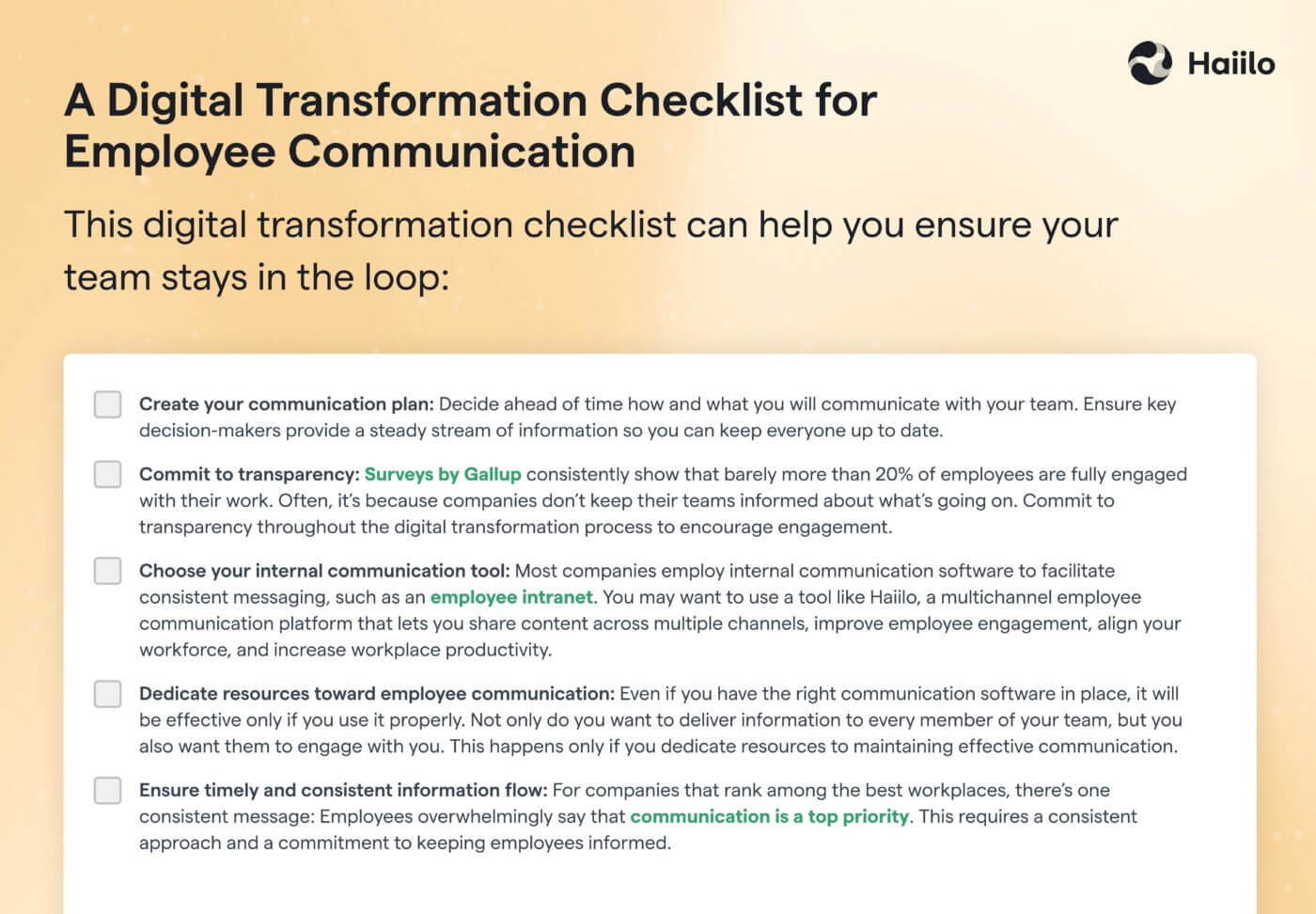
Digital transformation is easy with our simple checklist. Get it now!