
Enterprise social network or ESN is one of the must-have platforms in every large organization’s workplace tech stack.
In our private lives, we are used to social media platforms to connect with people, communicate, and find content relevant to our interests.
Today, employees expect the same digital experience in the workplace.
In this blog, we will define ESN, explain its benefits, and list the most important features and popular solutions in the market.
What Is an Enterprise Social Network
An enterprise social network (ESN) is a workplace technology that allows employees within an organization to connect, collaborate, and communicate with each other in a social media-like environment.
According to Enterprise Social Networks Market Report 2026
The demand for better internal communication is only growing. According to recent market data, the enterprise social network market reached $13.45 billion in 2024 and is expected to grow to nearly $29 billion by 2029, reflecting how critical these platforms have become for modern, distributed workplaces.
Some of the major driving factors include:
- Increased demand for streamlined communications
- Increased adoption of cloud-based technology
- Inclusive corporate culture and need for social informal communication
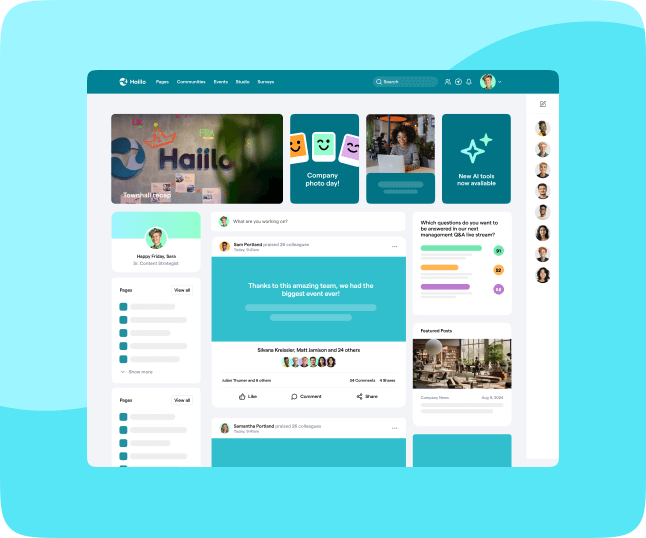
ESNs typically include features such as employee profiles, user directories, news feeds, social posts, 1-to-1 and group messaging, file sharing, content creation and distribution features, and others.
The primary purpose of an enterprise social network is to facilitate collaboration and knowledge sharing among employees and achieve better organizational alignment. By providing a digital space for employees to engage with personalized content, onboard more efficiently, interact, and share ideas, ESNs can enhance internal communication, foster innovation, and improve productivity within the organization.
In practice, a company social network becomes the place where daily work conversations actually happen. Instead of updates getting lost in long email threads or scattered across tools, teams can share quick wins, ask questions, and access important information in one central space. For example, a frontline employee can quickly find the latest safety update, while a manager can gather feedback from across locations without chasing responses. This visibility not only reduces noise but also helps employees feel informed and included, especially in hybrid or deskless environments. Over time, this consistent, open exchange builds stronger alignment and a more connected workplace.
How Organizations Can Benefit from Enterprise Social Networks
Let’s dig deeper into some of the biggest benefits of using enterprise social networks in your organization.
1. Higher employee engagement
According to a study from Gallup only 36% of employees are engaged in the workplace, and 13% are actively disengaged.
Today, many internal communications professionals still struggle with low employee engagement with their internal communications campaigns. One of the biggest reasons for that is content irrelevancy and lack of digital personalization.
McKinsey research found that companies that excel at personalization generate 40% more revenue from those activities than average players.

Enterprise social networks allow internal communications professionals to create more personalized and relevant content for every employee, resulting in higher engagement and improved employee experience. In a company social network, this means employees don’t just receive more information, but the right information for their role, location, or interests. Instead of broad, one size fits all updates, communicators can target messages so they feel useful and timely, which increases the chances that employees actually read and act on them.
2. Improved employee productivity
Enterprise social networks can significantly improve employee productivity in many different ways.
For example, by using ESNs, employees can find relevant information faster without digging through emails, folders, or disconnected tools. In many organizations, simply locating the latest version of a document or update can slow work down more than expected.
Furthermore, a well structured company social network reduces constant context switching. Instead of jumping between multiple platforms, employees can access updates, conversations, and resources in one place. More specifically, employees can save time from application-switching reductions by 24%. This reclaimed time adds up quickly, especially for teams already stretched thin.
3. Easier team collaboration and knowledge sharing
Centralized employee directories and profiles enable employees to find peers with specific skills, knowledge, expertise, and experience. This allows for improved team and cross-functional collaboration as well as more efficient knowledge-sharing, especially in large and distributed organizations.
In a company social network, this becomes part of the daily workflow. Employees can ask questions in open groups, share best practices, and build on each other’s ideas without needing formal meetings. For example, a regional team can quickly learn from a successful campaign run in another market, instead of starting from scratch.
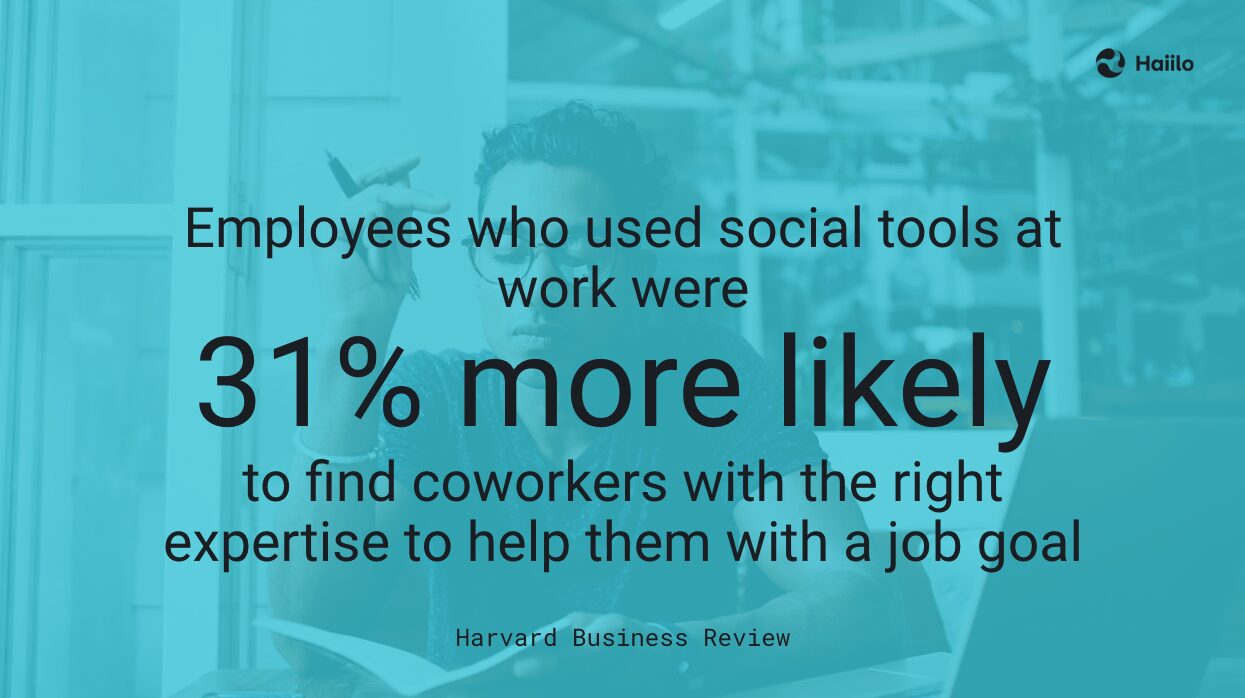
According to a study by the Harvard Business Review, employees who used social tools at work were 31% more likely to find coworkers with the right expertise to help them with a job goal, and 88% more likely to know who could put them in touch with the right person.
4. Faster onboarding
Studies show that employees are 69% more likely to stay if they experience strong onboarding, whereas 31% of new recruits leave the company within 6 months of joining.
Centralized content and easy access to tools, information, and people can improve the overall onboarding process and experience. On the other hand, chaotic onboarding creates confusion, slows productivity, and leaves new hires unsure where to start.
A company social network gives new employees a clear entry point into the organization. Instead of relying on scattered documents or ad hoc guidance, they can follow structured onboarding journeys, access role specific resources, and connect with colleagues from day one. For example, a new hire can quickly find team updates, ask questions in dedicated groups, and learn how work actually gets done beyond formal training. This makes onboarding feel less overwhelming and helps people contribute faster.
Enterprise social networks enable organizations to better structure onboarding processes and keep information up to date. All onboarding materials, videos, and resources are organized in one place, so the experience becomes more personalized to each employee.
5. Culture of belonging
According to Gallagher’s research, 82% of respondents who report into an internal communication department chose culture and belonging as their purpose. The right technology enables IC professionals to create open and transparent communication that builds trust and a sense of belonging and strengthens community in the workplace.
A company social network plays a key role here by giving every employee a voice, not just those in head office. Employees can react, comment, and share their perspectives, which helps reduce the disconnect often seen in hybrid or deskless environments. Recognition posts, community groups, and leadership updates become visible to everyone, not hidden in silos.
The benefits of creating such a culture are clear: a strong sense of belonging can increase job performance by as much as 56%, reduce staff turnover risk by 50%, and lower sick days by 75%. In other words, when people feel connected, they are more likely to stay, contribute, and perform at their best.

6. Streamlined employee advocacy
Some enterprise social networks offer built-in functionalities to boost and streamline employee advocacy initiatives.
For example, Haiilo enables employees to easily share company-generated content to their private social networks with just a few clicks. The gamification features create healthy competition among peers and motivate employees to act as brand ambassadors.
Learn about why large organizations choose Haiilo for their Enterprise Social Network!
Features to Look for In an Enterprise Social Network
When choosing an ESN for your organization, make sure to look for these features and functionalities:
1. Accessibility
Your company’s ESN should be accessible to every employee, regardless of their location and job function.
Oftentimes, the mobile and frontline workforce don’t have the same kind of access to important company information and updates compared to office employees.
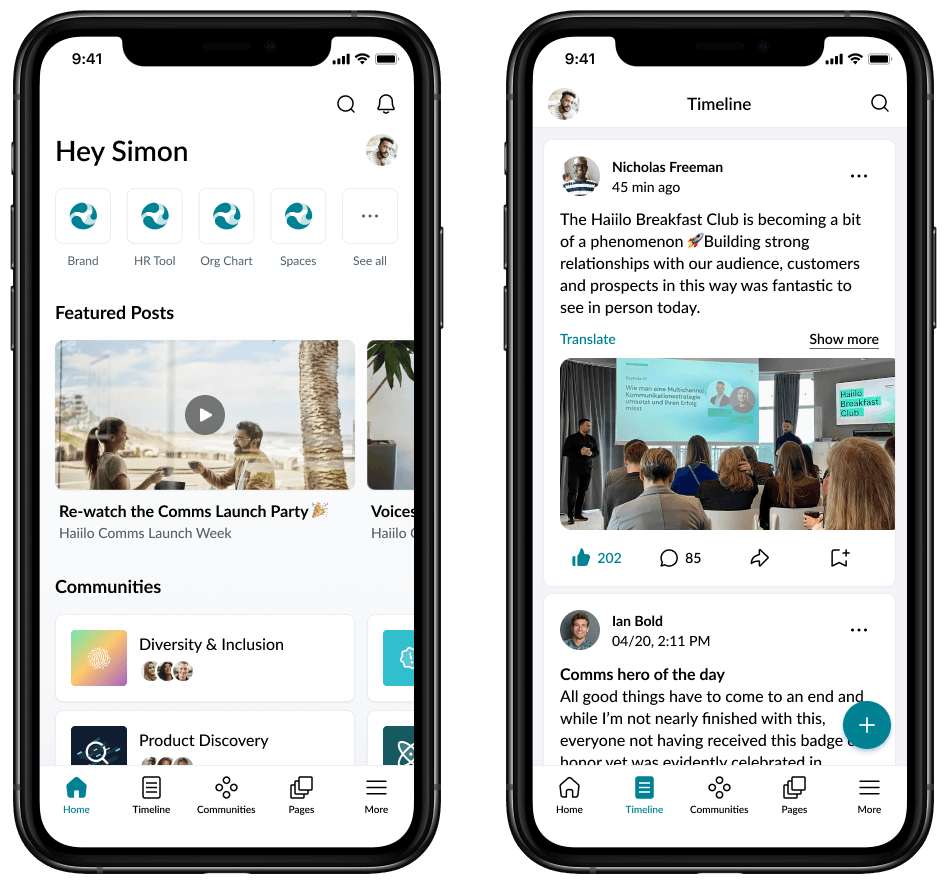
Hence, when looking for an enterprise social network, make sure that it comes with a native mobile app and that even employees without a company email can use it.
2. Employee profiles and directories
One of the most valuable features of any ESN is intuitive, searchable, and informative employee profiles and company directories.
This becomes especially important in remote workplaces where employees rarely meet in person and informal knowledge is harder to access.
In a company social network, directories go beyond basic contact details. Employees can search by skills, projects, or expertise, making it easier to find the right person without relying on word of mouth. For example, instead of asking around for “someone in legal,” employees can directly identify the right expert and reach out. This saves time, reduces frustration, and helps break down silos across teams and regions.
3. Customization and white labeling
Your enterprise social network should feel like a natural extension of your organization, not just another external tool. Matching the look and feel to your brand helps create familiarity and trust from day one.
A company social network that reflects your culture, tone, and visual identity is more likely to be adopted by employees. Beyond branding, customization options such as tailored navigation, custom fields, or role specific views allow you to adapt the platform to your workflows rather than forcing teams to adapt to the tool. This is especially valuable for organizations with diverse roles, from desk based employees to frontline teams.
4. Audience segmentation and personalization
According to research, around 50% of communication and HR professionals say their technology doesn’t allow them to tailor content based on employee needs or interests.
As a result, employees receive too many irrelevant messages or miss important updates, leading to poor employee experience and engagement.
A company social network solves this by enabling precise audience segmentation. Communicators can target content based on role, location, department, or behavior. For example, frontline employees can receive operational updates relevant to their shift, while managers see leadership communications tailored to their responsibilities. This reduces noise, increases relevance, and helps employees focus on what actually matters to them.
Robust audience segmentation and targeting is one of the must haves to look for in your ESN.
5. Content creation and distribution
Internal communications professionals are usually the main drivers behind enterprise social networks. For them, creating and delivering content efficiently is critical, especially when time and resources are limited.
That’s why strong ESNs focus on easy content creation, structured collaboration, and clear distribution workflows.
In a company social network, this means communicators can plan, create, and publish content in one place, while collaborating with stakeholders without endless email chains. For example, HR, leadership, and local teams can co create updates, review drafts, and approve content quickly, keeping communication consistent and timely.
If you are evaluating solutions, look for a tool that:
- Supports faster content creation with AI assistance
- Connects with your existing communication channels
- Offers an intuitive editor for engaging formats
- Simplifies feedback and approval workflows across teams
📹 Check out how internal communicators can create content 10x faster with Haiilo!
6. Employee feedback and sentiment tracking
Not every ESN includes this functionality, but it’s a valuable capability to look for, especially when teams struggle with low visibility into employee sentiment.
Solutions like Haiilo offer built-in surveys to capture employee feedback and regularly measure engagement, satisfaction, and other people related KPIs.
In a company social network, this creates a direct feedback loop. Employees can share their input in real time, while communicators gain a clearer picture of what is working and where communication falls short.
If AI is involved, insights go deeper. Patterns from employee surveys and feedback can be analyzed quickly, helping teams identify trends early and take action before issues grow.
7. AI-powered search
The most advanced ESN solutions use AI to improve how employees find information.
For example, Haiilo leverages AI so employees get direct answers to work related questions instead of searching through multiple links and documents.
In a company social network, this means less time spent searching and more time getting work done. Employees can ask a question and receive a clear, usable response instantly, similar to how tools like ChatGPT deliver answers instead of lists of results.
This is especially valuable in tackling information overload, one of the biggest barriers to productivity in modern workplaces.
8. Employee advocacy
Some ESN vendors also include features to boost employee advocacy and brand ambassadorship.
In a company social network, employees can easily find approved content and share it externally within seconds. This lowers the barrier to participation and makes advocacy part of the daily workflow rather than an extra task.
As a result, organizations can extend their reach, strengthen credibility, and support hiring efforts through authentic employee voices.
9. Integrations with the existing tech stack
Integrations are critical to getting real value from your ESN. Without them, even the best platform risks becoming just another disconnected tool.
A company social network should connect with tools employees already use, such as Google Workspace, Microsoft 365, Slack, or common workplace tools. This ensures information flows naturally instead of being duplicated across systems.
As highlighted in his annual report, Josh Bersin emphasizes the growing importance of integrated employee experience layers that bring communication, knowledge, and tools together.
10. Analytics
Advanced analytics help you understand whether your communication actually reaches and engages employees.
Within a company social network, you can track what content resonates most and use these insights to refine your internal communications strategy.
You can also identify highly engaged employees who act as internal champions and amplify messages across the organization.
Combined with survey data, analytics provide a clearer view of workforce sentiment, helping you improve engagement and reduce turnover before it becomes a larger issue.
Best Enterprise Social Networks In the Market
Now let’s take a look at some of the best vendors in the market.
Haiilo

Haiilo is a modern enterprise social network used by large organizations across the globe. It helps internal communications and HR professionals build more connected, informed, and engaged workplaces, especially when communication is fragmented across channels.
As a company social network, Haiilo brings communication, intranet, and employee listening into one place. This means you can reach employees with the right message, in the right context, without adding to the noise. Its flexibility allows teams to adapt the platform to their structure and workflows, while keeping everyone aligned with organizational goals.
With built in AI, including Haiilo’s Virtual Assistant (AVA), communicators can create content faster, surface relevant information, and reduce manual work. The result is more time for meaningful communication and less time spent managing tools.
Microsoft Viva Engage

This platform allows you to connect with your coworkers, and engage in social communities created around interests, job types, departments, and other topics.
It helps internal communications professionals keep employees informed and engaged with various types of announcements wherever they are.
An interesting feature called Leadership Corner enables employees to engage with leaders, catch up on their latest posts, discover their communities, and attend “Ask Me Anything” sessions.
Zoho Workplace

Zoho Workplace is an integrated suite of applications that empowers your team to level up their productivity. Workplace contains a feature-rich email service, a file management tool, and an office and collaboration suite.
The platform also provides a new generation of social media-style collaboration for your mailbox.
Last but not least, ZOHO Connect is a social intranet solution for organization-wide collaborations, where you can share ideas, spark discussions, and strengthen the work culture in your office. The built-in knowledge base enables employees to gain access to information such as HR and compliance records that they might need.
Check out our report on the synergy of multichannel communication and employee listening, featuring Forrester!


FAQs about company social networks
What is a company social network in simple terms?
A company social network is a central place where employees can communicate, share updates, and collaborate, similar to how social media works in everyday life. Instead of relying on scattered emails or multiple tools, everything happens in one space. Employees can find information, join conversations, and stay connected to what’s happening across the organization.
How is a company social network different from an intranet?
While traditional intranets are often static and top down, a company social network is interactive. Employees don’t just consume information, they contribute to it. They can comment, share ideas, and ask questions in real time. Many modern solutions combine both, offering structured content alongside social features to create a more engaging experience.
Why do companies need a company social network?
Many organizations struggle with too many tools, too much information, and not enough clarity. A company social network helps cut through that noise. It gives employees one place to find updates, connect with colleagues, and access resources. This improves alignment, reduces confusion, and helps teams work more efficiently, especially in hybrid or distributed environments.
What should you look for in a company social network?
Focus on what makes daily work easier for your employees. Look for strong search, mobile access for deskless teams, and personalization so people only see what’s relevant to them. Features like integrations, analytics, and employee feedback tools also matter. The goal is not just to introduce another platform, but to create a space employees actually use and rely on.