
Employee empowerment in the workplace is a great way to improve employee engagement and retain your top talent. It gives people more ownership over their work and helps them feel trusted, valued, and motivated. So, how can you support your employees’ personal and professional development? How can empowerment training for employees help them grow, perform better, and stay committed? How does employee empowerment impact the business’s bottom line?
In this blog, we will go over the importance of empowering employees in the workplace, how empowerment training for employees supports long-term success, and practical ways to do it right without losing structure or alignment.
Employee Empowerment: Definition
Empowerment is based on the idea that providing employees with the right resources, authority, opportunity, and motivation to do their work—while also holding them accountable for their actions—leads to better performance and higher job satisfaction. It’s about giving people the confidence and support they need to make decisions and take ownership of their responsibilities.
🎲Check out our article on Employee Engagement, its Drivers, Current Status and How to Improve it and learn how to effectively motivate and inspire your employees!
In practice, this often involves structured approaches such as empowerment training for employees, which helps individuals build the skills, mindset, and autonomy required to succeed in their roles.
In other words, allowing employees to take leadership of their roles results in high impact and positive long-term effects for the company and its individuals. It encourages faster decision-making, stronger accountability, and more innovation across teams.
When companies provide employees with enough support both individually and professionally, they integrate employees more closely into the company mission. This alignment helps people understand how their work contributes to bigger goals, which is a key outcome of effective empowerment training for employees.
3 Levels of Employee Empowerment in the Workplace
Employee empowerment can happen on different organizational levels, and the most common segmentation includes:
- empowerment on the organizational level
- empowerment on the managerial level
- empowerment on the individual level
Let’s now take a look into each of them.
1. Employee Empowerment on the Organizational Level
An organization that actively supports empowerment can create an environment where employees feel trusted and supported at scale. With the right structures and empowerment training for employees, companies can better:
- Embrace change such as digital transformation
- Recognize employees’ contribution to the business
- Reward responsible ownership in the workplace
- Support collaboration, including cross-departmental collaboration in the workplace
- Foster a culture of employee engagement
- Retain top talent
Organizations that prioritize empowerment also tend to create clearer processes, better communication flows, and stronger alignment across teams.
2. Employee Empowerment on the Managerial Level
Empowered team leaders play a critical role in turning strategy into everyday behavior. When managers are equipped with the right skills and mindset, they can:
- Better support the team and help each team member reach their targets
- Provide the information the teams need when they need it
- Inspire and motivate employees
- Help better connect employees, including the ones working remotely
- Facilitate work processes
- Spread team spirit in the workplace
- Better communicate the business goals and long-term vision
- Make the teams more successful
Managers who practice empowerment create more autonomy within their teams while still maintaining direction and accountability.
3. Employee Empowerment on the Individual Level
When employees feel empowered and trusted, they become more proactive and confident in their roles. This is where empowerment training for employees has the most visible impact. Empowered individuals:
- Are more willing to go the extra mile for the team and the business
- Take ownership over their work
- Generate ideas
- Know how to take prudent risks to take the business to the next level
- Find meaning and purpose at work
- Feel proud of the company they’re working at
- Feel more motivated and engaged
At this level, empowerment leads to stronger accountability, better problem-solving, and more innovation across the organization.
Empowerment on the organizational and managerial levels should exist by default, as they set the foundation for how work gets done and how decisions are made. However, achieving true empowerment at the individual level requires much more focused effort. It depends on clear communication, the right tools, and ongoing empowerment training for employees that helps people build confidence, skills, and accountability in their roles.
That’s why it is critical for HR and IC functions to work hand-in-hand and align their strategies. HR focuses on people development, culture, and training, while internal communications ensures that the right messages, context, and information reach employees at the right time. When these functions collaborate, they create a more consistent and supportive environment where empowerment can thrive.
The Current State of Empowerment in the Workplace
Even though employee empowerment has become a top priority in most industries, many businesses still struggle to put it into practice in a meaningful way. Policies may exist, but without the right culture, tools, and empowerment training for employees, empowerment often remains superficial.
We’ve compiled below workplace insights that highlight the gap between intent and reality:
Shocking workplace stats that show the importance of employee empowerment:
- A large share of employees report feeling disengaged or dissatisfied at work, which signals a lack of ownership, recognition, and growth opportunities.
- Many employees leave their jobs because they don’t feel valued or appreciated, showing how critical recognition and trust are for retention.
- A significant number of managers lack proper leadership training, making it harder to support and empower their teams effectively.
These challenges show that empowerment is not just about intention—it requires consistent action, strong leadership, and structured support. Without investing in the right strategies and training, organizations risk falling short of creating truly empowered workplaces.
- Increasing employee engagement investments can lead to measurable business improvements, especially when supported by structured empowerment training for employees that builds skills and accountability.
- HR leaders widely agree that ongoing feedback and regular check-ins are essential for better performance and stronger alignment within teams.
- Employees who regularly use their strengths tend to feel more engaged and confident in their roles, which directly supports empowerment.
- When employees feel their voice is heard, they are more likely to contribute ideas and take initiative, both of which are key outcomes of empowerment.
- Empathy in leadership plays an important role in retention, as employees are more likely to stay where they feel understood and supported.
- Work overload reduces productivity and makes it harder for employees to take ownership of their work, limiting true empowerment.
- Burnout remains a common issue in many workplaces, highlighting the need for better support systems and balanced workloads.
- Organizations that actively support employee well-being are more likely to earn positive recommendations from their workforce.
Why is Employee Empowerment in the Workplace so Important?
Empowerment in the workplace has many benefits. When employees feel trusted and supported, they are more engaged, productive, and committed to their work. This is why many organizations invest in empowerment training for employees as part of their long-term people strategy.
Broadly speaking, when employees feel empowered at work, they are more willing to:
- Go the extra mile to reach the company’s goals
- Follow best practices for improving collaboration in the workplace
- Improve their performance
- Drive effective communication in the workplace
- Embrace changes such as digital transformation or mergers and acquisitions
- Spread a positive attitude throughout the workplace
- Provide better customer service
- Drive innovation
- Advocate for the brand
Ultimately, empowered employees take more ownership, collaborate more effectively, and contribute to a stronger, more resilient organization.
Therefore, many employers are trying to empower their employees. However, many still struggle with how to start with employee empowerment and how to turn it into a consistent, scalable practice supported by empowerment training for employees.
Why Should You Make Employee Empowerment Your Priority
It is no secret that employee empowerment has many benefits. Organizations where employees feel empowered tend to perform better, adapt faster to change, and build stronger core company values that guide everyday decisions and behavior.
Let’s now take a look into the top 4 reasons why organizations should drive empowerment in the workplace.
1. It Impacts the Business’s Bottom Line
Empowered employees make faster decisions, solve problems more independently, and contribute more actively to business goals. This leads to better efficiency, improved productivity, and stronger overall performance.
When supported with the right structure and empowerment training for employees, teams are more confident in their roles and less reliant on constant approvals. This reduces bottlenecks and helps organizations move faster while staying aligned.
As a result, companies that invest in empowerment often see better financial outcomes and are better positioned to outperform competitors over time.
Many organizations recognize the link between engagement and performance, but turning that into action is where challenges begin. When employees feel empowered, they are more focused, productive, and committed to their work.
Creating an environment where employees can continuously learn, improve, and take ownership is essential. This is where structured empowerment training for employees plays a key role. It gives people the tools and confidence they need to perform at their best and contribute more effectively.
However, many businesses still struggle to empower and engage their workforce in a consistent way. Without clear direction, support, and communication, employees can feel disconnected and less motivated, which directly impacts productivity and overall performance.
2. It Keeps Employees Inspired and Engaged
Engaged employees have a direct impact on business success. They are more motivated, more productive, and more likely to contribute beyond their core responsibilities.
Providing the right balance of support and autonomy is key. When organizations listen to employees, understand their individual needs, and trust their expertise, people feel more valued and confident in their roles.
This is exactly where empowerment training for employees makes a difference. It helps individuals develop the skills and mindset needed to take initiative, stay engaged, and perform at a higher level.
That’s why employee empowerment is the key!
But keep in mind that empowering and engaging employees is all about providing them with the information they need when they need it. When employees have easy access to relevant updates, context, and resources, they understand the business better and can make smarter decisions in their roles.
In many organizations, employees still spend a significant amount of time searching for information instead of doing meaningful work. This slows down productivity and creates frustration. That’s why improved business communication is essential for enabling empowerment and making daily work more efficient.
Putting the right systems in place—such as shared platforms, clear knowledge hubs, and structured empowerment training for employees—helps ensure that information flows smoothly across the organization. It also makes it easier for employees to stay informed and aligned.
This can mean having shared technology in place and providing informative company and industry-related content that employees can share either internally or externally, strengthening both knowledge and engagement.
Related: 8 Employee Engagement Statistics You Need to Know [INFOGRAPHIC]
3. It Helps You Retain Top Talent
Helping your employees build their skills, grow professionally, and strengthen their personal brand is one of the best ways to retain your top talent. When people feel they are progressing and being supported, they are more likely to stay and contribute long-term.
Empowerment plays a key role here. Employees who feel trusted and in control of their work tend to be more satisfied and less likely to look for opportunities elsewhere. This is especially true when organizations invest in empowerment training for employees, giving individuals the tools and confidence to shape their own careers.
Retention is not just about compensation—it’s about growth, purpose, and ownership. Empowered employees are more engaged, more loyal, and more likely to build a strong connection with your brand.
And investing in employee empowerment is a win-win situation. Supporting employees’ personal branding efforts—by encouraging them to network, share insights, and build thought leadership—benefits both the individual and the organization. With the help of empowerment training for employees, teams gain the confidence and skills to represent the company in a credible and authentic way.
4. It’s Good for Your Brand
Employees who feel empowered and in charge of their work are far more likely to advocate for the brand within their networks. And the benefits of employee advocacy are significant!
When employees share company-related content, talk about their experiences, or highlight their work, it builds trust and visibility in a way traditional marketing cannot. Their voices feel more genuine, which strengthens your employer brand and overall reputation.
Positive word-of-mouth—through conversations, recommendations, and social sharing—helps attract both customers and talent. It also contributes to better online reviews, more referrals, and a stronger, more credible brand presence.
Related: Recruitment vs. Talent Acquisition [Infographic Included]
The Role of Company Culture in Employee Empowerment
Your company culture plays an essential role in employee empowerment and building a better employee experience in the workplace.
Basically, if you want to support your employees’ performance, help them find meaning at work, and understand how their jobs impact the business, you need to foster the “right” company culture for that.
And by the “right” company culture, I mean a culture that actively supports innovation in the workplace, prioritizes employees’ well-being, and encourages people to take initiative without fear of failure.
But keep in mind that building a company culture that supports employee empowerment doesn’t happen overnight. It requires consistent effort, clear direction, and the right support systems—often including structured empowerment training for employees to help turn intention into action.
First, you need to include employee empowerment in your business goals.
Think about it: if you want to empower your employees, you need to make it one of your top priorities from the start.
Making empowerment in the workplace a clear business goal helps you 1. commit to it and 2. ensure that everyone understands it is a company-wide priority, not just an HR initiative.
Next, you need to build an internal communication approach that actively supports empowerment. To do this effectively, your IC strategy should involve HR, internal communications teams, and line managers working together.
The way you communicate with employees—and the initiatives you take to motivate and inspire them—has a direct impact on how they feel about their roles, their managers, and the company as a whole.
When it comes to empowerment in the workplace, managers and team leaders play a critical role. They are the ones who translate strategy into daily actions, provide feedback, and create an environment where employees feel safe to contribute.
That’s why strong communication skills remain one of the most important capabilities for leaders today.
The Key to Employee Empowerment is Your Company Culture
If you’re still not convinced about the connection between the company culture and employee empowerment, check out this video by Great Place to Work.
In this short video, Executive Vice President Gary Peterson of O.C. Tanner, a Fortune 100 Best Company to Work For, explains how empowering employees supports the company’s growth in so many different ways and how they got there:
📚 Also read about how to build a great workplace culture.
The Role of Communication in Driving Employee Empowerment
Your leadership and communication skills have a direct impact on your ability to motivate, support, and inspire your employees. This is why transformational leadership has become so important, especially in environments where empowerment is a priority.
When it comes to empowerment in the workplace, success depends on communicating the right messages to the right employees at the right time—and in the right way. Clear, timely communication helps employees understand expectations, priorities, and how their work contributes to broader goals.
For example, you may be sharing the right information, but if it’s not delivered clearly or in a way that resonates, it can easily be misunderstood or ignored. Over time, this creates confusion and weakens trust.
In contrast, strong communication builds clarity and confidence. It helps employees feel informed, included, and empowered to act. This is where empowerment training for employees can support both leaders and teams by improving how information is shared, received, and applied in daily work.
Poor or inconsistent communication can have the opposite effect. It leads to frustration, disengagement, and a lack of alignment across teams. Employees may feel left out of decisions or unsure about what is expected of them.
That’s why developing strong communication skills is essential for any leader who wants to empower their team.
There are many definitions of great leadership, but they all share one common trait: great leaders are great communicators.
In a nutshell, great leaders know how to:
- Translate the company’s vision into reality
- Enhance dialogues in the workplace
- Listen to their employees
- Include employees in decision making
- Build trust in the workplace
- Encourage their teams
- Make complex ideas easy to understand for everyone
- Help employees take ownership over their work
- Inspire others
By strengthening communication across all levels, organizations create the foundation needed for true employee empowerment to grow and scale.
Achieve Empowerment in the Workplace With the Right Technology
To foster a culture of empowerment, it is crucial to improve employee communications and knowledge sharing in the workplace.
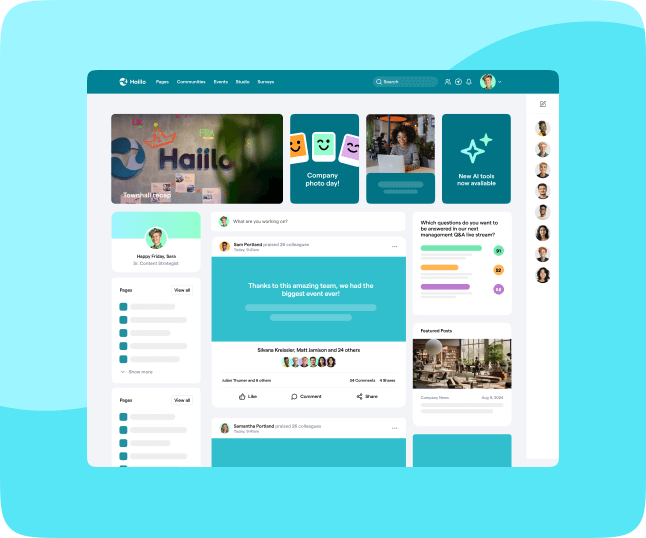
Companies around the world use Haiilo Home to boost employee collaboration and communication in order to encourage employee empowerment.
In a nutshell, Haiilo Home enhances empowerment in the workplace by:
- Helping employees to stay up-to-date with the company news and industry trends
- Helping employees to get the information they need when they need it so they don’t have to spend time looking for it
- Providing employees with a space for collaboration
- Encouraging employees to communicate through their favorite channels
- Allowing employees not only to reach to company news, but to drive discussions in the workplace through pages and communities
- Allowing employees to personalize their newsfeed so they receive content on the topics they are interested in in addition to the content shared within their teams
FAQ
What is empowerment training for employees and why is it important?
Empowerment training for employees helps people build the skills, confidence, and autonomy needed to take ownership of their work. It goes beyond motivation—it gives employees practical tools to make decisions, solve problems, and contribute ideas. When done right, it improves engagement, productivity, and alignment. It also works best when supported by strong internal communication, which ensures employees have the context and information they need to act effectively.
How do you implement empowerment training for employees effectively?
Start with clear goals and align empowerment with your business strategy. Then focus on communication, leadership support, and access to knowledge. For example, building a structured approach like this internal communication strategy helps ensure employees receive consistent guidance. You also need the right tools, such as platforms for knowledge management, so employees can easily access what they need to succeed.
What are the biggest challenges with employee empowerment?
One of the biggest challenges is poor communication and lack of clarity. When employees don’t understand expectations or can’t find the information they need, empowerment breaks down. Many organizations also struggle with outdated tools or low adoption, as explained in this intranet UX guide. Without the right structure, empowerment can feel like extra pressure instead of support. That’s why combining empowerment training for employees with clear processes and modern tools is essential.
How does empowerment training improve employee engagement?
When employees feel trusted and capable, they naturally become more engaged. Empowerment training for employees helps people understand their role, build confidence, and contribute more actively. It also improves early experiences, such as onboarding. A strong employee onboarding experience sets the foundation for empowerment from day one. Combined with solutions focused on employee engagement, this creates a more motivated, connected, and high-performing workforce.