
An appropriate multichannel communication strategy is critical for keeping employees informed, engaged, connected, and enabled to do their best work.
Unfortunately, one study showed that 60% of employees feel less-than-enthusiastic about internal communications in their organizations. 44% say that their business’ internal communications are stagnant, with nothing having changed in the past five years.
So if you are looking for ways to make your company’s workplace comms more efficient, engaging, and streamlined, keep reading this blog!
What Is Multichannel Communication
Multichannel communication is a term used to describe a workplace communication strategy in which multiple channels are used to deliver important company news and updates.
With the rise of the importance of internal communications in organizations, multichannel communication was introduced as a concept to help IC professionals do their jobs more efficiently. Increasingly, companies rely on a multichannel communication platform to manage these channels from a single place—whether that means sending updates through an employee app, email newsletters, intranet posts, chat tools, or digital signage used by deskless teams.
The biggest challenge every communicator faces today is the inability to always reach the right audience with the right message at the right time. Employees work across locations, devices, and schedules, making a single channel unreliable. So multichannel communication significantly increases the likelihood of better reach and employee engagement by ensuring messages appear where employees already work and interact.
Create a successful multichannel communication strategy with Haiilo!
Why Multichannel Comms Is a Must for Every Organization
In the same way we use multiple communications in our private lives, so we do in our professional lives. In fact, when multiple channels are used right, internal communications become much more efficient. Employees expect to access information in the tools they already use—whether that’s email, mobile apps, chat platforms, or an intranet. A multichannel communication platform helps communicators coordinate these touchpoints so updates reach employees wherever they work.
Most employees today depend on technology to do their jobs and collaborate with teammates on a daily basis. This is especially true for remote and hybrid organizations and for those that employ many frontline workers. For example, desk-based employees may rely on Slack or email, while frontline staff often depend on mobile apps or digital signage to stay informed.
These employees still regularly miss important company updates. In fact, according to Gallup, 74% of employees feel that they’re missing out on company information and news. However, when employees deal with information overload every day, it can be very hard to catch their attention. Delivering the same message through several well-chosen channels increases the chances it will actually be seen and acted upon.
Furthermore, it can be hard to understand which communication channel should be used for which department, topic, or project. Studies show that 68% of employees toggle between 10 apps in a single hour, with some even juggling up to 15. A centralized multichannel communication platform can streamline this complexity by helping teams plan, distribute, and measure communications across channels from one place.
Information is coming from everywhere, and while employees are left scrambling to figure out which app has the information they want, internal comms professionals need help understanding how to best reach their audience. Some employees use email, some use Slack, and some use Microsoft Teams as their primary means of workplace communication. So how can we always ensure we send information via the right channels? This is where a multichannel communication platform becomes essential—helping communicators distribute messages across multiple tools at once while tailoring them to different audiences and work environments.
Multichannel communications aim to enable workplace communicators to use internal channels strategically – not to overwhelm employees but keep them informed with relevant information. For example, urgent operational updates might be pushed to mobile apps for frontline teams, while leadership announcements are shared through the intranet or company newsletter.
Furthermore, a good multichannel communications strategy can go a long way in driving higher employee engagement and shaping positive employee experience in the workplace. When employees consistently receive clear, timely information in the channels they prefer, they’re more likely to stay connected to company goals and initiatives.
Last but not least, proper use of internal communications channels is critical for achieving better organizational alignment and trust in the workplace. Unfortunately, research shows that 72% of employees don’t fully understand the company’s strategy and poor internal comm is usually the main culprit. By using a multichannel communication platform to coordinate messaging, organizations can reinforce strategic priorities across several touchpoints instead of relying on a single announcement.
Top 6 Communication Channels Organizations Use
So what are the channels you should include in your multichannel communications strategy?
The answer often depends on how and where your employees work. Office staff may rely on desktop tools, while frontline employees often need mobile-first updates. A well-designed multichannel communication platform helps organizations coordinate these channels so messages stay consistent across the entire workforce without creating additional noise.
Social intranet
Social employee intranet serves as a digital home for every employee. They are the ultimate aggregator of all the important information, documents, and other company resources. Employees can access company news, policies, leadership updates, and collaboration spaces from a single place instead of searching across multiple tools.
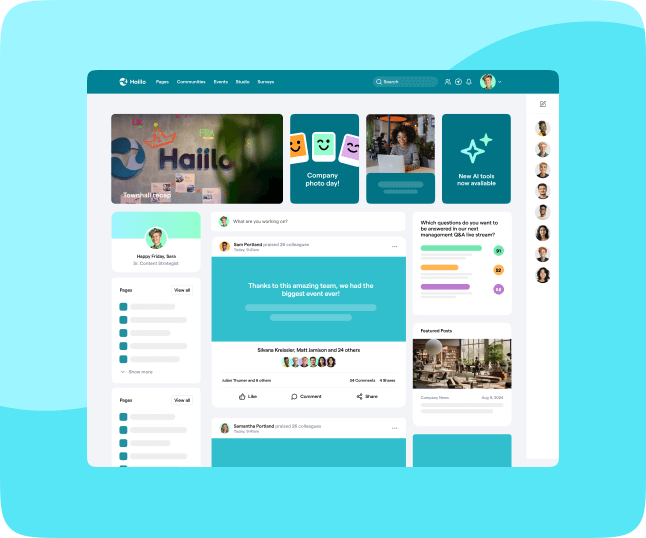
Historically, intranets were considered unintuitive workplace communications solutions. However, modern social intranets are a must-have employee experience platform for every organization that wants to keep employees informed and engaged. When integrated into a multichannel communication platform, the intranet becomes the central hub where updates published in one place can be distributed to other channels such as email digests, mobile notifications, or collaboration tools.

Even though the popularity of emails for internal communications has decreased with the emergence of instant messaging platforms, they are still an important communication channel. Email remains especially effective for formal updates such as leadership announcements, policy changes, or company-wide newsletters that employees may want to revisit later.
The fact that emails are interoperable with other email providers makes it an important channel for inter-company communications. Within a multichannel communication platform, email can also be used to amplify intranet posts or campaign messages, ensuring key updates reach employees who rely on their inbox as their primary source of workplace information.
Instant messaging platforms
Instant messaging platforms such as Slack and Microsoft Teams are the most popular real-time and asynchronous workplace communications solutions. According to research, Instant messaging platforms such as Slack and Microsoft Teams are among the most widely used real-time and asynchronous workplace communications tools. Recent data shows that Microsoft Teams has more than 320 million monthly active users worldwide, while Slack has roughly 47 million daily active users and around 79 million monthly users. These numbers highlight how central chat-based collaboration has become in modern workplaces. These platforms enable quick conversations, team updates, and fast decision-making without the delays of traditional communication methods.
Hence, including these channels in your multichannel communications strategy is critical. When integrated through a multichannel communication platform, important announcements shared in chat tools can be reinforced through other channels such as intranet posts or email summaries.
SMS
Even though not heavily used by office employees, some organizations use SMS to keep their frontline employees informed and engaged. Moreover, 70% of employees think texting should be used for interoffice communications. With open rates of 98% compared to just 20%, texting is a simple way to enhance your internal communication strategy
Mobile-heavy workforce that depends on smartphones to communicate with colleagues and employers, so integrating SMS in your workplace communications is an absolute must. A multichannel communication platform can help organizations trigger SMS alerts for urgent updates such as safety notices, shift changes, or operational disruptions.
Digital signage
Another channel organizations use to distribute important company information is digital signage.
Distributing messages to highly visible places ensures that employees are informed and that they get reminded about important company updates and events. This channel is particularly useful in locations such as factories, warehouses, hospitals, and retail environments where employees may not have constant access to email or messaging apps.
Project management and document-sharing tools
Project management solutions such as Trello and document-sharing platforms such as Google Workspace are also places where employees collaborate and communicate daily. Teams often discuss tasks, share updates, and manage workflows directly inside these tools.
So when thinking of all the different channels to include in your employee communications strategy, consider these as well. A multichannel communication platform can connect these tools with other communication channels, ensuring employees receive relevant updates without leaving the systems they already use to get work done.
Workplace Scenarios When Multichannel Comms Is Critical
There are certain workplace situations when multichannel communication plays a critical role. Let’s dig deeper into them. During periods of uncertainty or rapid change, employees rely on clear and consistent information to understand what is happening and how it affects their work. Using a multichannel communication platform helps organizations deliver timely updates across several touchpoints, ensuring employees receive the same message whether they check email, the intranet, or workplace chat tools.
Mergers and acquisitions
Internal communications departments play a critical role in making mergers and acquisitions more successful. These situations are usually stressful for employees, and during these times, employees expect relevant and timely information to reach them via their preferred channels. Regular updates about leadership decisions, organizational structure, and future plans help reduce uncertainty and prevent misinformation from spreading internally.
Various studies conducted on the outcome of M&As show that 30% of them fail within three years. The majority of them fail due to disparities in organizational culture.
Hence, IC professionals are tasked with aligning employees from the merged companies and ensuring seamless integration. A multichannel communication platform allows communicators to reinforce key messages across several channels—such as intranet updates, leadership videos, and team chat announcements—so employees stay informed and engaged throughout the transition.
Change management
Changes such as digital transformation initiatives require frequent and consistent workplace communications. An integrated multichannel communications strategy can make this process much more streamlined and efficient. Employees often need guidance, training resources, and regular progress updates to understand how new tools or processes will affect their day-to-day work.
When organizational change happens, it usually impacts the work of every employee, regardless of their location and job nature. Using a multichannel communication platform ensures these updates reach both desk-based and frontline employees through the channels they already rely on.
📹 Check out our Masterclass about how to create a successful change communications strategy.
Crisis management, emergency, and workplace safety
The COVID-19 pandemic was a real-life example of when crisis communication was critical for ensuring business continuity. During uncertain situations, employees look for fast, reliable updates that help them understand changing policies, safety procedures, and operational impacts.
To ensure maximum workplace safety, employers had to find a quick way to reach their frontline staff that didn’t have a designated working space. For example, retail associates, healthcare workers, and logistics staff often rely on mobile devices rather than desktop tools.
Mobile communications and timely mobile push notifications became an absolute must for organizations in healthcare, retail, and many other industries during this pandemic. Using a multichannel communication platform allows organizations to send urgent alerts through several channels at once—such as mobile notifications, SMS, or digital signage—ensuring critical updates reach employees immediately.
Intranet and instant messaging platforms were best for reaching in-office employees, while email was essential for reaching partners and other stakeholders. Combining these channels helps organizations maintain transparency and reduce confusion during high-pressure situations.
Employee advocacy
Multichannel workplace communications can be the most powerful method for driving employee advocacy in the workplace. When employees regularly receive engaging company content through channels they already use, they are more likely to read, react, and share it.
When done right, reaching employees with relevant and engaging content can result in greater employee ambassadorship, and it can positively impact the organization’s marketing, sales, and HR initiatives. A multichannel communication platform can simplify this process by making it easy for employees to access and share approved content directly from the tools they use every day.
Moreover, if employees can seamlessly share that content with their personal networks, multichannel internal communications can turn into the most efficient marketing channel for companies. This extends brand reach organically while strengthening employees’ connection to the organization.
Various HR initiatives
Human resources departments often deal with company-wide initiatives in which their performance mostly depends on employees’ engagement and responsiveness. Unfortunately, many HR professionals struggle to reach every employee, via the right channel, at the right time. This is especially challenging in organizations with distributed teams, deskless workers, or multiple office locations.
Some examples may include open enrollments, new hire announcements, referral invitations, team building planning, company-wide surveys, and many more. These initiatives often require reminders and follow-ups across several channels to ensure high participation.
So using various channels is absolutely necessary to reach every employee on their favorite platform. With a multichannel communication platform, HR teams can coordinate announcements, reminders, and updates across email, intranet, and mobile channels while tracking engagement.
How to Create and Streamline a Successful Multichannel Communication Strategy
Now that you understand the importance of multichannel communications strategy let’s take a deep dive into the steps for implementing and managing a successful strategy. Building a sustainable approach requires more than simply adding new channels—it requires coordination, clear governance, and the right technology to ensure messages remain consistent across the organization. A well-implemented multichannel communication platform helps teams plan, distribute, and measure communications from one place while avoiding unnecessary duplication.
Integrate all communication channels
The success of every multichannel communications strategy depends on the ability to integrate all of your organization’s communications channels into a single platform. Only when you can easily distribute information to all the internal channels can you say that you have met the most important prerequisite. Without integration, communicators often spend hours copying updates across tools, increasing the risk of inconsistent messaging.
Choosing the right technology is a critical step here, and most companies rely on easy-to-implement social intranets that come with pre-built integrations with all of their existing internal communications channels. When connected through a multichannel communication platform, updates published in one place can automatically appear in channels such as email digests, collaboration tools, or mobile notifications.
Segment your audience
To ensure maximum engagement with your company’s content, you need to make sure that the content resonates with the audience. Employees are far more likely to engage with information that directly relates to their role, team, or location.
To ensure such hyper-personalization, comms departments need to be able to make lists and segments based on various criteria such as departments, locations, job functions, interests, channels, and other properties. For example, frontline teams may receive operational alerts through mobile channels, while corporate teams receive strategy updates via the intranet or email.
Only then can you ensure that the right content reaches the right audience and achieve the best possible readership. A multichannel communication platform makes this process easier by allowing communicators to target specific employee groups without creating separate messages for each channel.
Go mobile for a better reach
Your intranet provider should ideally have a native mobile app to better serve deskless and frontline workers. Mobile-first communication ensures that employees who are rarely at a desk—such as retail staff, healthcare workers, or field technicians—still receive important company updates.
Moreover, even office workers are sometimes better available on mobile devices than on their desktops. According to Statista, the population of mobile workers in the United States is forecast to increase from 78.5 million in 2020 to 93.5 million by 2024. The source defines mobile workers as workers who are equipped with mobile devices such as smartphones and tablets by their company to work on tasks and workflows assigned to them. This shift makes mobile capabilities a critical feature of any modern multichannel communication platform.

Collaborate with other departments
In many cases, IC departments need to collaborate with other team members and various departments on new releases and company updates. Marketing, HR, leadership, and operations teams often contribute important information that needs to be communicated clearly and consistently across the organization.
To streamline this process, it is important that all the stakeholders can easily collaborate on the copy and the overall content strategy. Without a structured process, messages can become inconsistent or delayed as teams work across different tools and approval chains.
Ideally, your intranet platform should have a central comms calendar where all the stakeholders can plan, review, approve, and give feedback on the content in one place. When connected through a multichannel communication platform, this calendar can also help teams coordinate when and where messages are published across different channels.
Leverage the power of AI
Leveraging AI is one of the best ways to make your multichannel communications strategy more efficient. With AI, internal communications departments don’t have to create content from scratch. AI tools can also help repurpose the same message for different formats, such as turning a long intranet article into a short chat update or email summary.
For example, Haiilo’s AI-powered AVA can create content more aligned with your company’s style. You can change tonality to friendly, formal, or professional. You can also make texts longer, shorter, simplify, or summarize. When all is set and done, you can ask AVA to create matching hashtags for your post. Integrated into a multichannel communication platform, these capabilities help teams adapt content quickly for multiple communication channels.
Measure, measure, measure
One of the biggest challenges with multichannel communications is understanding which channels work best for which audience. Different employee groups often engage with content in different ways, depending on their role, location, and preferred communication tools.
Luckily, the most advanced internal communications platforms offer an easy way to get valuable insights about workplace communications initiatives, including the best channels to reach employees. A modern multichannel communication platform allows communicators to track engagement metrics such as views, clicks, reactions, and shares across multiple channels.
Haiilo platform helps organizations understand their audience and get insights through reach and interaction tracking on posts, articles, and events. These insights make it easier to refine messaging strategies and continuously improve internal communications performance.
FAQ: Multichannel Communication Platforms
What is a multichannel communication platform?
A multichannel communication platform is a tool that helps organizations distribute internal messages across multiple communication channels from one central place. Instead of sending the same update separately through email, chat, intranet posts, or mobile notifications, communicators can manage everything in one system. This ensures messages stay consistent and reach employees wherever they work. For example, a company announcement might appear on the intranet, in an email digest, and as a mobile push notification—all coordinated through the same platform.
Why do companies need a multichannel communication platform?
Modern workforces are distributed across offices, homes, stores, factories, and field locations. Because employees rely on different tools—such as Slack, Microsoft Teams, email, or mobile apps—it’s difficult to reach everyone through a single channel. A multichannel communication platform helps solve this by allowing internal communications teams to deliver messages across several channels at once. This improves message reach, reduces information silos, and helps employees stay informed regardless of where or how they work.
How does a multichannel communication platform improve employee engagement?
Employees are more likely to read and respond to messages that appear in the tools they already use. A multichannel communication platform allows organizations to tailor communications to different audiences and channels. For instance, frontline workers might receive updates through a mobile app or SMS, while office employees see them on the intranet or in collaboration tools. By delivering relevant information through the right channels, companies increase visibility, encourage interaction, and strengthen overall employee engagement.
What features should you look for in a multichannel communication platform?
The most effective platforms combine several capabilities in one place. Key features typically include channel integrations, audience segmentation, analytics, and a centralized content calendar. Many modern platforms also include AI-powered content support and automation to help teams adapt messages for different formats. Together, these features allow internal communications teams to plan campaigns, deliver messages efficiently, and measure which channels perform best.
Curious to learn more? Read about 10 principles of modern employee communications