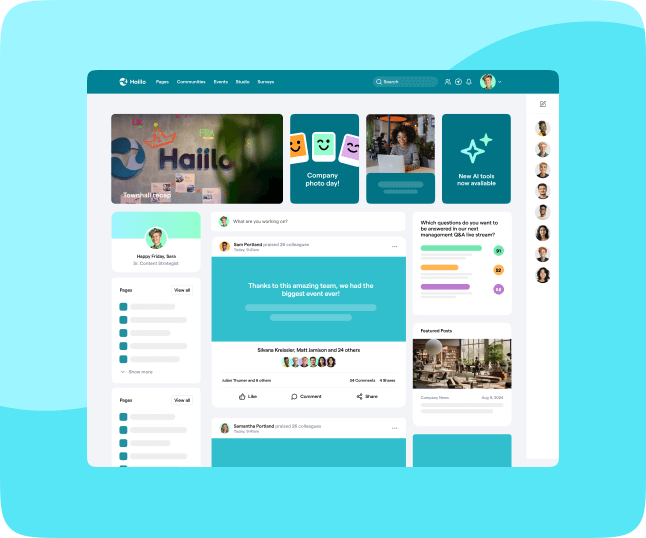

Employee intranet softwares have a long history in the workplace tech world. However, today’s intranets have very different purposes, features, functionalities, looks, and feels than they used to have.
Early intranets primarily acted as static document repositories — places to store policies, forms, and company announcements. Modern employee intranets, on the other hand, are dynamic digital workplaces designed to centralize communication, foster collaboration, and enhance the overall employee experience. They integrate with essential business tools, support mobile access for frontline workers, and provide analytics that help measure engagement and communication effectiveness.
According to Ragan, 72% of communicators adopted or upgraded at least one channel or tool in the past year. Intranets are one of the must-have solutions in every organization’s tech stack as they significantly impact employees’ engagement and experience at work. When implemented strategically, they reduce information silos, increase transparency, and ensure employees can easily access the content they need to perform their roles effectively.
In this blog, we will define employee intranet, explain the benefits of intranet, and conclude with a short buyer’s guide to help you choose the right platform.
💡 Also, learn about what is an employee app and why every company needs one!
Book a Haiilo demo to see how an employee intranet software can improve engagement and retention
What is an intranet?
An intranet is a secure private network or software platform used for sharing information and communication within a company between employees. It serves as a centralized digital workspace where organizations publish updates, store documents, and enable collaboration across teams and departments.
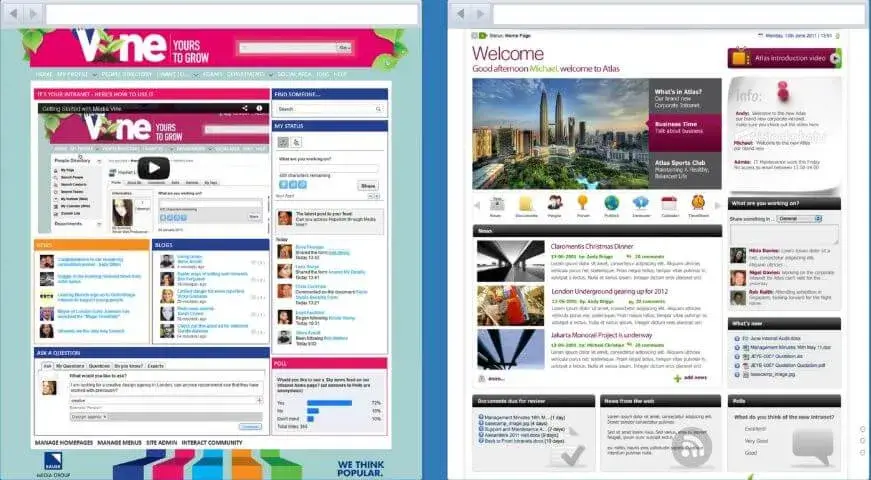
Intranets have been on the market for decades now. Moreover, they are considered one of the oldest workplace technologies out there. Unfortunately, some big intranet providers haven’t been updating their technologies for years, which is why intranets got a reputation of non-intuitive and outdated workplace tech. Many traditional systems were built primarily as static information repositories, lacking social features, personalization, search capabilities, and mobile responsiveness.
Here is an example of an outdated intranet.
What is an Employee Intranet
Employee intranet is a technology that most people list under the HR tech category. This is understandable, as intranet platforms are designed to make people more productive, informed, and engaged at work. However, modern employee intranets go far beyond HR use cases. They serve as centralized digital workplaces where internal communications, knowledge management, collaboration, and employee engagement initiatives come together in one secure environment.
Today’s employee intranet supports onboarding, company-wide announcements, document management, employee recognition, and cross-department collaboration. By reducing information silos and creating a single source of truth, organizations can improve transparency and alignment across teams.
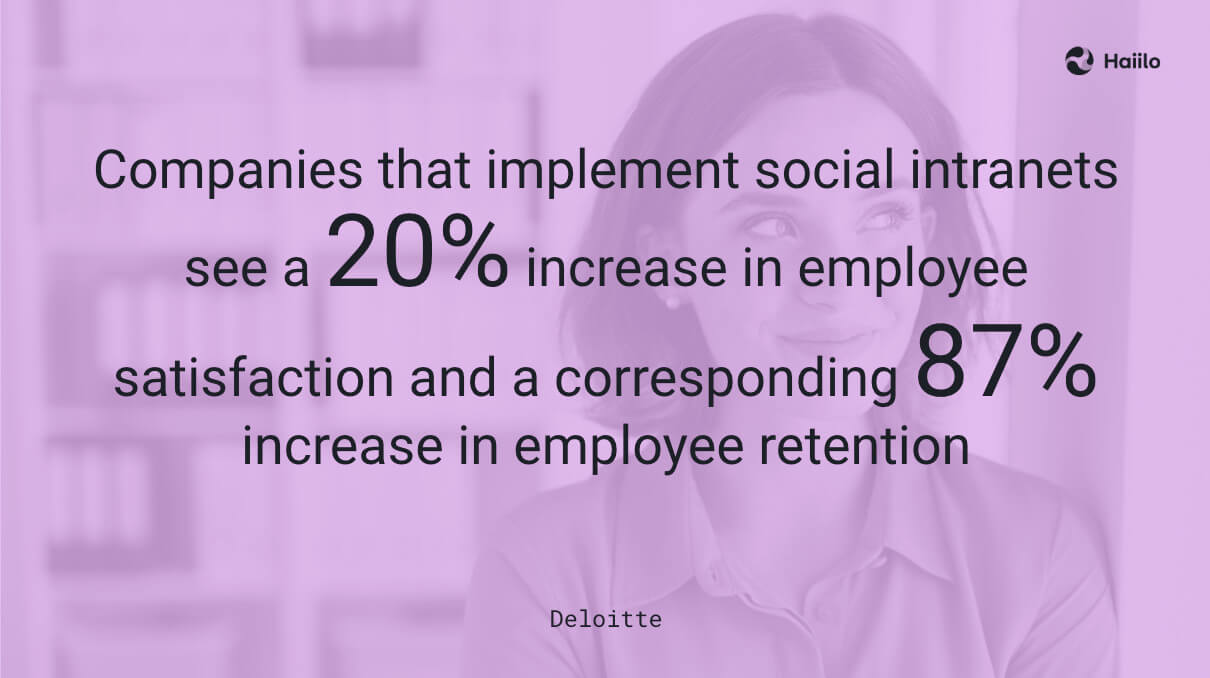
A survey by Deloitte found that there was a 20% increase in employee satisfaction and a corresponding 87% increase in employee retention in organizations that implemented social intranets. These numbers highlight how a well-designed employee intranet can directly impact both engagement and long-term business performance.
What is employee intranet software?
Employee intranet software is the same as an employee intranet – a digital platform that enables organizations to facilitate communication, collaboration, and information sharing among employees within a secure internal network. It acts as a centralized hub where employees can access company news, policies, resources, and tools needed to perform their jobs effectively.
Most modern intranets serve multiple purposes; they are used for internal communications, document management, team collaboration, and knowledge sharing. They often include personalized news feeds, advanced search capabilities, employee directories, and integration with workplace tools such as Microsoft 365 or Google Workspace.
The latest solutions, however, offer additional features and functionalities as add-ons, including employee recognition modules, analytics dashboards, workflow automation, and mobile-first experiences designed to support deskless and hybrid workers. This flexibility allows organizations to tailor their employee intranet software to specific business goals and workforce needs.
💡Related: What is an Employee Engagement App and Why Your Company Needs One
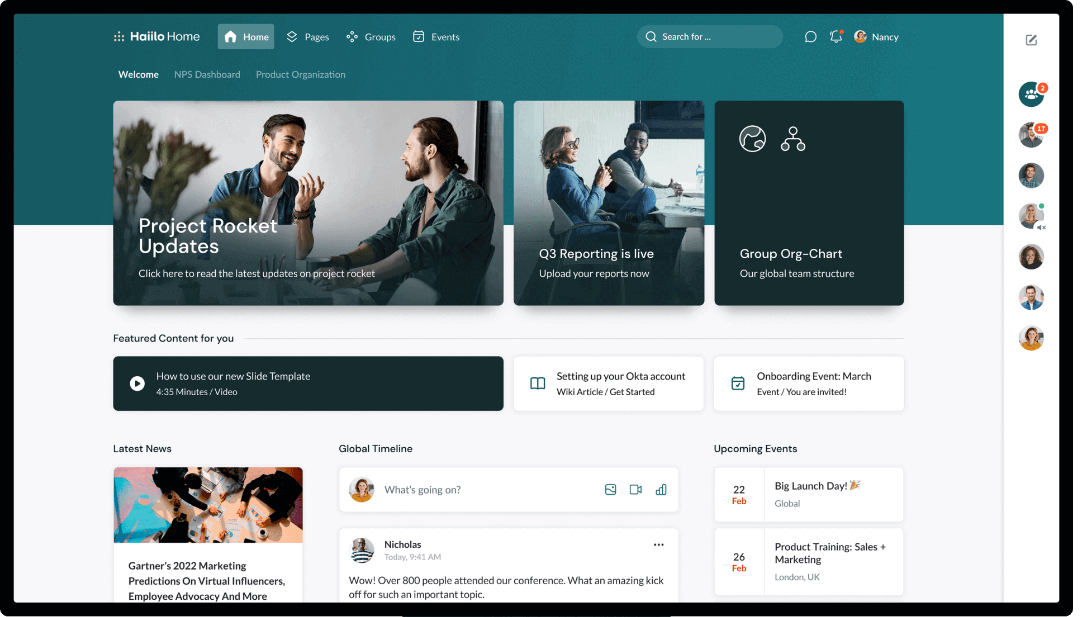
This was true until the emergence of social intranets. Unlike traditional employee intranets, social intranets mimic the social media platforms we use in our private lives. They are designed to engage the end user, connect peers in the workplace, and make work more enjoyable. Features such as activity feeds, comments, likes, user profiles, and communities transform one-way communication into interactive conversations that encourage participation and knowledge sharing.
On the admin side, they enable employers to inform the entire workforce at all times, regardless of their locations and job functions (think desk vs. deskless workers). With personalization and targeted content distribution, social intranets ensure that the right information reaches the right employees at the right time, improving transparency and alignment across the organization.
Here is an example of a modern social intranet.
10 Reasons to Implement an Employee Intranet
54% of HR leaders indicated that poor technology and/or infrastructure for remote working is the biggest barrier to effective remote working in their organization. As hybrid and distributed work models become the norm, organizations need centralized digital environments that support seamless communication and collaboration across locations.
An employee intranet provides that foundation by creating a single source of truth where updates, documents, and conversations are easily accessible. Instead of relying on fragmented tools and long email threads, employees can access everything they need in one secure place.
Intranets can eliminate some of the most significant communication barriers in the workplace! Here are the top reasons why companies implement intranets:
1. Creates positive workplace culture
Consistent, open, and frequent employee communications is critical for building trust and embedding and nurturing your company’s core values. An employee intranet makes this consistency possible by providing structured communication channels and leadership visibility.
According to research, 50% of employees say that a lack of transparency holds their company back. A social employee intranet can go a long way in ensuring transparency in the workplace and building a positive company culture by encouraging open dialogue, peer recognition, and knowledge sharing across departments.
2. Boosts employee engagement and experience at work
Workplace communication is one of the main building blocks of a positive employee experience. When employers frequently communicate with their employees, they also enjoy higher levels of trust. Clear expectations, leadership visibility, and easy access to relevant updates all contribute to stronger engagement and improved morale.
According to the Edelman “Trust Barometer”, trusted employers see much higher employee engagement than those workplaces where there is no trust.
3. Improves asynchronous communications
With the emergence of remote and hybrid work, asynchronous communications have become a must. While some internal communications tools, such as instant messaging platforms, are great for synchronous communication, employee intranets are better solutions for asynchronous communications. They create a structured environment where information can be accessed anytime without disrupting workflows.
They help companies organize critical company information and make it easily accessible to every employee.
💡 Learn about how to improve virtual communication in your company!
4. Eliminates information overload
Advanced employee intranets are built to make information more relevant to employees. Robust segmentation features enable employers to create groups and communities with common interests, locations, job functions, and other criteria.
And such segmentation helps them deliver hyper-personalized content, drastically improving readership and engagement with the company’s content. On the other hand, it eliminates information overload, one of the biggest productivity killers in the workplace.
Based on research, 36% of managers say they suffer from poor health due to the excessive amount of information they have to process at work.
5. Drives knowledge sharing
One of the biggest benefits of employee intranet is knowledge sharing. Moreover, by using social technologies, companies can raise the productivity of knowledge workers by 20% to 25%.
Here are some of the features and functionalities you should look for if you want to improve knowledge sharing in your organization:
- Global search for fast results
- Wikis that are more than texts
- Departmental knowledge hubs
- Documents & content management
6. Encourages share of voice
Historically, information within intranets would always flow one way. Today, two-way workplace communication is a must. Employees expect to be heard, and they expect to be able to provide feedback at any time.
Social intranets should drive the share of voice in the company. The best solutions out there should have the capability of creating groups and communities where people of similar interests come together and freely express themselves.
💡 Learn about intranet best practices to get the biggest possible intranet ROI.
7. Improves employee onboarding
Organizations with structured onboarding see up to 82% higher retention and over 70% greater productivity in new hires.
Social intranets are a great way for HR professionals to structure their onboarding process and make it more intuitive for employees.
You can upload relevant content, serve onboarding videos, post onboarding feedback surveys, connect newcomers with other peers, and much more.
8. Ensures workplace safety
Employee intranet is a must if your workplace mostly consists of frontline workers. It helps companies communicate the importance of workplace safety and encourages responsible behaviors. It also enables faster crisis communication and real-time updates during emergencies.
Also, it can actually warn employees about potential hazards in a timely manner.
If your employees risk getting injured or ill at work, then a mobile-friendly intranet with push notifications is a must! Furthermore, employees should, at all times, be able to warn each other about potential hazards regardless of their locations.

Similarly, if you are looking to improve crisis communications in your company, having an appropriate workplace communications technology is a prerequisite for success.
9. Enhances organizational change
Employee intranets are essential in situations of organizational change management, such as mergers and acquisitions or digital transformation initiatives.
Implementing change within organizations requires a lot of communication as it often fails due to a lack of employee buy-in.
With proper communication tools, companies can more successfully communicate the importance of change and embed new behaviors among their people.
10. Encourages employee advocacy
Companies that communicate transparently are more likely to have brand ambassadors. Social employee intranets support ambassadorship by making company content accessible to every employee.
Some solutions even have built-in functionalities for employee advocacy where employees can share the company’s content on their social media profiles in a matter of seconds.
How to Choose the Best Employee Intranet Software for Your Organization
In the sea of various communication tools available on the market, it can get hard to scan through all of them, evaluate them, and choose the right solution for your company. With so many vendors promising similar features, it’s important to focus on your specific business goals, workforce structure, and long-term communication strategy before making a decision.
Before implementing or building an intranet, it’s always worthwhile to map out the communication needs your future intranet should meet as well as your target audiences. Consider whether your primary goal is improving engagement, strengthening knowledge sharing, enhancing leadership visibility, or streamlining document management. There are many employee intranets on the market that serve different purposes and are a good match for companies of different sizes. Blue-collar heavy companies with the primary goal of updating employees might benefit from top-down communication, while companies that are looking for ways to engage and retain mixed-collar workers would need features for leaving feedback, comments and building communities in addition to top-down comms. In turn, companies that look for document repositories might benefit from document management systems, such as Sharepoint.
If you are looking for a modern employee intranet that has capabilities of top-down and non-vertical communication as well as knowledge management, then make sure you evaluate all of the following:
1. Two-way communication
Many intranets today still serve as top-down communication only. Meaning companies use them to push out announcements without allowing employees to join the conversation and have social interactions.
These days are over! If your goal is to improve employee engagement with the company content, you need to involve them first. Two-way communication fosters transparency, builds trust, and makes employees feel valued.
So look for a solution that provides a way to create chats, groups, and communities where people can interact with each other and make reactions to your company’s communication campaigns.
2. Intuitive interface
The biggest reason for low intranet usage is the unintuitive interface. When evaluating different solutions, make sure that the interface is intuitive even for your multigenerational workforce. A clean design, strong search functionality, and mobile responsiveness can significantly improve adoption rates.
Consider asking for a testing phase where your employees of different ages can try using the intranet.
3. Easy roll-out
Older intranets built on-premises can be very expensive and slow to roll out. On the other hand, more modern, cloud-based solutions are much easier to implement and set up. They typically require less IT involvement and offer faster time-to-value.
When choosing an employee intranet for your company, consider asking for a reference similar to your company. This is a great way to find out how the roll-out looked and what to expect for your organization.
4. Integrations
Integrating workplace technology is, indeed, one of the primary goals for technical and non-technical professionals within organizations. Seamless integrations reduce friction, prevent duplicate work, and ensure employees don’t need to switch between multiple systems.
Make sure that your employee intranet integrates with Microsoft 365, Google Workspace, and other communication, document sharing, collaboration, and project management tools!
5. White labeling
The look and feel of your intranet’s interface should follow your company’s brand guidelines. This can significantly improve user engagement and develop a sense of belongingness. A branded employee intranet feels like a natural extension of your organization rather than a third-party tool, which increases trust and adoption.
So don’t forget to ask for white labeling options when choosing a social intranet. Custom logos, color schemes, domain names, and personalized layouts can make a meaningful difference in how employees perceive and use the platform.
6. Mobile app
Digital workplaces are mobile-heavy. Workplaces with blue-collar workers are mobile-dependent. Being able to use intranet on your phone seamlessly is a big advantage. This is the only way to really make information accessible to everyone at all times. A mobile app with push notifications ensures urgent updates, safety announcements, and company news reach employees instantly, regardless of location.
7. Security and compliance
Security and compliance are growing challenges for many internal communications professionals. So make sure that your employee intranet is at least ISO27001-certified and GDPR-compliant. Enterprise-grade security measures such as encryption, secure hosting, and regular audits are essential for protecting sensitive company data.
You, as the buyer, should be the data controller within the meaning of the GDPR and decide on the purpose and means of this data. Clear data governance policies reduce risk and build employee trust.
8. User management and role-based permissions
Intranet is a workplace technology usually used by the entire workplace. However, the content within the platform can be created, managed, and approved by different roles and departments.
This is particularly true for large organizations where multiple teams contribute content.
When evaluating different social intranet solutions, make sure that they offer granular user-management functions and robust role-based permission features to fit your organizational structure. This ensures the right people have the right level of access while maintaining content quality and security.
9. Other built-in features
When you compare different employee intranet options, you will notice that they can have different features and functionalities. Some may have optional or built-in employee surveys and employee advocacy features. Some may have more advanced analytics than others.
In any case, think of what your company may need in the future as well. Scalable employee intranet software should evolve with your organization, supporting long-term growth, new communication channels, and changing workforce expectations.
Employee intranet examples
Modern employee intranet software fosters collaboration and streamlines communication in today’s fast-paced work environment. These intranet platforms leverage social and analytics features to enhance employee engagement and provide easy access to information and resources. Below are some modern employee intranet examples that focus on the shift towards more dynamic and user-friendly intranet experiences.
1. Haiilo
Haiilo is an employee experience platform designed for internal communication, engagement, and collaboration, catering to large and medium-sized companies across diverse industries. As a modern social intranet, Haiilo helps organizations centralize communication, strengthen culture, and improve alignment across distributed teams.
Therefore, if you’re seeking an all-in-one solution, Haiilo provides an intranet that delivers targeted communications tailored to user needs, along with actionable analytics through its employee engagement and insights capabilities. The platform also integrates seamlessly with workplace tools, making it a scalable option for organizations looking to unify their digital workplace.
2. Workvivo
Workvivo is built to improve internal communications, collaboration, and engagement by integrating social networking features with intranet capabilities.
This platform enables organizations to unite their workforce, celebrate achievements, and disseminate important company updates through a user-friendly, branded interface.
3. Simpplr
Simpplr is an AI-driven intranet platform to enhance employee communication, engagement, and productivity by centralizing company resources, announcements, and collaboration tools.
Moreover, Simpplr offers an intuitive and customizable experience that seamlessly integrates with existing systems, enabling businesses to keep their employees informed and connected wherever they are located.
4. Staffbase
Staffbase is an intranet platform with a focus on boosting employee engagement by offering a centralized hub for news, updates, and corporate resources. It targets large enterprises aiming to streamline internal communication and cultivate a cohesive, unified company culture.
5. Firstup
Firstup is an employee communication platform providing personalized communication and information sharing, with the option to include an intranet.
It aims to enhance employee productivity and retention by utilizing behaviour-based insights and highly personalized communication. It is mainly aimed at larger enterprises and comes with a higher price tag.
Employee Intranet FAQs
1. What is an employee intranet software?
An employee intranet is a secure internal platform that acts as a central hub for communication, collaboration, and information sharing within an organization. It replaces fragmented channels like emails and disparate tools with a unified digital workspace where employees can access news, documents, updates, and tools relevant to their roles. Modern intranets go beyond document repositories to support real engagement and connection.
2. Why should companies implement an employee intranet software?
Employee intranet software solves core communication and engagement challenges. It helps reduce information silos, improves transparency, and strengthens workplace culture. Research shows that companies investing in communication tools — including intranets — see better employee satisfaction and retention rates, because people feel more informed and connected.
3. What are the business benefits of an employee intranet?
A modern employee intranet streamlines internal communication, supports asynchronous work, enhances engagement, and makes knowledge easy to find. It also helps eliminate information overload by delivering targeted content and supports organizational change by ensuring consistent messaging across teams and locations.
4. How does an employee intranet support hybrid and remote teams?
In today’s digital workplace, hybrid and remote employees rely on intranets to stay informed and aligned. Because intranets centralize updates, resources, and collaboration tools in one place, they ensure that every team member — regardless of where they work — has access to the same information at the same time.
5. What features should I look for in employee intranet software?
Key features include intuitive navigation, powerful search, integration with tools like Microsoft 365 and Google Workspace, social interaction features (comments and reactions), and mobile access. These capabilities help boost adoption and make the platform genuinely useful in employees’ daily work.
6. Is employee intranet software still relevant?
Yes — intranets remain essential in modern workplaces. While the form has evolved from simple internal networks to dynamic, social platforms, they continue to serve as the backbone of internal communication and employee engagement strategies.
The retention playbook for tomorrow’s workforce