
If you’ve ever pitched employee advocacy to your CEO and got that polite-but-skeptical nod, you’re not alone.
For most executives, “employee advocacy” sounds like another marketing experiment: a feel-good initiative that will clutter their feeds, not move the business forward.
But the truth is, employee advocacy is far from a soft, social play. When done right, it’s one of the most efficient, scalable growth levers a company can pull. And it’s something CEOs will want to back once they see the numbers.
Here’s how to make that case in a language your CEO actually speaks.
1. Lead with business impact, not engagement metrics
CEOs don’t really care how many likes your post got. They care about growth, trust, and influence.
Telling them “employee advocacy helps our posts perform better” is like telling a CFO your new software is “really intuitive.” It means nothing unless it drives measurable impact.
Here’s what does cut through:
- Employee-shared content converts 7× higher than brand content
- 92% of buyers trust messages from people they know over brand messaging
- And 77% of buyers say personal recommendations influence a purchase
Framing advocacy as an efficiency play – a way to scale reach, credibility, and conversion without scaling spend – instantly changes the conversation. You’re not asking for more marketing budget. You’re showing that there’s a smarter way to use what’s already there.
2. Frame advocacy as a growth engine, not a campaign
CEOs fund engines, not experiments. They don’t want another “initiative” that spikes for a quarter and fades. They want systems that compound value over time.
Employee advocacy isn’t a campaign; it’s a channel strategy. One that builds momentum with every post shared, every employee voice activated, and every audience touchpoint gained.
Show how it compounds:
- More credible reach = more inbound opportunities
- More employee voices = stronger brand familiarity
- More familiarity = faster deals and better recruitment
In other words: advocacy is how you scale trust without scaling spend.
💡 Read: How marketing can retain credibility in a skeptical world
When executives see that employee voices generate warm demand and improve efficiency across multiple metrics, it stops being “marketing’s idea”, and becomes part of the company’s growth model.
3. Show how it benefits the whole business, not just Marketing
Your CEO sees the business as one interconnected system where Marketing, Sales, HR, and Comms all impact each other.
That’s the beauty of employee advocacy: it naturally connects those dots.
Here’s how to map it:
- Marketing gets lowers customer acquisition cost (CAC) and increases pipeline influence
- Sales gets warmer outreach, higher response rates, and shorter sales cycles
- HR gets stronger employer brand, more referrals, and faster hires
- Comms gets consistent messaging and visibility across regions and channels
Because what’s good for brand visibility is often just as good for recruitment, reputation, and revenue.
4. Prove it delivers stronger results for less spend
Here’s something every CEO notices: marketing costs keep climbing, but returns keep flattening. Paid social is more expensive than ever, and organic reach is shrinking fast.
Advocacy flips that equation.
When your employees become your distribution network, your content earns reach that paid can’t buy and trust that money can’t fake.
Reducing paid reliance by even 20–30% can free up tens of thousands in monthly spend. That, coupled with higher conversion rates and greater trust from employee-shared posts, makes for compelling reading.
When you can show stronger performance at lower cost, you’re pitching a smarter allocation of resources.
5. Connect it to strategy, not sentiment
Executives fund things that move the business forward.
So drop the “it’ll make people more engaged online” narrative and tie advocacy to strategic outcomes your CEO already cares about:
- Visibility: Getting the company in front of the right audiences faster
- Talent: Turning employees into magnets for top candidates
- Efficiency: Reducing paid dependency and content production waste
This is about long-term competitive advantage.
💡Read: How Eilakaisla turned employee voices into a competitive advantage
Every credible share, every authentic story, every employee post compounds into brand equity. And brand equity, as any CEO knows, pays back for years.
6. Back your pitch with proof, not promises
No CEO wants another slide deck full of promises. They want proof.
Start small. Run a pilot with one region, team, or function. Then measure:
- Participation rate: How many employees joined in?
- Earned reach: How far did the content travel?
- Traffic and leads: What real business outcomes did it drive?
When you walk into the next leadership meeting with those numbers, you change the tone of the conversation.
The bottom line
Done right, employee advocacy builds brand trust, slashes marketing costs, accelerates deals, strengthens culture, and attracts top talent all at once.
And when you can prove that kind of impact, your CEO will be the one promoting it at the next all-hands.
How can Haiilo Advocacy help?
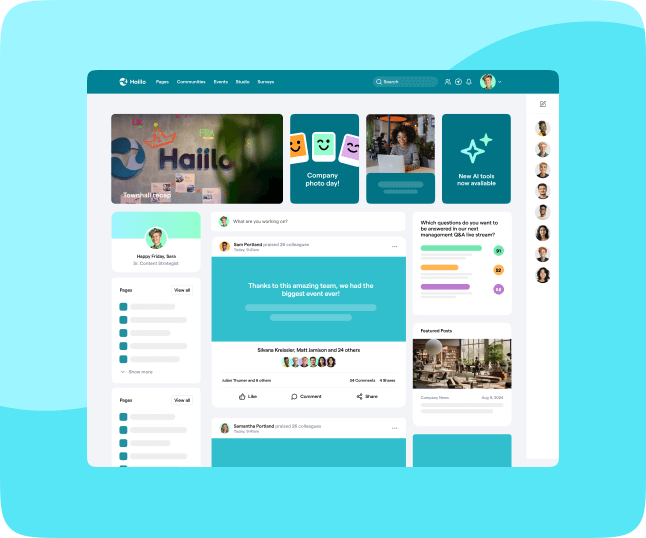
Haiilo Advocacy turns employees into your most trusted growth channel.
With one-tap sharing, AI-assisted content, and built-in approvals, it makes advocacy easy to run, safe to scale, and simple to prove.
Reach grows. Paid spend drops. And your CEO “gets it”.
Want help convincing your CEO?
Our latest report includes:
- How to frame advocacy as a growth driver
- How to prove it delivers real impact
- How to position advocacy as a multiplier