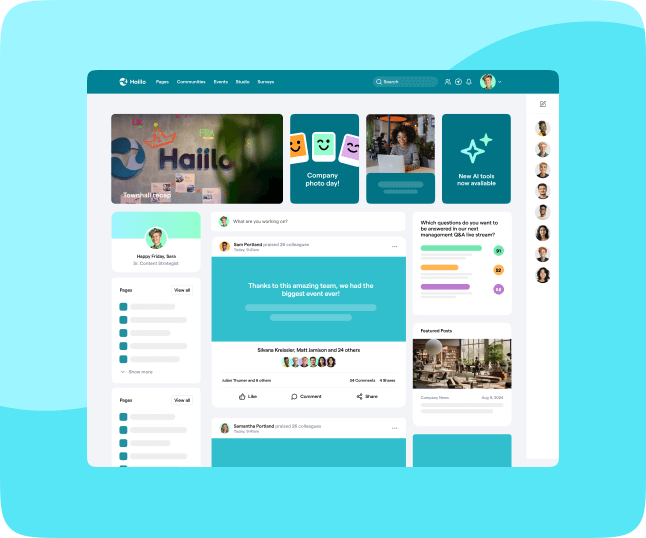

Building an intranet is a challenging task. Yet, intranet platforms should be a core part of every organization’s tech stack—especially as distributed and hybrid work become the norm. Many companies exploring how to build a company intranet quickly realise that success depends on more than just technology. It requires clear goals, strong governance, and alignment with your broader digital workplace strategy. When building an intranet in your organization, many factors must be considered, from user adoption to long-term scalability.
Recent research shows that only 23% of employees strongly agree they feel connected to their company’s culture, highlighting a major communication gap that modern intranets are designed to solve (Gallup, 2024). This is where a modern enterprise communication platform becomes critical—bringing together communication, engagement, and knowledge sharing in one place.
If you are in the process of implementing an intranet in your company, this blog is for you!
Here, you will find useful information about whether you should build an intranet in-house or buy a ready-made solution built by experts in this field. We will also discuss some of the important things to consider when deciding whether to take the buy or build route. To go deeper into planning your approach, you may also find this guide on intranet best practices helpful, along with insights on creating a scalable enterprise communication platform that supports your employees long-term.
Building an Intranet: What Does It Really Mean?
Building an intranet can mean two things: building a solution from scratch or implementing an out-of-the-box solution built by a third-party company. For organisations researching how to build a company intranet, this distinction is critical—because each approach comes with very different risks, timelines, and long-term implications for your digital workplace.
These two are quite different, and they require different amounts of expertise, resources, time, and other investments. Building from scratch often involves ongoing development cycles, maintenance overhead, and the challenge of keeping up with evolving employee expectations. In contrast, modern intranet platforms—especially those designed as an enterprise communication platform—offer faster deployment, built-in integrations, and continuous updates without heavy internal workloads.
Historically, many enterprise organizations have chosen to build their homegrown intranet solutions. The main reason for that was the belief that out-of-the-box intranets cannot meet specific enterprise needs. However, this often led to fragmented user experiences and low adoption—two of the most common reasons intranet projects fail.
Today, however, this is not the case anymore. The intranet and communication software market has grown exponentially in the past decade, driven by the rise of hybrid work and the demand for better employee experiences. In fact, according to Deloitte’s 2024 Global Human Capital Trends report, organisations that prioritise employee experience are 2.2 times more likely to outperform their peers (Deloitte, 2024). This shift has pushed vendors to deliver highly flexible, scalable solutions that rival—and often exceed—custom-built systems.
As a result, companies exploring how to build a company intranet now have access to sophisticated platforms that combine communication, collaboration, and knowledge sharing in one place. To understand what features matter most in these solutions, explore this guide on essential intranet features or learn how modern tools improve engagement in this article on employee communication strategy. These resources can help you evaluate whether building or buying is the smarter long-term investment for your organisation.

So is it worth building an intranet in-house, or should you take the simpler route? Keep reading to discover why buying an intranet is better than building it.
💡 Also, learn about what is an employee experience platform and how to choose one.
Experience seamless intranet implementation with Haiilo!
Buy vs. Build an Intranet: 10 Things to Consider
If you are in a dilemma about building an intranet versus buying an existing solution, you’re not alone. Many organisations exploring how to build a company intranet face this exact decision—and the stakes are high. Choosing the wrong approach can lead to wasted budget, low adoption, and a platform that fails to support your employees’ daily needs. That’s why more organisations are shifting towards modern, ready-made solutions designed to evolve alongside their business.
Here are the most important reasons.
1. Expertise and technical resources
The people who work for companies that sell intranet platforms have knowledge and expertise specialised in this field. They speak with their users daily and understand the features and functionalities that drive strong user experience, high adoption, and measurable business impact. This continuous feedback loop is something most internal teams simply can’t replicate at scale.
Technical teams are well equipped with the knowledge and the latest technology to build intranet solutions that best fit organisations’ internal communications needs. Many of these solutions now function as a full enterprise communication platform, combining content, communication, and engagement tools in one seamless experience.
Realistically, it would take years for your own company to gain such knowledge and expertise and learn the best practices for building an intranet from scratch. In the meantime, your employees are left navigating inefficient systems that slow down productivity and collaboration.
Employees today navigate increasingly complex digital environments. Gartner reports that workers use an average of 11 applications daily, leading to fragmented workflows and inefficiencies when systems are not connected (Gartner, 2023). A well-designed intranet directly addresses this challenge by centralising knowledge and improving accessibility.
💡 Related: How to build engaging intranet content!
2. Cost and high risk of failure
The cost of building a homegrown intranet is extremely high, and the biggest two expenses are people and technology. If you decide to build an intranet in-house, you must count on extensive involvement from your IT department. Moreover, you will probably have to hire an additional team of developers, UX designers, and product specialists to make this happen—often for a project that continues to evolve long after launch.
These are the primary reasons why most companies today decide to buy a software solution instead of building it. Moreover, This trend has only accelerated, with Gartner reporting that worldwide SaaS spending is projected to reach $232 billion in 2024 (Gartner, 2024), as organisations prioritise scalable, lower-risk solutions.
When evaluating how to build a company intranet, it’s important to factor in not just upfront costs, but also long-term maintenance, upgrades, and user adoption efforts. Many organisations find that investing in a proven solution—such as a modern enterprise communication platform—significantly reduces risk while accelerating time to value.
For more insights into planning and avoiding common pitfalls, explore this guide on digital workplace strategy and learn how leading companies approach intranet success in employee experience strategy. You can also dive deeper into improving adoption with this recent article on change management communication.

At first, it may seem that buying an OOTB solution is a more cost-friendly option, but that assumption doesn’t always hold up under scrutiny. When evaluating how to build a company intranet, many organisations underestimate the hidden costs of failed internal projects—ranging from low adoption to expensive rework. In fact, poorly implemented digital workplace tools often end up unused, creating sunk costs rather than value. According to a 2023 report by WalkMe, 70% of digital transformation initiatives fail to meet their objectives (WalkMe, 2023), often due to lack of user adoption and unclear strategy.
This is why choosing a proven enterprise communication platform can significantly reduce risk—giving you access to validated features, ongoing support, and a clear path to ROI.
💡 Related: 11 Best Intranet Software Platforms in 2024
3. Time to realize value and speed of implementation
Intranet software companies take years to build and refine their platforms. Moreover, SaaS adoption continues to accelerate. According to Gartner, worldwide SaaS spending is projected to reach $232 billion in 2024, as organisations prioritise scalable, cloud-based solutions over in-house development (Gartner, 2024). they operate with continuous product roadmaps focused on improving existing and building new features and functionalities based on real customer needs and evolving workplace trends.
Often with software development, the need is immediate, so minimizing time to market is crucial. Purchasing solutions can reduce time to market by up to 80%, according to recent industry benchmarks (Gartner, 2023), while also minimizing the risk of unforeseen delays that are common in internal development projects.
If your organization has identified a need for an intranet platform to improve workplace communication or team collaboration, you probably can’t afford to spend months or years to get the most out of your intranet. Instead, modern platforms—like a scalable enterprise communication platform—enable faster rollout and quicker wins.
It is important to understand that some OOTB solutions also take months to be implemented, especially in complex enterprise environments. That’s why implementation support, onboarding, and change management are just as important as the technology itself. For more guidance, explore this recent article on change management communication and how to drive adoption from day one.
So when choosing an intranet to buy, make sure that you pick a provider that can ensure a fast and seamless implementation process with clear timelines and measurable milestones.
4. Built-in integrations
Intranets without proper integrations with your existing workplace tech stack are likely to become a productivity killer instead of a productivity booster for your employees. Because intranets should serve as a digital home for your workplace, they must connect seamlessly with the tools employees already rely on.
Research from Gartner shows that employees use an average of 11 applications daily to complete their work (Gartner, 2023). Without proper integration, this leads to constant context switching and reduced efficiency. A modern intranet solves this by centralising access to systems like HR tools, project management platforms, and communication channels.
The good news is that intranets available on the market mostly have built-in integrations or open APIs that make integrations easy and fast. If you, however, decide to build an intranet in-house, it will take significant time and resources to build and maintain all the necessary integrations with various communication channels, project management tools, document-sharing solutions, and others.
To better understand how integrations impact employee experience, read this guide on employee experience strategy and how connected systems improve engagement.
5. Security
Intranet software vendors usually have designated teams and experts who focus on making their solutions secure for organizations, and enterprise-grade security is one of the main prerequisites for most intranet buyers. These platforms are continuously tested, updated, and audited to meet evolving compliance requirements.
So if you decide to build an intranet on your own, you need to take security into serious consideration. For example, making a GDPR-compliant intranet takes significant time, expertise, and ongoing monitoring. According to IBM’s 2024 Cost of a Data Breach report, the global average cost of a data breach has reached $4.45 million (IBM, 2024), making security a critical factor in your decision.
Additionally, compliance and security requirements can account for a substantial portion of development costs. This reinforces why many organisations evaluating how to build a company intranet opt for trusted vendors with built-in security frameworks rather than taking on that burden internally.
If you want to explore how secure communication tools fit into a broader strategy, check out this recent post on internal communications trends and how security is evolving alongside digital workplaces.

Existing vendors are required to provide a certain level of security to remain competitive in the market. So when choosing a vendor, make sure that they can guarantee GDPR compliance and, ideally, hold certifications such as ISO 27001. These standards are not just checkboxes—they demonstrate a mature approach to data protection, risk management, and operational resilience.
This becomes even more important when considering how to build a company intranet that employees can trust. According to Cisco’s 2024 Data Privacy Benchmark Study, 94% of organisations say customers and employees would not buy from them if data is not properly protected (Cisco, 2024). Having that peace of mind that all of your employees’ data is secure is priceless—especially when your intranet acts as a central enterprise communication platform connecting people, content, and systems.
6. Maintenance
High maintenance cost is one of the biggest reasons why companies decide to buy versus build an intranet. With a homegrown solution, maintenance doesn’t stop after launch—it requires continuous updates, bug fixes, performance optimisation, and feature development just to keep up with user expectations.
Since a vendor-supplied intranet is supported by experts with extensive knowledge and experience in the field, their ultimate goal is usually to provide their users with access to the latest features and functionalities without adding pressure to internal IT teams. This allows organisations to focus on strategic initiatives rather than ongoing technical upkeep.
So buying an intranet is best for organizations that want to simplify the implementation and maintenance software process and ensure a smooth and reliable digital workplace experience. To see how this fits into a broader strategy, explore this guide on digital workplace strategy and how to future-proof your tools.
7. Scalability
When building an intranet, you need to take into consideration that your company will eventually grow—whether that means more employees, more locations, or more complex communication needs. So how do you build a solution that can scale as your company grows without requiring constant redevelopment?
This is where modern platforms have a clear advantage. Many ready-made intranet solutions are built on cloud-based infrastructure designed for flexibility and growth. According to Flexera’s 2024 State of the Cloud Report, 87% of organisations now use multi-cloud strategies (Flexera, 2024), highlighting the shift toward scalable, adaptable systems.
For organisations evaluating how to build a company intranet, this means choosing a solution that can evolve with your needs—without costly rebuilds. A scalable enterprise communication platform ensures your intranet grows alongside your business while maintaining performance and usability.
8. Support and professional services
Even if you decide to build an intranet on your own, it’s important to understand that your job doesn’t end with implementation. Customer support is a critical component of long-term success and should never be overlooked—especially when adoption challenges arise.
Most companies that sell intranet platforms offer extensive customer support and customer success services along with the purchase. This means your employees are only a phone call or email away from solving issues quickly, reducing downtime and frustration. When you build your own intranet, this luxury goes out the window, leaving your internal teams responsible for troubleshooting and user support.
Furthermore, some vendors offer professional services, which can be extremely valuable for large organizations with complex structures or for those needing help with rollout and engagement. Strong onboarding and change support can significantly impact success—according to Prosci, projects with excellent change management are 7 times more likely to meet objectives (Prosci, 2023).
To improve adoption and long-term success, you may also find this recent article on employee communication strategy helpful, along with insights on engagement in internal communications trends and practical tips in intranet content strategy.
9. Mobile apps
Today’s workplaces are highly digital, distributed, and increasingly mobile-first. So if you decide to build an intranet, you also need to make sure that you build a mobile app as well—not as an afterthought, but as a core part of the user experience. Otherwise, your intranet adoption will likely suffer, especially among frontline and remote employees who rely on mobile access.
This is a critical consideration when evaluating how to build a company intranet that actually drives engagement. According to Deskless Report 2024, 80% of the global workforce is deskless, yet only 1% of enterprise software is designed for them (Deskless Report, 2024). Without mobile accessibility, a large portion of your workforce may be excluded from important communications.
The good news is that most existing intranet vendors offer mobile apps as an out-of-the-box feature, ensuring consistent access across devices. Many modern solutions—such as a enterprise communication platform—are designed mobile-first, enabling employees to stay connected, informed, and engaged wherever they work.
💡 Related: How to Choose the Best Intranet Software for a Large Company
10. Artificial intelligence
Whether you are buying or building an intranet, you should think about the latest market trends and technology advancements—especially when it comes to AI. Organisations exploring how to build a company intranet are increasingly prioritising intelligent features that go beyond basic communication.
The most advanced intranet platforms in the market leverage artificial intelligence to make internal communicators more productive and enable them to create more engaging internal content. With the use of specific and well-optimized AI prompts, IC teams can streamline workflows and significantly reduce content creation time.
AI-powered intranet platforms can also analyse large volumes of employee data, helping identify communication gaps, predict low engagement, and proactively address retention risks. According to Microsoft’s Work Trend Index 2024, 75% of knowledge workers already use AI at work, highlighting how quickly expectations are evolving (Microsoft, 2024).
Furthermore, advanced solutions use generative AI to optimise and streamline information search across the organisation—reducing time spent looking for information and improving overall productivity. This is another reason why many organisations choose a ready-made enterprise communication platform rather than building these capabilities from scratch.
11. Additional features and functionalities
Sometimes, intranet platforms available on the market offer additional built-in features that go far beyond basic communication and improve employee experience in the workplace. These features can play a major role in adoption and long-term success—especially when aligned with your broader digital workplace strategy.
For example, Haillo social intranet comes with built-in surveys to measure employee engagement and monitor experience in the workplace, giving organisations real-time insights into how employees feel and where improvements are needed.
Additionally, it offers a powerful employee advocacy module, enabling companies to turn employees into brand ambassadors and boost sales, marketing, and HR performance. According to LinkedIn, employee-shared content receives 2x higher engagement than company-shared content (LinkedIn, 2023), making advocacy tools a valuable addition to any intranet strategy.
When thinking about how to build a company intranet, it’s important to consider not just core functionality, but also the additional features that drive engagement, culture, and business outcomes. For more insights, explore this guide on employee engagement strategy and how modern platforms support it.
💡 Also, learn about what is an employee engagement app and why every company news one.
Ready to Buy (or Build) an Intranet in Your Organization?
If you’ve made it this far, you’re likely deep into evaluating how to build a company intranet that actually delivers value—not just another underused internal tool. The reality is that success doesn’t depend solely on whether you build or buy, but on how well your intranet aligns with employee needs, business goals, and your overall digital workplace strategy.
Regardless of whether you are buying or building your own intranet, these are the things to consider:
- Two-way communication
- Intuitive interface
- Easy roll-out
- Integrations
- White labeling needs
- Mobile apps
- Security and Compliance
- User management and role-based permissions
- Other features and functionalities.
Each of these elements plays a critical role in driving adoption and long-term success. For example, two-way communication and intuitive design directly impact whether employees actually use your intranet, while integrations and mobile access determine how well it fits into daily workflows. According to Forrester, improving employee experience can increase productivity by up to 20% (Forrester, 2023), making these considerations business-critical—not just technical decisions.
This is why many organisations opt for a modern enterprise communication platform that already includes these capabilities out of the box—reducing complexity while accelerating time to value. Instead of building everything from scratch, you can focus on strategy, content, and engagement.
If you’re still refining your approach, you may find these resources helpful: explore intranet content strategy to improve engagement, learn about internal communications trends shaping modern workplaces, and review practical tips in employee communication strategy.
To learn more about how to make sure you choose or build the best intranet solution for your organization, check out our intranet buyers guide!
Curious to learn more? Check out our report on IC trends in 2023