
Understanding your intranet’s ROI is important for building a solid use case for the new investment. When it comes to social intranets, it is critical that organizations evaluate a number of different factors that have a direct or indirect impact on the overall intranet ROI.
That means looking beyond surface metrics like logins or page views. To understand true Intranet ROI, you need to connect your platform to outcomes that matter to leadership: time saved searching for information, fewer internal emails, faster onboarding, stronger alignment with company goals, and higher employee engagement. These are measurable shifts that influence productivity, retention, and ultimately business performance.
These technologies create significant value for organizations by improving productivity across the value chain, and they could potentially contribute $900 billion to $1.3 trillion in annual value.

Even though calculating exact intranet ROI is quite difficult, we will try to help you get started. In fact, measuring the precise value of an intranet is likely impossible, but we can help you better understand the factors that contribute to getting the best possible intranet ROI.
- 1. Turnkey vs. Homegrown
- 2. Employee Engagement, Productivity, and Retention
- 3. Information Overload and Knowledge Management
- 4. Workplace Collaboration
- 5. Employee Onboarding
- 6. Ease of Use, Implementation, Maintenance
- 7. Scalability
- 8. Integrations with Other Workplace Tech Stack
- 9. AI-Powered Capabilities
- 10. Extended Features and Functionalities
1. Turnkey vs. Homegrown
When measuring intranet ROI or building a business case for implementing a new intranet solution in your company, it’s important to differentiate between ready-made turnkey solutions available on the market and building an intranet in-house.
The cost of building an intranet from scratch is extremely high. This is why intranet buyers’ demand has shifted away from “build” to “buy.” Today’s turnkey intranets are software-as-a-service platforms designed for the communicators, HR professionals, designers, and authors who are responsible for creating relevant, tailored information for employees in an any work environment.
But the real difference shows up when you calculate intranet ROI over time. An in-house solution often requires ongoing developer support, maintenance, security updates, integrations, and continuous feature improvements. What starts as a “one-time investment” quickly turns into a long-term cost center. Delays in launch also mean delayed impact, whether that is improved onboarding, reduced email volume, or better alignment across teams.
Because it took years for intranet vendors to design and develop perfect solutions, it can take years and extensive resources to build an in-house intranet. On the other hand, according to G2, software businesses are facing pressures to show results and are urging vendors to not just tell them how their offerings can drive value but show them—within 6 months.
If leadership expects measurable outcomes within months, not years, time to value becomes a decisive factor. Turnkey solutions allow you to launch faster, track adoption early, and demonstrate progress quickly, which strengthens your intranet ROI story when it matters most: during budget reviews and strategy discussions.
Get the best intranet ROI with Haiilo!
2. Employee Engagement, Productivity, and Retention
Internal communications have a direct and strong impact on engagement. Recent research shows only about 27% of leaders and 9% of employees feel teams are fully aligned with organisational goals — a gap internal communications and intranets are uniquely positioned to help close. But what role does an intranet play in improving overall employee engagement and strengthening intranet ROI?
By streamlining daily processes and procedures, making information readily available and accessible to everyone, and opening two-way communication between and among peers and managers, you can improve the overall employee experience, hence making employees more motivated.
In practical terms, that means employees spend less time chasing updates and more time doing meaningful work. A sales team quickly finds the latest pitch deck. A production manager accesses updated safety guidelines instantly. Leadership shares strategy in one central place and invites feedback. These everyday interactions directly influence engagement, alignment, and performance.
When set up properly, intranets can serve as the biggest productivity boosters in modern organizations. They can help workers improve email treatment management, reduce the number of meetings, and cut time wasted searching for information.
Another benchmark for your intranet ROI is powerful built-in and AI-powered analytics, which helps organizations measure the engagement of various company programs and initiatives. Content statistics, readership, employee reactions, audience insights, search metrics, and interactions with posts can give you valuable insights and actionable recommendations for improvement.
Instead of guessing what works, you can see which messages resonate, which teams are less engaged, and where communication gaps exist. This allows you to adjust quickly and prove impact with data, not assumptions.
Furthermore, low employee engagement results in high employee turnover, and turnover can be extremely costly. According to Gallup, the cost of replacing an employee can range from one-half to two times the employee’s annual salary.
When you connect higher engagement, lower turnover, and measurable productivity gains, intranet ROI becomes a strategic lever, not just a communication metric.
📹 Check out our Masterclass about how to drive employee engagement in the workplace.
3. Information Overload and Knowledge Management
Inefficient content and knowledge systems take a real toll: modern benchmarks show employees can waste the equivalent of over 30 working days per year just trying to find the information they need — time that could be saved with a well-structured intranet.
That is one full day each week lost to searching and sorting instead of delivering results. When information is scattered across emails, shared drives, and chat tools, frustration rises and productivity drops. Improving knowledge management is not a nice to have. It is central to improving intranet ROI.
So better information and knowledge management is critical for boosting employee productivity, and social employee intranets are the perfect solution for this. For example, Haiilo’s Content Lifecycle Management makes it easy to keep content pieces in your digital home up to date. It helps identify and eliminate duplicates or outdated information and more.
This means employees can trust what they find. Instead of double checking versions or asking colleagues for confirmation, they access a single source of truth. Search functions, clear ownership, and structured content reduce noise and make knowledge reusable across teams.
According to research, by using social technologies, companies can raise the productivity of knowledge workers by 20 to 25%.
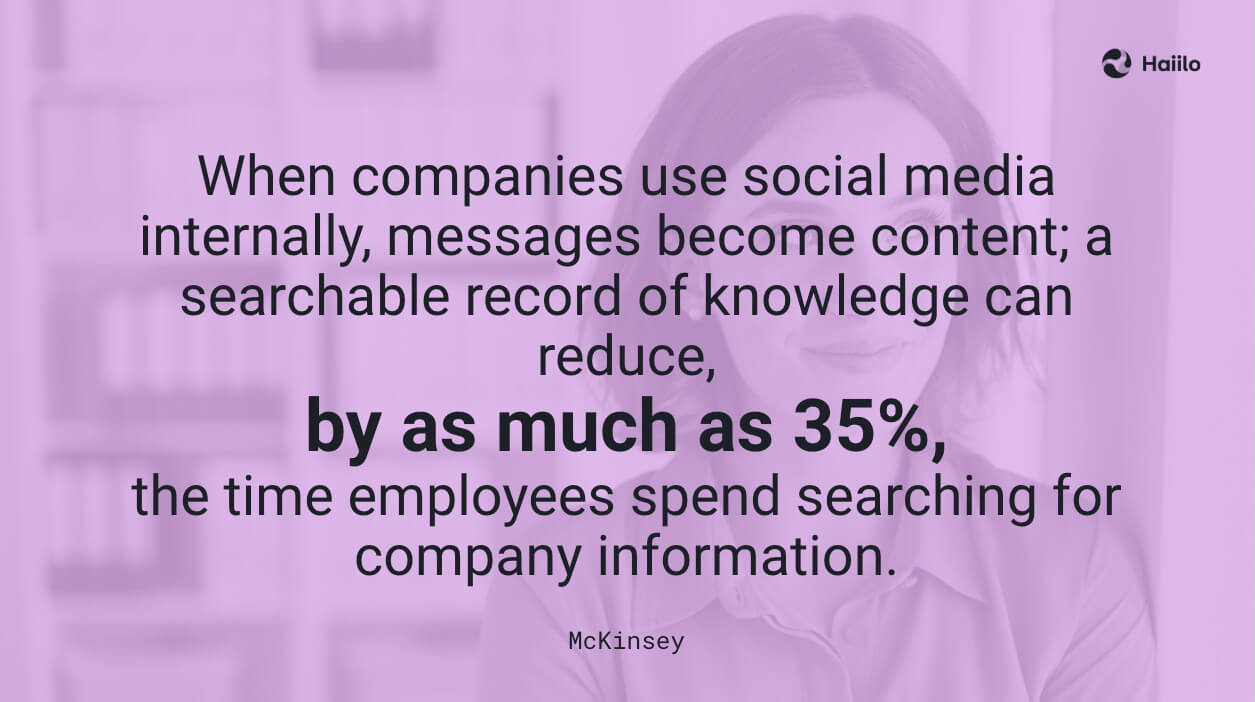
McKinsey’s research found that when companies use social media internally, messages become content; a searchable record of knowledge can reduce, by as much as 35%, the time employees spend searching for company information. The results are visible through faster, more efficient, and more effective workplace collaboration.
When you translate these time savings into hours and salary costs, the financial impact becomes clear. Reducing search time alone can justify your investment and makes intranet ROI tangible for leadership.
4. Workplace Collaboration
When evaluating intranet ROI it’s important to understand how it improves overall workplace collaboration and team communication.
With the emergence of remote and hybrid work, collaboration and communication have become the biggest struggles for many employees across the globe. The inability to always stay connected with peers makes cross-functional collaboration extremely difficult.
Even though most companies use instant messaging solutions to communicate asynchronously, the lifespan of these messages and information is causing frustrations among teams working on the same projects.
Important decisions get buried in chat threads. Project updates live in private channels. New team members struggle to catch up because context is scattered. This slows execution and increases the risk of misalignment. A social intranet creates shared spaces where conversations turn into structured knowledge that remains accessible long after the initial discussion.
Instead of switching between tools, teams collaborate in transparent project spaces, share updates company wide, and connect across departments. That visibility strengthens alignment and reduces duplicated work which directly impacts intranet ROI through time savings and faster decision making.
One of the most popular use cases that prove the power of intranet-like social workplace technologies is the one by Cosco. When Cisco implemented new collaboration tools and internal processes for their 80,000 employees, they saw a 9x return on investment.
The lesson is clear: when collaboration becomes structured, searchable, and inclusive, the financial impact is measurable. Stronger collaboration is not just a cultural benefit. It is a business advantage you can quantify.
5. Employee Onboarding
Intranets are heavily used to improve employees’ preboarding and onboarding experience and efficiency. Since employee onboarding can be quite expensive, taking it into consideration when calculating intranet ROI is critical.
According to research, it costs at least $4,000 to onboard a new hire. So it’s critical to make onboarding as streamlined and as effective as possible. By centralizing forms, training videos, important documents, and policies and procedures sets a uniform experience for every new person. Consequently, onboarding becomes much faster and more enjoyable for everyone.
But the real impact goes beyond cost savings. A structured intranet onboarding journey reduces uncertainty in the first weeks, answers common questions before they are asked, and connects new hires with the right people from day one. Instead of relying on scattered emails or outdated documents, they follow a clear path with milestones, learning modules, and relevant contacts.
According to Forrester, when intranets are effectively used, organizations can decrease the employee onboarding time by an average of 20%. This not only alleviates internal resources, but also quickly aligns your new team members to processes, company culture, and expectations.
When you multiply faster ramp up time across every new hire, the contribution to intranet ROI becomes clear. New employees reach productivity sooner, managers spend less time repeating information, and the organization benefits from stronger early engagement and retention.
6. Ease of Use, Implementation, Maintenance
Some intranets are easier to implement and maintain than others. Because implementation can make up a significant portion of the overall intranet expense, it directly impacts intranet ROI.
For some intranet providers, costs start with licenses. Consultation hours, implementation support, logistical help, customization services, and employee training are some of the added expenses to keep a platform running. Very quickly, thousands of dollars can be added to the initial investment.
What often gets overlooked is the internal cost. How many hours will IT spend on setup and maintenance? How much time will communicators invest in managing complex structures? If your platform requires constant technical support, your intranet ROI shrinks before you even see results.
So when choosing an intranet vendor, make sure that the implementation processes and expenses are reasonable and that there are no hidden costs. According to G2, enterprise software buyers are pressured to show the value of the new investment fast. So fast implementation is critical for them. According to the research, of those who purchased shadow IT, medium-sized companies (87%) and enterprises (93%) did so because they needed to move quickly.
Furthermore, many intranets on the market lack the intuitiveness needed for the best possible user adoption.
If employees struggle to navigate the platform, they simply will not use it. Low adoption means low impact, regardless of features. According to a study by 1E, US companies wasted $30 billion on rarely used or unused software over the span of four years.
Ease of use, fast rollout, and minimal maintenance are not operational details. They are core drivers of intranet ROI because they determine how quickly your organization sees value and whether that value lasts.

With intranets, user adoption is critical for ensuring the highest intranet ROI. To ensure great user adoption, the intranet’s interface needs to be intuitive, helpful, and fun to use. Furthermore, the platform needs to be accessible to every employee, even to frontline workers without a designated working space or company email. So make sure that the intranet provider offers a native mobile employee app for those workers who are always on the go.
7. Scalability
It’s important that your intranet lets you scale confidently. Meaning, your intranet should be able to grow as your company grows without creating friction or unexpected costs. If every expansion requires renegotiation, technical rework, or new infrastructure, your intranet ROI quickly declines.
Adding new users to your intranet platform should be simple. Launching new features and functionalities should not take years. Expanding storage or supporting new locations should not require complex projects. When growth is smooth, your platform supports momentum instead of slowing it down.
Scalability also means adapting to new business needs. Maybe you expand into new markets, introduce deskless employees, or strengthen leadership communication during change. Advanced intranet solutions make this easier by offering built in capabilities such as employee advocacy, employee surveys, and analytics with clear insights and recommendations. You extend value without starting from scratch.
To achieve such flexibility and protect your intranet ROI, look for a flexible and extensible cloud based solution.
Furthermore, many vendors offer volume discounts for scaling companies or large enterprises. The more users your company needs, the lower the price per user. This means your cost per employee can decrease while your reach and impact increase, strengthening the long term business case.
8. Integrations with Other Workplace Tech Stack
The role of an intranet is to become the ultimate digital home for every employee. A place from which every employee starts their day.
To build such a single source of truth, it is important that the intranet integrates with other critical workplace tech your company uses. Integrations with Google Workspace, Microsoft 365, Teams, Slack, Trello, and other project management and communication tools are an absolute must.
Without integrations, employees are forced to switch between platforms, duplicate information, and manually search for updates. That fragmentation increases frustration and reduces adoption. When your intranet connects directly to the tools your teams already rely on, it becomes a central access point instead of an additional destination.
This way, employees can have all the important events, information, tasks, tools, people, and documents in a single view. They see their calendar, project updates, corporate news, and collaboration spaces in one place, which reduces context switching and saves time. That efficiency directly contributes to stronger intranet ROI.
If this is not achieved, the intranet becomes just another workplace tool with no added value for the company – it becomes an expense rather than an investment. In fact, 82% of respondents in the G2 research mention it is important to them that the software they buy integrates with their existing solutions. Buyers rank ease of integration higher than the cost of the software, the kind of security it provides, or its TCO.
In short, integrations are not a technical detail. They determine whether your intranet drives daily usage and measurable impact, or whether it risks becoming shelfware.

Besides native integrations, look for a vendor that offers open API access so that you can integrate your intranet with any software your employees use. Solutions that grant you access to their API are the best choice because this allows you to build your own integrations when they don’t already exist. This way, you can ensure your internet works with every tool your employees need.
💡 Related: What is an Employee Engagement App and Why Your Company Needs One
9. AI-Powered Capabilities
In a previously mentioned research by G2, 81% of respondents say that it is important or very important that the software they purchase moving forward has AI functionality. Organizations are well aware of the benefits of AI.
With the emergence of Chat GPT, the popularity of AI in marketing, sales, HR, and internal communications departments has become even more significant.
In the previous sections, we mainly talked about the benefits of intranet for employees who consume content. But what about the people who create and manage that content every day?
AI-powered intranets support communicators, HR teams, and leaders by reducing the time spent drafting, editing, and optimizing content. Instead of starting from a blank page, they can generate structured drafts, refine messaging, and adapt tone within minutes. That efficiency can dramatically increase output without increasing headcount, directly strengthening intranet ROI.
Haiilo’s AVA can create content drafts based on the topic of interest. After this, it can adjust the tone and voice of the article to match your company style, make the content shorter or longer, and automatically generate relevant hashtags.
Beyond content creation, AI can surface relevant information to employees, personalize news feeds, and analyze engagement patterns. This means employees see what matters to them, while communicators gain insights into what drives action. The result is better reach, higher engagement, and measurable business impact.
10. Extended Features and Functionalities
Some intranet providers offer built in features that help you consolidate tools, reduce software costs, or even create new revenue opportunities. When you evaluate intranet ROI, it is worth asking not only what the platform adds, but also what it can replace.
According to research, software buyers prefer to work with fewer vendors (78%) and use a single solution instead of multiple tools (84%). When multiple solutions are required, 77% of buyers prefer to buy complementary products from the vendors they already work with.
Managing fewer systems reduces complexity for employees and lowers administrative effort for IT and procurement. It also increases adoption, because employees are not asked to log into yet another standalone platform.
This is where Haiilo comes in very handy. It comes with features and functionalities that can replace survey solutions to measure employees’ pulse, employee advocacy tools, and it can even serve as a social recognition solution.
If we know that leads generated through employee social marketing convert 7 times more frequently than other leads, then it’s clear that employee advocacy capabilities can significantly increase your intranet ROI.
When one platform supports communication, engagement measurement, advocacy, and recognition, you not only reduce costs but also amplify impact. That combination strengthens the business case and positions your intranet as a strategic driver, not just a communication tool.
Check out our report on the synergy of multichannel communication and employee listening, featuring Forrester!


FAQ: Intranet ROI
1. What does Intranet ROI actually mean?
Intranet ROI measures the business value your intranet delivers compared to what you invest in it. That includes license costs, implementation, maintenance, and internal resources. But the return is not just financial. It shows up in time saved, faster onboarding, better alignment, stronger engagement, and lower turnover.
For example, if employees spend less time searching for information or sitting in unnecessary meetings, that regained time translates into real productivity gains. Intranet ROI connects communication efforts to outcomes leadership cares about.
2. How can you measure Intranet ROI in practice?
Start with metrics that tie directly to business impact. Look at time savings, reduction in email volume, onboarding duration, engagement rates, and content reach. Pulse surveys and analytics can help you measure how well key messages land and where gaps exist.
Then quantify the impact. If each employee saves 20 minutes per day thanks to better knowledge access, multiply that across the organization. That is where Intranet ROI becomes tangible and credible.
3. Is Intranet ROI only about cost savings?
No. Cost savings are important, but they are only one side of the equation. Intranet ROI also includes value creation. That might mean higher employee engagement, stronger collaboration across teams, or improved advocacy that drives leads and employer branding.
A well used intranet strengthens culture, supports managers, and keeps hybrid teams connected. These outcomes influence retention and performance, which have long term financial impact.
4. How long does it take to see Intranet ROI?
It depends on implementation and adoption. Organizations that launch quickly, integrate with existing tools, and actively promote usage often see measurable impact within months. Faster onboarding, better content reach, and improved feedback loops can show early wins.
The key is not just launching the platform, but managing it strategically. Clear goals, strong leadership support, and regular measurement make Intranet ROI visible and sustainable.