
The right intranet brings effortless communication, seamless collaboration, and meaningful employee engagement to the workplace. But what does the actual data say about the potential impact on engagement, productivity, retention and revenue?
We look at some of the biggest challenges facing organizations today, and how an intranet can solve for each of them…
For many leaders, the pressure isn’t just improving the employee experience — it’s proving intranet ROI in measurable business terms. Engagement scores are one thing; reduced time spent searching for information, faster onboarding, fewer duplicated efforts, and stronger retention are another. When internal updates reach frontline teams instantly, when knowledge is centralized instead of siloed in inboxes, and when employees can easily find the tools and people they need, productivity gains compound quickly. The data increasingly links connected employees with higher performance and lower turnover, turning what was once seen as a “nice-to-have” platform into a strategic driver of revenue, efficiency, and long-term growth.
1. 79% of Employees Are Not Engaged at Work
A disengaged workforce means low productivity, high turnover and reduced profitability for your organization. And if you choose not to address the disengagement epidemic, you can expect around three quarters of your employees to effectively “check out”.
The cost isn’t abstract. Disengagement shows up in missed deadlines, avoidable mistakes, increased absenteeism, and higher recruitment spend. When employees feel disconnected from company goals or leadership decisions, performance plateaus and top talent quietly starts looking elsewhere — directly impacting intranet ROI before you’ve even calculated it.
How can an intranet help?
The right intranet boosts engagement by providing a seamless, centralized platform for communication, recognition, and collaboration.
Instead of fragmented updates across email, chat, and meetings, employees have one reliable place to access company news, leadership messages, team updates, and shared knowledge. That clarity reduces noise and increases alignment — two critical drivers of engagement.
Personalized dashboards and interactive features help employees stay connected and motivated, while engagement tools like polls, surveys, and recognition programs help employees to feel valued and heard.
This is important, because, according to Quantum Workplace, workers who believe their success is recognized are 2.7 times more likely to be highly engaged.
When recognition is visible, consistent, and embedded into daily workflows, engagement becomes measurable — not anecdotal. Higher participation rates, improved pulse survey scores, and stronger retention figures all contribute to demonstrable intranet ROI, turning engagement from a “soft” metric into a clear business outcome.
2. Poor Workplace Communication Reduces Productivity by 40%
When cross-departmental communication fails, organizations and their employees suffer delays and missed opportunities, according to Grammarly’s State of Business Communication report.
When departments work in isolation, it breeds inefficiency and confusion throughout your organization.
In practical terms, that looks like duplicated work, inconsistent messaging to customers, and teams wasting hours searching for the latest version of a document. Multiply those lost hours across the organization and the productivity drain becomes significant — quietly eroding margins and undermining intranet ROI before collaboration even begins.
How can an intranet help?
Companies that embrace digital workplace solutions see a 20-25% increase in productivity, according to McKinsey.
Having that unified intranet platform means even siloed teams can access information to improve cross-functional collaboration in the workplace, regardless of location or department.
Instead of relying on scattered email threads or isolated tools, project updates, shared files, and leadership announcements live in one searchable environment. Version control becomes clearer, responsibilities are visible, and conversations are transparent — reducing bottlenecks and accelerating decision-making.
Centralized file sharing and cross-departmental workspaces break down those silos to support improved communication, faster decision-making, and stronger teamwork. Over time, fewer delays and more aligned execution translate directly into measurable intranet ROI through reclaimed hours, higher output, and better business outcomes.
3. Employees Spend 20% of Their Time Searching for Information
The struggle to locate resources is a contant source of frustration for employees. Microsoft’s 2023 Work Trend Index found that employees are interrupted every two minutes on average during the workday, highlighting how digital fragmentation and constant context-switching reduce focus and productivity.
We’ve all been there, and we all know how endless searching can crush morale and waste resources.
But that 20% isn’t just an annoyance — it’s a measurable productivity leak. For a 1,000-person organization, that’s the equivalent of hundreds of lost workdays every month spent digging through inboxes, outdated shared drives, or disconnected tools. When critical knowledge lives in silos, decisions slow down and momentum stalls, directly impacting intranet ROI.
How can an intranet help?
Advanced search capabilities and well-organized content libraries streamline information retrieval, so employees can quickly access exactly what they need without endless scrolling or constant questions.
Modern intranets surface the most relevant documents, people, and updates in seconds — with filters, tags, and smart recommendations that reduce guesswork. Clear governance ensures outdated content is archived, while ownership structures keep information accurate and current.
What’s more, personalized content delivery based on roles, departments, interests, and other criteria further minimizes those search times, which should come as a relief to employees and employers alike. The result is more time spent executing work instead of chasing it — a tangible, defensible boost to intranet ROI.
💡 Read: Should You Build or Buy an Intranet? Everything You Need to Know
4. Only 13% of Employees Use Their Intranet Daily
Despite the potential benefits of an intranet for centralizing communication and resources, actual daily engagement remains low. According to recent industry data, only about 13 % of employees access their company intranet on a daily basis, and roughly a third never use it at all—leaving many workers reliant on alternative channels for information and collaboration.
Such low numbers often reflect poor usability or irrelevant content.
When employees avoid the intranet, it quickly becomes a static repository rather than a living workspace. Important updates get missed, adoption of new initiatives slows, and leadership visibility drops. In that environment, intranet ROI is almost impossible to prove — not because the platform lacks potential, but because employees see no compelling reason to return.
How can a (well-designed) intranet help?
Intuitive design, mobile accessibility, and features like gamification can drive that daily engagement.
But design alone isn’t enough. A well-designed intranet integrates with the tools employees already use — HR systems, collaboration apps, document management platforms — so it becomes part of the daily workflow rather than an extra destination.
Personalized newsfeeds, tailored content, and push notifications keep employees connected and informed, while a seamless, user-friendly interface helps them find value in every interaction.
This is important, because 88% of online users say they are less likely to return to a site after a bad user experience. Let’s face it, not a single person in the world wants to waste their time navigating a poorly designed experience.
When usability and relevance come together, daily usage rises — and with it, measurable intranet ROI through stronger alignment, faster communication, and sustained employee engagement.
5. 75% of Employees Feel Overwhelmed by Workplace Communication
Between emails, messages, and meetings, employees are struggling to prioritize and process the sheer volume of workplace communication they’re receiving.
Without streamlined systems or clear communication protocols, this barrage of information leads to confusion, and ultimately affects both individual and organizational outcomes.
How can an intranet help?
By delivering updates tailored to an employee’s role, department, or project, you ensure they only receive the most relevant and actionable information. You minimize distractions, reduce the noise, and empower employees to focus on their core tasks.
After cutting through the noise, employees can finally dedicate their time and energy to high-priority tasks, instead of drowning in information.
6. 35% of Workers are Considering a Job Switch This Year
Employee retention has always been a big challenge. But today, retention is tougher still, with over a third of employees globally considering a job switch this year.
Even remote workers, who often report higher levels of well-being and work-life balance, are not immune – 41% say they are likely to switch jobs.
Retention is not just offering flexibility or perks; it requires a deeper focus on employee engagement, growth opportunities, and fostering a sense of connection to the organization.
How can an intranet help?
A recent recognition/engagement survey found that 60% of employees say that feeling recognized for their efforts makes them less likely to job-hunt or accept a recruiter’s call, showing that feeling valued reduces turnover intention.
Intranets support this endeavour with tools for recognition, personalized content, training portals, and transparent updates. Structured onboarding via intranets alone boosts retention by up to 82%, helping new hires to feel supported and settled from the start.
7. 90% of Intranets Fail
Intranets ben around for decades, yet the intranet industry still hasn’t found a way to set organizations up for success. 9 in 10 intranets fail before the 3-year mark.
The biggest reasons for the failure boil down to unclear purpose and governance, poor user experience, and an inability to measure ROI.
Too often, intranets launch with enthusiasm and then stagnate. Content becomes outdated, ownership is unclear, and leadership loses visibility into performance. Without defined objectives and success metrics, adoption drops — and intranet ROI becomes a guessing game rather than a business case.
How can the right intranet help?
What separates the winners from the losers is that focus on data-driven decision-making.
The right platform gives internal communications continuous feedback from employees on every initiative. They empower you to really understand the impact of your efforts, so you can have a direct and measurable impact on employee engagement and experience.
Built-in analytics — from reach and engagement rates to content performance and sentiment trends — allow you to refine strategy in real time. Clear governance structures, defined KPIs, and executive sponsorship ensure the intranet evolves alongside the organization. When success is tracked against tangible business outcomes, intranet ROI shifts from aspiration to evidence — and long-term adoption follows.
Why These Statistics Matter for Your Organization
The data is clear: disengaged employees, poor communication, and outdated processes are costing organizations dearly – not just in lost revenue, but in morale and retention.
The statistics above highlight the potential loss for your organization, but more importantly, they show the potential impact of an intranet on workplace communication, collaboration, and productivity.
Taken together, these numbers tell a simple story: the real risk isn’t investing in an intranet — it’s failing to fix the friction slowing your workforce down. Every missed update, duplicated task, and disengaged employee compounds over time. That’s where intranet ROI becomes critical. When you connect communication to measurable outcomes — faster onboarding, reduced turnover, reclaimed productivity hours — the platform shifts from a cost center to a performance driver.
The right intranet addresses these pain points by centralizing communication, streamlining workflows, and fostering a culture of recognition, connection, and growth. The result? Higher engagement, better retention, and a measurable impact on organizational performance — backed by data, not assumptions.
How can Haiilo help?
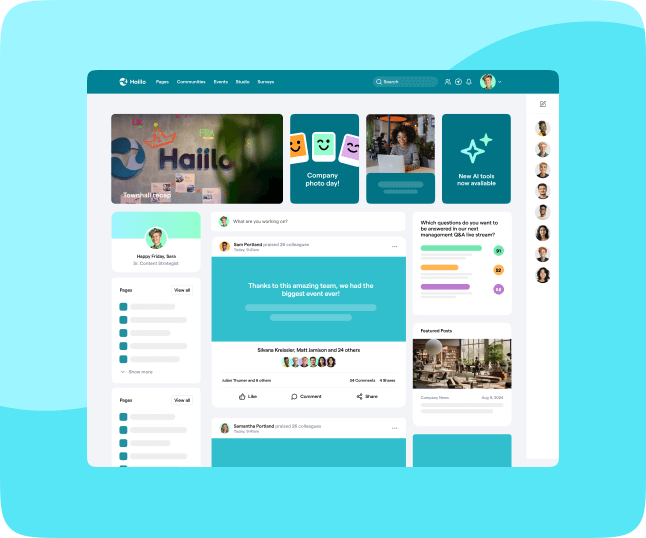
Haiilo helps organizations turn communication challenges into measurable intranet ROI. By bringing together a modern social intranet, powerful internal communications capabilities, built-in analytics, and employee advocacy tools, the platform connects your workforce while giving you the data to prove impact.
Instead of juggling disconnected systems, you get one intuitive environment where content reaches the right people, conversations drive alignment, and performance can be tracked in real time. That means engagement isn’t guesswork, collaboration isn’t fragmented, and leadership has clear visibility into what’s working.
With Haiilo, you can boost…
- Engagement, with tailored content, social features, and measurable interaction data
- Collaboration, with advanced tools and a unified platform that breaks down silos
- Efficiency, with centralized resources, smart search, and streamlined workflows
- Scalability, with an intranet that adapts as your organization grows
- Flexibility, with mobile access and seamless integrations into your existing tech stack
The result is more than a better employee experience — it’s demonstrable intranet ROI backed by engagement metrics, productivity gains, and stronger organizational performance.
Frequently Asked Questions
1. What exactly is intranet ROI and why should we care?
Intranet ROI (Return on Investment) is a way to measure the value your intranet brings compared to what it costs — not just in dollars, but in time saved, better communication, and more engaged employees. Rather than seeing your intranet as just another tool, ROI helps you connect it to real business outcomes like productivity gains, smoother information flow, and higher retention, all of which matter to leadership and your internal comms team alike.
2. How do you actually measure ROI for an intranet?
Start by defining clear goals (e.g., reduce email volume, cut search time, boost engagement). Choose KPIs that tie directly to those goals — like active user rates, time spent finding information, or number of internal interactions. Compare these against your costs (licensing, training, maintenance) to see the net impact. Analytics, surveys, and usage dashboards are all helpful tools in this step.
3. What are common mistakes teams make when calculating intranet ROI?
A big one is looking only at hard numbers — like time saved — and ignoring soft returns like employee satisfaction and cross-team collaboration. Another is failing to set benchmarks before launch, meaning there’s no baseline to compare against later. Without both clear goals and consistent tracking, intranet ROI ends up being guesswork, not insight.
4. How can I improve the ROI of our intranet over time?
Focus on adoption first — an intranet that nobody uses won’t deliver value. Then iterate: refine content and navigation, boost integrations with other tools, and listen to feedback. Regularly reviewing performance and aligning features with real employee needs keeps your ROI trending upward as the platform evolves with your organisation.