
Diversity and inclusion consist of the efforts and practices a company implements to support a diverse workplace and leverage the effects of diversity to achieve a competitive business advantage.
Workplace diversity has become one of the main challenges and top priorities for recruitment and other HR departments. Many organizations struggle to turn intent into action, especially when it comes to hiring, retention, and creating a culture where people feel they truly belong. Still, companies that get this right often see clear diversity in the workplace benefits, including stronger innovation, better decision-making, and improved employee experience.
📚Check out our article on Employee Engagement: Definition, Current Status and the Main Drivers and learn about other aspects that add up to employee enagegement.
More companies are now actively adapting their talent strategies to attract a broader range of candidates and reduce bias in hiring. This shift reflects a growing understanding that diverse perspectives add real business value and help teams respond faster to change. However, attracting diverse talent is only the first step—organizations also need inclusive policies and daily practices to sustain long-term impact and fully realize diversity in the workplace benefits.
Track the success of your diversity and inclusion initiatives with the right employee engagement surveys
Difference Between Diversity and Inclusion
In order to set up clear diversity and inclusion strategies, it is important for employers to understand the main difference between these two notions. While they are often used together, they address different aspects of how people experience the workplace and how organizations create value from diverse teams.
What is diversity?
Diversity includes any dimension used to differentiate groups and people from one another. When talking about diversity in a workplace, we focus mostly on respecting and appreciating what makes employees different in terms of age, gender, ethnicity, religion, disability, sexual orientation, education, and national origin.
Each employee in an organisation brings with them a different set of perspectives, thoughts, beliefs and ideas. This diversity of thinking allows companies to approach challenges from multiple angles and uncover solutions that may otherwise be overlooked. Research shows that diverse leadership teams are associated with stronger business performance and broader growth ambitions (McKinsey, 2023).
Today, it is crucial for employers to recognize these diversity in the workplace benefits and learn to respect and value each individual in order to build a better employee experience company culture. Diversity alone, however, is not enough to drive results without the right environment to support it.
How does inclusion differ from diversity?
Inclusion, on the other hand, implies organizational efforts to make employees of all backgrounds feel welcomed and equally treated. It focuses on how people are integrated into the workplace and whether they have equal access to opportunities, resources, and decision-making.
Inclusive organizational culture makes people feel respected and valued for who they are as individuals or groups. When employees feel that their perspectives are heard and appreciated, they are more likely to contribute actively and collaborate effectively. This directly influences motivation and overall performance.
Employees who feel welcomed are often much more committed to their work, are more motivated and have higher levels of employee engagement. Recent research also highlights that inclusion has a strong and consistent impact on performance and engagement outcomes, making it a critical factor in realizing diversity in the workplace benefits (Mercuri Urval, 2025).
The process of inclusion focuses on making people feel valued and important for the company’s success. When people feel valued and appreciated, they function at full capacity, collaborate more openly, and feel part of the organisation’s mission and core company values. Without inclusion, diversity cannot deliver its full potential or create lasting impact.
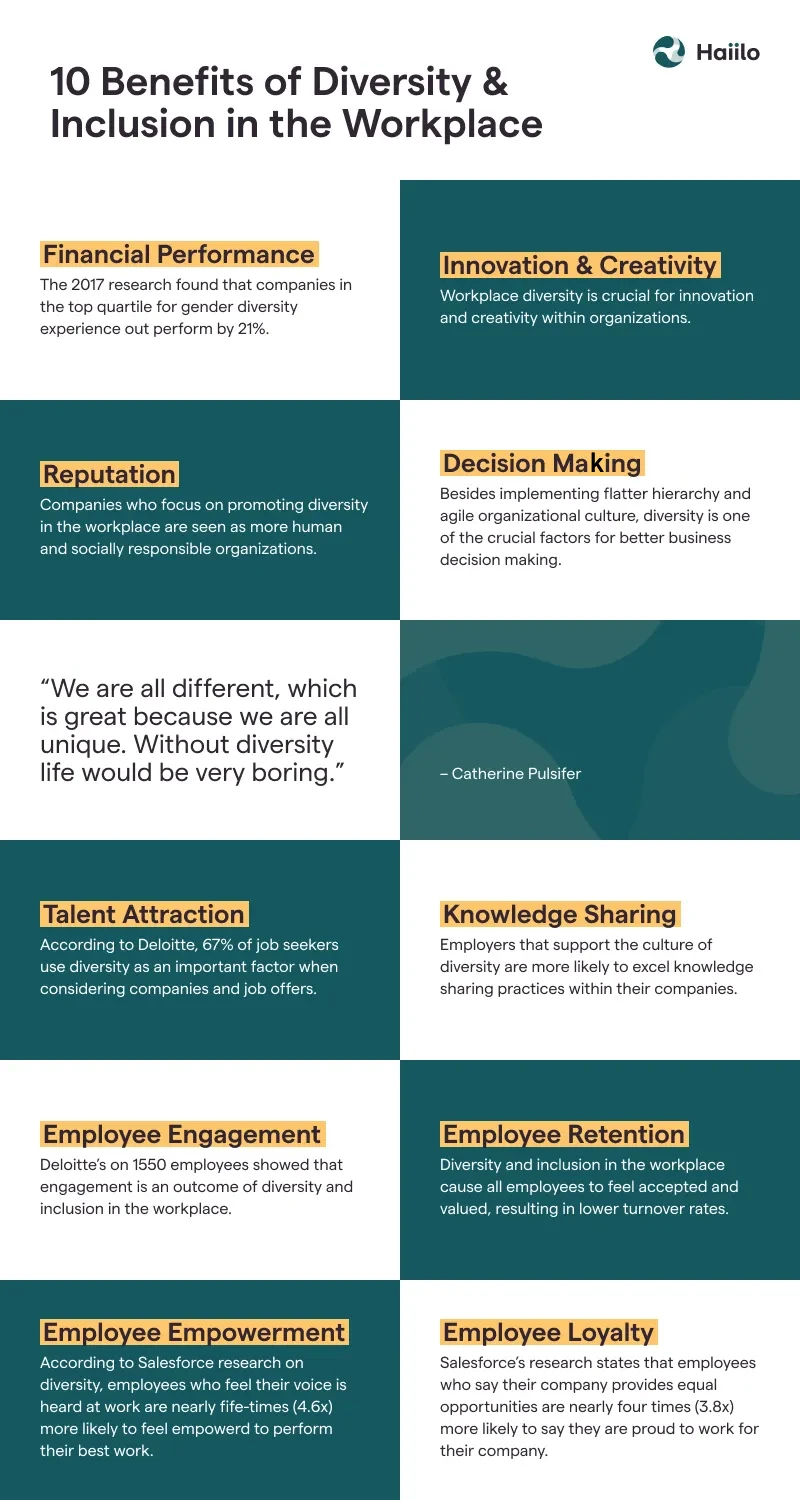
10 Benefits of Diversity and Inclusion in the Workplace
Organisations need to focus on allocating their resources and training efforts in order to attract the right employees with the best minds, skills and experience.
10 Benefits of Diversity and Inclusion in the Workplace
Organisations need to focus on allocating their resources and training efforts in order to attract the right employees with the best minds, skills and experience. This is especially important as employee expectations continue to evolve and candidates increasingly look for purpose, fairness, and belonging—not just compensation. Companies that invest in diversity programs often build stronger employer brands and create environments where talent can thrive long term.
In today’s war for talent, this may require employers to look beyond the traditional talent acquisition and recruitment practices. Instead, organizations are rethinking how they promote inclusion across the entire employee lifecycle—from hiring and onboarding to development and retention. Leveraging modern employee communications solutions can also help ensure that every voice is heard and that information is accessible, transparent, and inclusive.
Companies that succeed here often combine inclusive hiring with strong culture-building initiatives, such as employee engagement strategies, employee experience programs, and ongoing feedback loops. These practices make it easier to identify gaps, improve collaboration, and reinforce shared values. For a deeper dive, explore related insights on employee engagement, company values, and DEI communication strategies.
Ultimately, diversity without inclusion does not deliver meaningful results. Organizations must create systems that support equal opportunity and empower employees to contribute fully. This is where the real diversity in the workplace benefits emerge—through stronger collaboration, better ideas, and more resilient teams.
Here are some of the most important benefits of focusing on diversity and inclusion in the workplace.
Accelerate business growth and financial performance
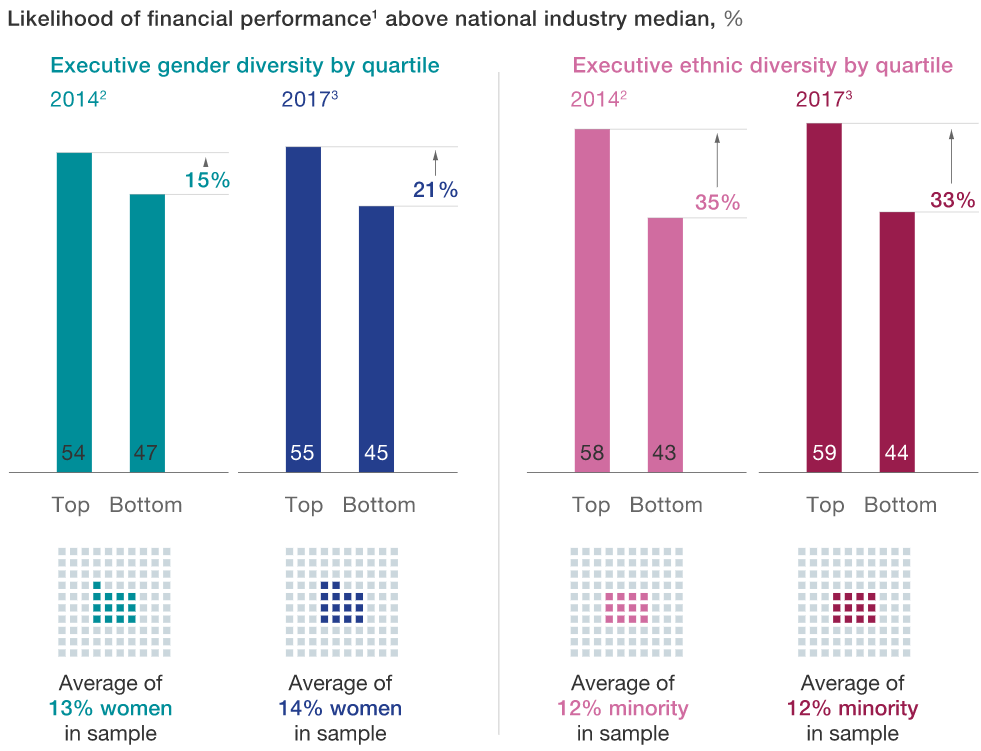
McKinsey’s latest research on diversity confirms that companies with more diverse leadership teams tend to outperform those that do not actively support diversity and inclusion. The data consistently shows a strong link between diversity and business performance across industries and regions.
The most recent findings reveal that companies in the top quartile for gender diversity on executive teams are 39% more likely to outperform financially compared to those in the bottom quartile. [1](https://hrbrain.ai/blog/unlocking-competitive-advantage-through-enhanced-dei/)
Similarly, companies with high ethnic and cultural diversity also show a 39% greater likelihood of outperformance, reinforcing the business case for building more inclusive leadership teams. [1](https://hrbrain.ai/blog/unlocking-competitive-advantage-through-enhanced-dei/)
These updated figures highlight how diversity in the workplace benefits go beyond representation. When companies combine diverse perspectives with inclusive practices, they are better equipped to adapt to market changes, make stronger decisions, and drive sustainable growth.
Boost innovation and creativity
Workplace diversity is crucial for innovation and creativity within organizations. Having employees from various backgrounds brings different perspectives and ideas into everyday business.
“Research shows that even just the presence of physical diversity results in better performance and for companies that are data-driven, that extra performance boost can be extremely motivating”, says Clark Sabrina Clark, associate principal at SYPartners. “It’s also the fact that companies that lack diversity are being called out publicly and may even be losing business, not to mention falling behind when it comes to recruiting. Even Google is starting to show signs that their lack of diversity is affecting them”, says Clark (CIO).
Improve company’s reputation
Companies that promote diversity in the workplace are seen as more human and socially responsible organizations.
In addition, supporting diversity and inclusion is proof of the employer’s morale, fairness and empathy. These employer’s characteristics are often very attractive to Millenials and younger generations.
Make better business decisions
Besides implementing a flatter hierarchy and agile organizational culture, diversity is one of the crucial factors for better business decision-making.
Attract high-quality candidates
According to Deloitte, 67% of job seekers use diversity as an important factor when considering companies and job offers.
Improve knowledge sharing in the workplace
Diverse workplace often means more knowledge on different business areas. Therefore, employers that support the culture of diversity are more likely to excel in knowledge-sharing practices within their companies.
Improve employee engagement
Workplace diversity boosts employee engagement.
Deloitte conducted research that captured the views and experiences of 1,550 employees in three Australian corporations operating in manufacturing, retail and healthcare. This research showed that engagement is an outcome of diversity and inclusion.
📹 Internal communications also play a critical role in driving employee engagement. Check out our internal comms Masterclass to learn about how to create a successful employee communications strategy.
Decrease employee turnover
Companies with a diverse workforce are generally have lower turnover rates.
Diversity and inclusion in the workplace cause all employees to feel accepted and valued. As the result, employees feel more satisfied and they stay longer with their companies.
Increase employee empowerment
According to Salesforce research on diversity, employees who feel their voice is heard at work are nearly five-times (4.6X) more likely to feel empowered to perform their best work.
📚 Read on: Empowerment in the Workplace: Definition & Best Practices
Increase employee loyalty
The same research states that employees who say their company provides equal opportunities are nearly four times (3.8X) more likely to say they are proud to work for their company.
And you know the trick: when your employees are proud to work for your company, they are more willing to stay, to give their very best, and they naturally advocate for your brand. In short, making diversity and inclusion one of your top priorities is a win-win situation.
Key Stats on Diversity and Inclusion You Can’t Ignore
- Diverse companies enjoy 2.3 times higher cash flow per employee (BuiltIn)
- Diverse management boosts revenue by 19% (Boston Consulting Group)
- Teams that are gender, age and ethnically diverse make better decisions up to 87% of the time (Global Diversity Practice)
- However, 41% of managers say they are too busy to prioritize diversity in the workplace (BuiltIn)
- What’s more, only 55% of employees agree that their organization has policies that promote diversity and inclusion (Sapling)
- Deloitte found that 74% of Millennials believe their organization is more innovative when it has a culture of inclusion (World Economic Forum)
- 57% of employees think their company should be doing more to increase diversity among its workforce (Glassdoor)
- 50% of organizations where diversity is not seen as a barrier to progression have leaders trained on managing diverse populations (PwC)
- 82% of business leaders whose organizations have a global footprint agree or strongly agree that employees demonstrate a commitment to inclusion – compared to 67% of local companies (PwC)
- Gender-diverse companies are 15% more likely to outperform their peers and ethnically-diverse companies are 35% more likely to do the same (McKinsey & Company)
- Inclusive teams outperform their peers by 80% in team-based assessments (Deloitte)
- For every 10% increase in gender diversity among senior executive teams in the United Kingdom, companies earn 3.5% more in earnings before interest and taxes (BuiltIn)
- The 2019 diversity statistics predict that by 2044, the current “minority” groups will reach a “majority” group status (What to Become)
- A McKinsey & Company research shows that only 23% of C-suites are made up of women (McKinsey & Company)
- Only 3.2% of Fortune 500 companies share diversity data in an open and transparent way (Yahoo! Finance)
- 67% of active and passive job seekers said that a diverse workforce is an important factor when evaluating companies and job offers (Glassdoor)
- The World Economic Forum Global Gender Gap Report shows that the gender pay gap would close in 108 years (World Economic Forum)
- 40% of people think there’s a double-standard against hiring women (ClearCompany)
- Research shows that blind applications lead to 5x more women (ClearCompany)
10 Diversity and Inclusion Best Practices
Even though many businesses are trying to create and manage diverse workplaces, many are not aware of some of the best practices to follow.
Here are some of the must-follow diversity and inclusion best practices.
1. Establish a sense of belonging
Establishing a sense of belonging is crucial for employees to bring the best out of them.
Having a sense of belonging is one of the most important psychological needs that need to be met for employees to feel connected with their employers and organizations.
2. Treat ALL your employees fairly
Fairness is one of the crucial prerequisites for employees to feel valued and accepted. Unfair salaries and benefits packages for employees from different backgrounds lead to unhealthy workplace culture and a lack of diversity.
3. Offer equal growth opportunities
Opportunity to grow is one of the main factors that attract and keep talent within companies. Therefore, employers need to be careful about offering fair and equal growth and career advancement opportunities to their employees.
4. Rewrite your job descriptions and job ads
If you want to attract more diverse talent, the language you use in your job posting makes a big difference.
A study on job postings found that those using masculine-type words like “ambitious” and “dominate” were less appealing to female applicants.
5. Support innovation and creativity
In order to build a diverse workplace, companies must support creativity within their organizations. If innovation and creativity are not one of your main business goals, it will be hard to build and maintain workplace diversity.
6. Educate employees on diversity and inclusion
For diversity and inclusion to work within your organization, employees need to be educated about the benefits and best practices to support those initiatives.
It is not enough for upper-level management to be aware of what diversity and inclusion mean for business success and company’s reputation.
7. Support teamwork and collaboration
Teamwork and collaboration are what employees expect from their employers to support.
Therefore, in order to attract and keep a more diverse workforce within your organization, collaboration should be one of your main company core values.
8. Support flexibility in the workplace
Research on workplace diversity found that one of the best workplace policies to attract diverse candidates is flexibility.
- A PwC survey found that, compared to older generations, Millennials value company culture that supports work/life balance.
- McKinsey’s research found that the #1 company value for women is a flexible work schedule.
Therefore, offering flexible work locations and hours helps you attract and retain more diverse employees.
9. Restructure your recruitment process
In recruitment, focusing on what company candidates worked at or what school they went to can often lead to a decrease in diversity of the candidate pipeline.
However, a valid and reliable personality assessments are great tools to measure candidates’ personality traits, motivations, and skills.
A study of 150 companies found that those that used a personality assessment in their hiring processes had more racially diverse workforces.
10. Promote diversity and inclusion at all levels of the organization
In order for diversity and inclusion initiatives to work, all levels of your company’s hierarchy need to understand and support it.
How to Measure Diversity and Inclusion Initiatives
All the employees should be on the same page when it comes to understanding the benefits of having a diverse workplace. Clear communication is essential here, and many organizations rely on tools like internal communication platforms to share goals, track progress, and align teams around inclusion efforts.
While older studies suggested widespread use of DEI metrics, more recent insights show that many companies still struggle to measure impact effectively. Instead of relying on a single indicator, leading organizations combine qualitative feedback with quantitative data to get a more complete picture. This approach helps them better understand how well they are unlocking diversity in the workplace benefits.
Even though diversity and inclusion efforts are not easy to measure, some of the most popular success metrics include:
- Employee productivity
- Employee morale
- Employee engagement
These metrics are often tracked through regular feedback cycles, such as employee engagement platforms and surveys. Companies also increasingly monitor collaboration, retention, and inclusion sentiment to capture how employees actually experience the workplace.
Managers and senior executives are being held accountable for their diversity and inclusion programs performance through:
- Performance reviews
- Bonuses
- Business/department reviews
- Salary increases
- Promotions
Embedding these metrics into leadership evaluation ensures that diversity and inclusion remain a business priority, not just an HR initiative. Many organizations also connect these goals to broader employee experience strategies to drive long-term impact.
Employee engagement tools like Haiilo Insights are used by employers around the world to keep a finger on the atmosphere in the workplace. Your diversity and inclusion initiatives should be supported by pulse surveys, real-time analytics, and continuous feedback from your employees’ experience. You can also explore additional frameworks for DEI communication strategies and employee engagement best practices to strengthen your measurement approach.
Having the information on what works and what needs to be further adjusted will help you to improve employee experience. It will also boost your strategy in attracting top talent from different backgrounds. When measurement is done right, companies can clearly connect their initiatives to outcomes and fully realize the diversity in the workplace benefits.
Humanize Diversity and Inclusion
Check out this great video on which Damien Hooper-Campbell, the Chief Diversity Officer at eBay, talks about the importance of humanizing diversity and inclusion.
Check out our report on the key drivers of employee engagement