Making your workplace more connected is no longer a “nice to have.” It’s the foundation of a strong employee experience — especially in a world where hybrid and remote work are the norm. But many organizations are still struggling to bring their people, tools, and information together in one place.

Instead, employees are navigating fragmented systems, duplicated tools, and constant context switching. The average company now uses more than 100 SaaS applications, which creates complexity instead of clarity. It’s no surprise that so-called “digital tool fatigue” is now a real issue, with employees reporting that too many platforms hurt productivity and wellbeing.

Top 5 benefits of connected workplace solutions and how to create one

At the same time, the need for better connection is growing. Hybrid work is here to stay — with around 70% of employees working remotely at least part of the week — but that flexibility often comes at a cost. Many employees still report feeling disconnected or lacking visibility at work, especially when communication and culture aren’t intentionally designed.

That’s where connected workplace solutions come in. Done right, they don’t just add more tools — they simplify the experience of work. A connected workplace brings together communication, knowledge, and workflows into a seamless digital environment that helps people collaborate, stay informed, and feel part of something bigger.
At its core, this is about building engaging employee communities — a concept we define as:
a virtual, social-media-like space where employees connect, communicate, and collaborate. It acts as a central hub for knowledge, updates, and conversations — making it easier to find information, share ideas, and get work done without friction.
In this guide, we’ll break down what a connected workplace really means today, why connected workplace solutions are critical for modern organizations, and the practical steps you can take to build one that actually works.

What is a connected workplace

A connected workplace is more than a collection of tools. It’s an ecosystem where people, technology, and information come together in one seamless experience. The goal isn’t to add more platforms — it’s to simplify work through connected workplace solutions that remove friction and make collaboration feel natural.
At its best, a connected workplace acts as a single, reliable source of truth. Employees know where to go for information, how to communicate, and how to get work done — without jumping between systems or second-guessing where things live. This clarity is what drives productivity, resilience, and consistency across teams.
Connected workplace solutions bring three core elements together: people, tools, and knowledge. When these are aligned, work becomes faster, more transparent, and far less frustrating.

People

In a hybrid world, connection doesn’t happen by accident — it has to be designed. Employees need simple, intuitive ways to communicate and collaborate, regardless of location, role, or device.
That’s especially true when you consider how work has changed. Employees now spend significantly more time collaborating than they did just a few years ago, making connection and visibility critical to success. At the same time, many remote workers still struggle with feeling disconnected or overlooked when communication is unclear or fragmented.
Connected workplace solutions solve this by creating a shared space where communication is consistent, inclusive, and accessible to everyone — from desk-based employees to frontline teams. Instead of relying on scattered channels, organizations can build a digital environment where people feel informed, involved, and connected to the bigger picture.

Tools

Most organizations don’t have a technology problem — they have a fragmentation problem.
The average company now uses over 100 different SaaS applications, forcing employees to constantly switch between tools just to get through their day. This “tool sprawl” is a major driver of frustration, reducing focus and slowing teams down instead of helping them move faster.
Connected workplace solutions take a different approach. Instead of adding yet another platform, they bring existing tools together into a unified experience. That means fewer silos, less duplication, and a clearer path to productivity.
When tools are properly integrated, employees don’t have to think about where to go or what to use — they can simply focus on the work that matters.

Documents and knowledge

Access to information is one of the biggest hidden blockers to productivity.
When documents are spread across multiple systems, employees waste time searching, recreating work, or chasing down the latest version. In fact, research shows that fragmented systems and poor knowledge management are a major contributor to workplace inefficiency, with employees frequently duplicating work when information isn’t easy to find.
Connected workplace solutions address this by centralizing knowledge and making it searchable, accessible, and up to date. Instead of hunting for documents, employees can find what they need in seconds — and trust that it’s accurate.
The result? Less frustration, less wasted effort, and more time spent on meaningful work.
Connected workplace solutions

No matter which document management systems your organization uses, critical company resources should be easy to find and access from a single, centralized hub. That’s a core principle behind connected workplace solutions — creating one place employees can trust for accurate, up-to-date information.

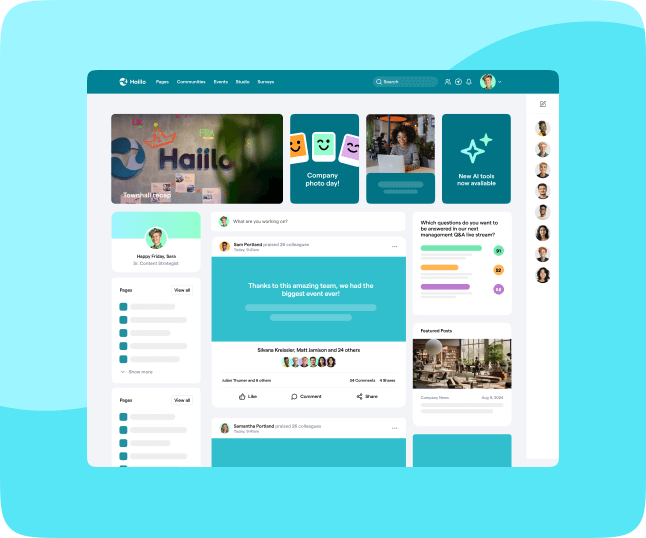
Many organizations rely on modern social intranets or employee experience platforms to bring documents, knowledge, and communication together. When done right, this creates a true “single source of truth” — reducing duplication, confusion, and wasted time, while helping employees stay focused on meaningful work.

Information

Documents are only part of the picture. Employees also need access to company news, updates, events, and leadership communication — and they need to know they haven’t missed anything important.
The challenge is that this information is often spread across multiple channels: email, chat tools, intranets, and shared drives. As a result, visibility drops and employees are left piecing together updates from different places.
This has a real cost. Employees spend an average of 1.8 hours every day searching for and gathering information. Combined with tool sprawl and fragmented systems, this creates a constant layer of friction that slows down decision-making and impacts productivity.
Connected workplace solutions solve this by bringing communication and knowledge into one consistent experience. News, updates, and resources are surfaced in the same place employees already go to work — making information easier to find, easier to trust, and far more likely to be seen.
When information flows properly, organizations don’t just communicate better — they move faster, align more easily, and create a stronger sense of connection across teams.

Connect your people, tools, and information with Haiilo!

The Benefits of a Connected Workplace

Connected workplaces have many benefits, and we will cover them all in the following section. 

Easier team collaboration

Organizational silos is one of the most common characteristics of disconnected workplaces. According to PwC survey, 55% of organizations work in silos and are fighting the negative sides of it every day. 

When workplaces are connected, silos get broken and teams from different departments are able to collaborate more efficiently without any knowledge and information gaps. 

Better employee engagement and productivity

Gallup research found that 30% of employees say they have a best friend at work. That percentage of workers is reportedly seven times as likely to be engaged with their jobs and produce higher-quality work. 

More organizational alignment

Connected workplaces are much better at streamlining their process and achieving better organizational alignment. When people are connected, critical information is much more likely to reach them, and people tend to have a better understanding of the company’s mission, vision, and goals. 

Unfortunately, IBM found that 72% of employees don’t have a full understanding of their company’s strategy and what it takes to get there. In most cases, poor internal communication is the main culprit here, and it is the consequence of people, tools, and information being completely disconnected. 

Lower employee turnover

One of the most concerning negative sides of remote work and disconnected workplaces is loneliness. Consequently, employees feel more lonely than ever, and lonely employees are 2 times more likely to quit their jobs

Also, within connected workplaces, it’s much easier to form strong bonds and relationships. A study conducted by Workforce found that 62% of employees who had 1 to 5 close friends at work said they would reject another job offer. That number increases to 70% for employees who have 6 to 25 close work friends. 

Furthermore, 54% of employees say a strong sense of community (great coworkers, celebrating milestones, a common mission) kept them at a company longer than was in their best interest.

Furthermore, disconnected workplaces deal with information and app overload on a daily basis. When employees receive irrelevant information from various internal communication channels, they waste hours every week trying to filter through this information and find what matters to them. 

On the other hand, when IC departments have the ability to segment their audiences and distribute content via the right channels, they help employees stay productive and engage with the company’s content. 

Similarly, when workplace apps are not well integrated, app-switching can be the biggest productivity killer. 

Asana’s Anatomy of Work Index found that, with excessive app switching:

  • 27% of messages and actions are missed
  • 26% of individuals are less efficient
  • 24% of work is duplicated

The same research found that knowledge workers switch between 10 apps 25 times per day.

onnected workplace solutions retention

Improved workplace accessibility and safety

Connected workplace solutions play a critical role in making the digital workplace more accessible — and safer — for everyone.
Accessibility isn’t just about compliance. It’s about ensuring that every employee, regardless of role, location, or ability, can access the information and tools they need to do their job effectively. Yet many organizations still fall short. In fact, 74% of employees who request workplace accommodations report having at least one request denied, highlighting how far many businesses still have to go on accessibility.
This becomes even more important when you consider the frontline workforce. These employees often lack access to basic communication channels. Research shows that 83% of non-desk workers don’t have a corporate email address, and 45% don’t have access to the company intranet.
Connected workplace solutions close this gap. By providing mobile-first, inclusive access to communication, knowledge, and tools, they ensure that frontline, remote, and desk-based employees all share the same level of visibility and support.
That accessibility also has a direct impact on safety.
When employees receive timely, relevant updates — especially in high-risk environments — they are better equipped to follow protocols and respond to potential hazards. Poor or delayed communication, on the other hand, can increase safety risks and operational issues.
Modern workplace technologies are now designed to go even further. From real-time alerts and mobile notifications to wearable devices and sensor-based systems, digital tools can identify risks early and help prevent incidents before they occur.
In other words, accessibility and safety go hand in hand. When everyone has access to the right information at the right time, organizations don’t just become more inclusive — they become more resilient.
forrester-connected-workplace

One survey found that nearly 83% of professionals depend on technology to collaborate and stay connected. 82% of the participants felt that they would feel impacted if this technology to collaborate was lost.

Naturally, Gartner found that with the right collaboration technology, hybrid teams were 70% more likely to be agile, 66% more likely to feel comfortable in their role, and 67% also agreed their team was skilled at working asynchronously.

So when choosing your workplace technology to improve your employees’ digital experience, make sure that enables better workplace communications, improves team collaboration, and provides seamless access to information. 

While implementing new solutions is necessary for improving business operations, ensuring that this technology connects people, tools, and information is critical. 

Social employee intranets are, therefore, considered the ultimate platforms for making organizations more connected. The most advanced solutions are designed to create dialogues between people, aggregate critical information in a single source of truth, and integrate various tools so that app-switching stops being a major productivity killer. 

Furthermore, with intranets, multichannel workplace communication becomes more simple, more intuitive, and more accessible to every employee.

FAQs – connected workplace solutions

What is a connected workplace solution?

A connected workplace solution is a platform or ecosystem that brings together communication, knowledge, tools, and workflows in one place. Instead of switching between multiple apps, employees can access everything they need in a single, seamless experience. The goal is simple: reduce friction, improve visibility, and make work easier for everyone.

Why are connected workplace solutions important today?

Modern work is more distributed than ever. With hybrid and remote models now standard, employees often struggle with fragmented tools and scattered information. Connected workplace solutions help solve this by creating a shared digital environment where people can collaborate, stay informed, and feel part of the organization—no matter where they work.

How do connected workplace solutions improve productivity?

By reducing app switching, simplifying access to information, and centralizing communication, these solutions help employees focus on meaningful work. When people don’t have to search for updates or jump between tools, they can spend more time getting things done and less time managing systems.

Can connected workplace solutions support frontline employees?

Yes — and this is one of their biggest advantages. Frontline and deskless workers are often excluded from traditional communication channels. Connected workplace solutions, especially mobile-first ones, ensure everyone has access to the same updates, tools, and knowledge, creating a more inclusive and aligned workforce.

How do these solutions impact employee engagement?

Employees are more engaged when they feel informed, connected, and heard. Connected workplace solutions create spaces for communication, recognition, and collaboration — helping build stronger relationships and a greater sense of belonging across teams.

What should you look for in a connected workplace solution?

Look for a platform that:
  • Integrates with your existing tools
  • Offers a simple, intuitive user experience
  • Supports mobile and frontline use cases
  • Centralizes communication and knowledge
  • Scales with your organization
The best solutions don’t add complexity — they remove it, helping your employees find their flow at work.

Discover how Haiilo’s employee experience platform can transform your organization

Haiilo Platform