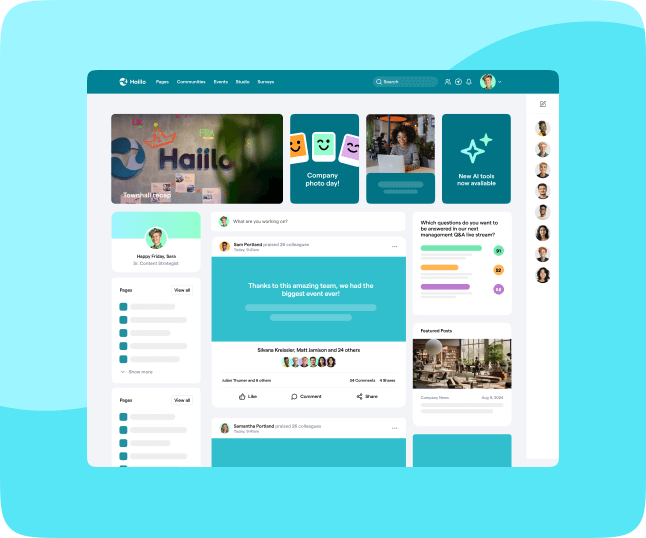

Intranet software has become one of the most important — and most misunderstood — tools in modern organizations.
When it works, it gives employees one clear place to start work. Communication improves. Information is easier to find. Tools actually get used. Work feels calmer.
When it doesn’t, it becomes just another system employees avoid.
This guide is designed to help you choose the best intranet software for your organization. We’ll explain what intranet software is, why it matters today, how to evaluate your options, and how leading intranet platforms compare — so you can make a confident, informed decision.
If you’re actively researching intranet software, this page is built to save you time.
See the 2026 guide on how to build an intranet 👉

What is intranet software?
Intranet software is a private digital platform used by organizations to communicate with employees, share knowledge, and bring everyday tools together in one place.
Modern intranet software goes far beyond a static internal website. It acts as a central hub for:
- Company news and leadership updates
- Policies, procedures, and shared knowledge
- Employee directories and organizational information
- Links to tools employees use every day
- Personalized content based on role, location, or team
The goal is simple: help people quickly find what they need, understand what’s happening, and focus on their work — without digging through emails, chats, and folders.
Why intranet software matters more than ever
Work is more fragmented than it used to be.
💡Read: The Digital Workplace Problem Report
Employees now juggle multiple tools, channels, and priorities. Teams are distributed. Information lives everywhere. Important updates get lost. New hires don’t know where to look first.
This is where intranet software plays a critical role.
The right intranet helps organizations:
- Create clarity in a noisy digital environment
- Reach every employee, including frontline and remote teams
- Reduce dependency on email and chat for important information
- Preserve institutional knowledge as teams change
- Increase adoption of existing tools by connecting them through one experience
In other words, intranet software isn’t about adding another platform. It’s about simplifying the ones you already have.
What makes intranet software “the best”?
There is no single best intranet software for every organization. But there are clear signals that separate strong platforms from frustrating ones.
The best intranet software typically:
- Is intuitive enough to use without training
- Makes it obvious where to find things
- Integrates with existing tools instead of replacing them
- Adapts to different roles, locations, and devices
- Feels helpful, not overwhelming
Most importantly, it gets used. Adoption is not a communications problem. It’s a usability problem.
💡Read: The State of Intranet Usability Report
If employees don’t know where to start, they won’t come back.
How to choose the right intranet software
Before comparing vendors, it’s worth stepping back.
Many intranet projects fail because organizations start with features instead of problems. A better approach is to focus on friction first.
1. Identify the problems you’re trying to solve
Ask questions like:
- Where do employees struggle to find information today?
- Which updates are most often missed or misunderstood?
- What tools do people open every morning?
- Where does work feel more complicated than it should?
Your intranet software should directly reduce those pain points.
2. Be clear about who the intranet is for
An intranet is not “for the business.” It’s for people.
Some platforms work best for desk-based knowledge workers. Others are designed for frontline employees. Some prioritize HR workflows, while others focus on communication and engagement.
Consider:
- Desk-based vs. frontline employees
- Mobile vs. desktop access
- Languages, regions, and time zones
- How often employees will realistically use the intranet
The best intranet software fits naturally into daily work.
3. Look beyond feature lists
On paper, many intranet platforms look the same.
The real differences show up in the experience:
- Navigation and structure
- Search quality
- Personalization and relevance
- Editorial control for content owners
- How quickly employees can get value
If it feels complex during a demo, it will feel even more complex at scale.
Common types of intranet software
Not all intranet software is built the same way. Most platforms fall into one of these categories.
SharePoint-based intranets
These intranets are built on Microsoft SharePoint, either using native functionality or with additional tools layered on top.
They work well for organizations deeply invested in Microsoft 365, but often require governance, customization, and ongoing maintenance to remain usable.
💡Read: Should you choose M365 as your intranet?
Out-of-the-box intranet platforms
These are dedicated intranet solutions designed specifically for internal communication and knowledge sharing.
They typically launch faster, require less IT involvement, and prioritize employee experience over configuration.
Employee experience platforms
Some modern intranet software sits within a broader employee experience platform, combining intranet, communications, and engagement tools into a single experience.
Understanding these categories helps narrow your shortlist quickly.
Best intranet software platforms compared
Below is a comparison of some of the leading intranet software platforms on the market.
Each section is structured the same way so it’s easy to scan and compare:
- What it is
- Who it’s best for
- What makes it different
This is not about declaring one universal winner. It’s about helping you find the best fit for your organization.
Microsoft SharePoint

What it is:
Microsoft SharePoint is one of the most widely used intranet foundations in the world. It’s included in many Microsoft 365 plans and is often the default starting point for internal sites.
Who it’s best for:
Organizations already standardized on Microsoft 365, with internal resources to manage structure, governance, and customization.
What makes it different:
SharePoint is highly flexible and deeply integrated with Microsoft tools like Teams, Outlook, and OneDrive. That flexibility can be powerful — but it also means many organizations rely on additional layers or third-party tools to create a more intuitive employee experience.
LumApps

What it is:
LumApps is a cloud-based intranet platform designed to sit alongside Google Workspace or Microsoft 365. It positions itself as a modern employee hub with a strong focus on content and personalization.
Who it’s best for:
Mid-sized to large organizations looking for a branded intranet experience that integrates closely with their productivity suite.
What makes it different:
LumApps emphasizes personalization and visual design. Content can be targeted by role, location, or language, and the platform is often used by organizations with complex global communication needs. It’s typically chosen by teams that want a polished intranet experience and are comfortable managing content and structure over time.
Workvivo

What it is:
Workvivo is an intranet and employee engagement platform built around social-style communication. It combines company updates with feeds, comments, and peer interaction.
Who it’s best for:
Organizations that want to increase visibility, participation, and a sense of connection across distributed teams.
What makes it different:
Workvivo leans heavily into social interaction. Updates appear in activity feeds, and employees can react, comment, and share. For companies focused on culture and engagement, this approach can help surface conversations that might otherwise stay hidden in chat tools.
Unily

What it is:
Unily is an enterprise-grade intranet platform built on Microsoft 365, often used by large, complex organizations.
Who it’s best for:
Enterprises with advanced governance requirements, multiple regions, and dedicated internal teams to manage intranet strategy and structure.
What makes it different:
Unily offers deep customization and scalability. It’s designed to handle complex organizational structures and high content volumes. This makes it powerful — but also means it typically requires more planning, ownership, and ongoing management than simpler platforms.
Simpplr

What it is:
Simpplr is a modern intranet platform focused on improving internal communication and knowledge sharing.
Who it’s best for:
Growing organizations that want a structured intranet without heavy technical overhead.
What makes it different:
Simpplr positions itself as easy to deploy and manage, with an emphasis on usability and governance. It’s often selected by teams looking for a straightforward intranet that supports internal communications without extensive customization.
Happeo

What it is:
Happeo is an intranet platform built primarily for organizations using Google Workspace, with communication and knowledge at its core.
Who it’s best for:
Google-centric organizations that want an intranet closely aligned with their existing tools.
What makes it different:
Happeo’s strength lies in its tight Google integrations and content organization. It’s frequently used by teams that want a central place for updates and documentation without moving away from Google’s ecosystem.
Haiilo

What it is:
Haiilo is an employee communications and intranet platform designed to give people one calm place to start work.
It brings together communication, knowledge, and everyday tools into a single, focused experience — without adding more noise.
Who it’s best for:
Organizations that want their intranet to actually be used. Especially those struggling with scattered tools, missed updates, and low adoption of existing systems.
Haiilo works well for both desk-based and frontline employees, with experiences
designed around how people really work.
What makes it different:
Haiilo is built around clarity.
Instead of trying to do everything at once, it focuses on removing friction and helping employees know where to start. Content is structured, searchable, and relevant. Communication is intentional, not overwhelming. Tools are connected, not competing.
Key differences include:
- A clear, guided starting point for every employee
- Strong focus on communication that reaches everyone
- Knowledge that’s easy to find and keep up to date
- Integrations that bring existing tools together instead of replacing them
- An experience designed to feel calm, not crowded
Haiilo doesn’t assume employees want another platform. It’s designed to make the ones you already use work better together.
Comparing intranet software at a glance
While each platform takes a slightly different approach, most intranet software can be compared across a few consistent dimensions:
- Ease of use: How quickly employees can find what they need
- Content clarity: How information is structured and surfaced
- Integration: How well the intranet connects to existing tools
- Adoption: How naturally it fits into daily work
- Ongoing effort: How much time and ownership it requires to maintain
This is where many buying decisions are made — not on features, but on how calm and usable the experience feels over time.
How to decide which intranet software is right for you
At this point, most buyers aren’t choosing between features. They’re choosing between philosophies.
Ask yourself:
- Do we want an intranet that’s endlessly configurable — or one that’s easy to use by default?
- Do we want more activity — or more clarity?
- Do we want employees to visit occasionally — or start their day there?
The best intranet software is the one your employees trust. The one they come back to without being told.
Final thoughts: choosing intranet software that actually works
Intranet software should make work easier. If it adds complexity, it’s missed the point.
The strongest platforms share a common goal: helping people find what they need, understand what’s happening, and focus on what matters. The difference is how directly they get there.
If your organization needs deep customization and has the resources to manage it, an enterprise intranet may make sense. If culture and conversation are your priority, a social-first platform might fit. If clarity, adoption, and simplicity matter most, a calm, communication-led intranet can change how work feels day to day.
The best intranet software doesn’t shout for attention. It earns it.