
Deskless workers make a significant portion of the overall global workforce. Still, employers have a long way to go in empowering their deskless employees for success. Moreover, deskless workers are often “forgotten” by their employers who tend to be more focused on their deskbound employees.
In this blog, we will cover some interesting facts about deskless workers, the challenges that organizations face with their deskless and frontline employees, as well as how the right technology can keep deskless workforce empowered, engaged, safe, and productive.
About Deskless Workers
Deskless workers are employees who don’t have a fixed or designated workspace as part of their role. Instead, their jobs require them to stay mobile, work on the move, or operate directly where services are delivered and products are made. Today, deskless workers make up the majority of the global workforce, spanning millions of roles across essential industries that depend on speed, coordination, and frontline decision‑making rather than desks and screens.
These employees are most commonly found in sectors such as:
- Healthcare
- Retail
- Manufacturing
- Construction
- Transportation
- Telecommunications
Despite their scale and importance, deskless workers are often harder to reach through traditional internal communication channels. Many don’t have regular access to company email, intranets, or desktop tools, which can leave them feeling disconnected from organisational updates, policies, and culture.
7 Challenges Organizations Face with Deskless Workforce
The deskless workforce is on the front line—producing goods, serving customers, maintaining infrastructure, and keeping communities safe and healthy. Their roles are often physically demanding, time‑sensitive, and carried out under real‑world constraints that office teams don’t face.
Yet many organisations struggle with a core question: how do you effectively support, inform, and engage employees who aren’t sitting behind a desk each day?
It’s crucial that employers recognise the unique challenges that come with the nature of deskless work. Without regular access to laptops, corporate email accounts, or shared digital spaces, important information can be slow to reach the people who need it most—or not reach them at all.
This is especially problematic in industries like retail and hospitality, where turnover rates are traditionally high. In these environments, ensuring deskless workers have fast, reliable access to their managers, company policies, operational updates, and brand values isn’t just a “nice to have”—it directly impacts retention, safety, and performance.
Let’s take a closer look at the seven main challenges organisations face when supporting deskless workers.
They have high turnover rates
Organisations with large deskless populations often struggle to attract and retain talent, particularly in operational and frontline roles. Compared to office‑based employees, deskless workers are more likely to change roles frequently, driven by demanding working conditions, limited flexibility, and a lack of visible career progression.
Many deskless employees also view their roles as temporary rather than long‑term, especially when they feel disconnected from the wider organisation or excluded from internal communication and development opportunities. This perception makes it harder to build loyalty and a strong sense of belonging.
In sectors such as retail and food service, annual turnover can reach extremely high levels, creating constant recruitment pressure and operational disruption. When employees feel unsupported, under‑informed, or unseen, dissatisfaction grows—and leaving becomes the easiest option.
They are hard to reach
A recent study found that over 83% of frontline workers don’t have a corporate email address, and many lack regular access to a company intranet during their working day. This creates a fundamental communication gap between organisations and a large part of their workforce.
Deskless workers are typically at the frontline of the business—on shop floors, factory lines, construction sites, or out in the field. As a result, it’s far harder for employers and managers to reach them quickly, especially when information is time‑sensitive or operationally critical. While office‑based employees may rely on email, intranets, Slack, Microsoft Teams, and other communication channels, many deskless workers either don’t have access to these tools or find them impractical for on‑the‑go use.
This disconnect has real consequences. If 74% of all employees feel they miss important company information, the impact is often even more severe for deskless workers—who may hear about updates late, second‑hand, or not at all. Missed information can affect safety, compliance, engagement, and customer experience in equal measure.
To better understand the scale of this challenge, SAP’s HR analysts have highlighted how limited access to digital tools actively shapes the deskless worker experience—making consistent, clear communication one of the hardest problems organisations must solve at scale.
💡 Related: Why Your Employees Are Missing Out on Important Information.
They don’t have a sense of belongingness
Because of poor workplace communication, deskless employees often feel left out of the organisation. They are not aligned with the company’s strategy, and many struggle to see how their work connects to wider business goals. Over time, this disconnect can weaken trust, motivation, and commitment—especially in large or distributed organisations.
As Mara Hesley explains:
“This lack of an adequate communication channel then contributes to the third-most cited challenge: connectivity to the company culture.”
When organisations are unable to communicate consistently with deskless workers, it becomes far more difficult to keep them connected to the company’s core values and culture. Important messages about purpose, priorities, and progress often reach desk-based teams first, or in greater detail, reinforcing a sense of “us versus them.”
This sense of separation is especially common among employees who spend little or no time in a central office. Research into digital and remote work environments shows that workers without regular access to shared communication channels are more likely to feel excluded and undervalued, and some interpret this lack of visibility as a sign that their contribution is temporary or replaceable.
💡 Read further about how to keep your remote employees engaged and connected.
They don’t have easy access to the right information
Searching for relevant information is a challenge for many employees, but for deskless workers it can be particularly frustrating. Limited access to devices, shared systems, or searchable knowledge bases makes finding up‑to‑date guidance far harder during a busy shift.
According to a McKinsey report, employees spend a significant portion of their working time searching for information or trying to locate the right person to help them complete a task. For deskless workers, this time pressure is amplified by real‑world constraints—customers waiting, machines running, or safety risks that require immediate answers.
Additional research highlights that many employees struggle to locate documents and procedural information when they need it most, increasing frustration and inefficiency. Without easy access to reliable, role‑relevant information, deskless workers are often forced to rely on word of mouth, outdated documents, or guesswork—raising the risk of errors, delays, and inconsistent service.
They are disconnected and disengaged
In most organisations, office workers use more communication and engagement tools than frontline employees. Regular access to email, collaboration platforms, and internal channels makes it easier for desk‑based teams to stay informed, share feedback, and feel connected to leadership and peers.
For many deskless workers, the experience is very different. Without consistent access to these tools, they are more likely to feel out of the loop, unsure about company priorities, and disconnected from decision‑making. Over time, this lack of visibility can affect motivation, confidence, and day‑to‑day performance—especially in fast‑moving operational environments.
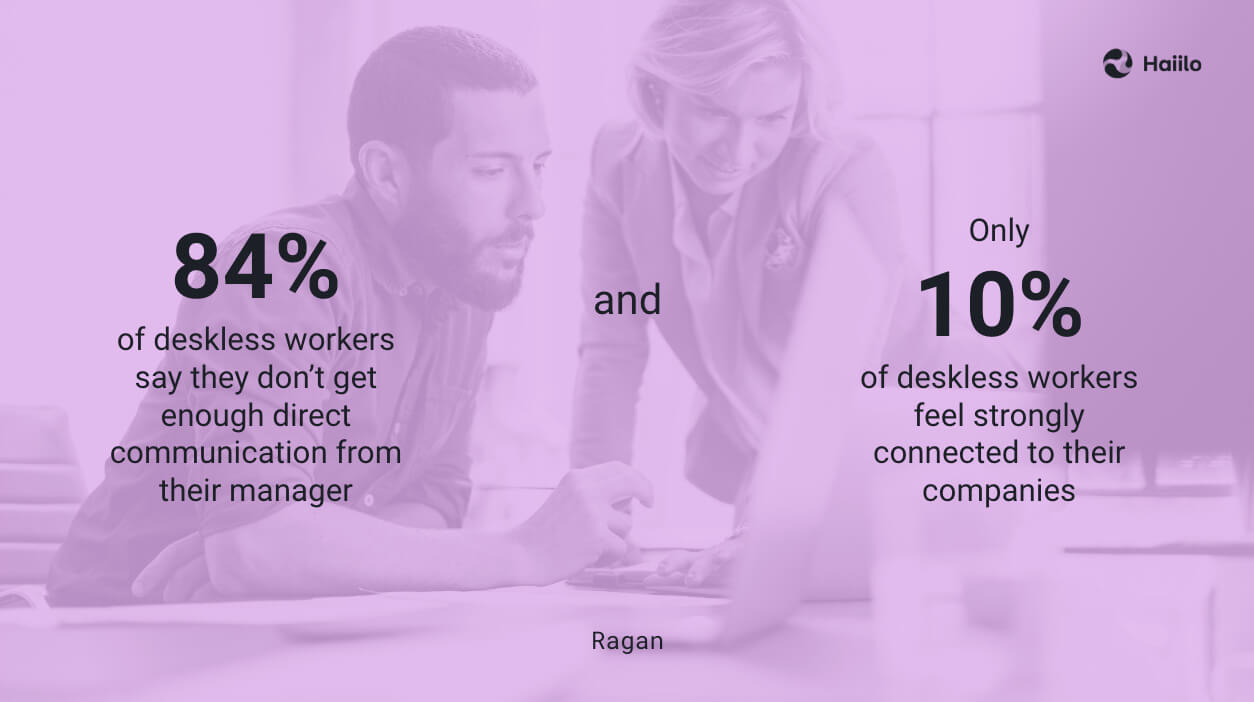
A study by Ragan highlights how widespread this challenge is. Just 56% of deskless workers in the United States say they feel connected and engaged with their employer. More strikingly, 84% report that they don’t receive enough direct communication from top management, and only 10% feel strongly connected to their company overall.
These numbers underline a critical issue: when communication primarily flows through desk‑based channels, deskless workers are often left behind. Without intentional effort to reach and involve them, disengagement can quickly become the norm—impacting retention, safety, and the consistency of customer and employee experience.
Ultimately, this lack of connection has a direct impact on productivity and performance. When employees don’t feel informed, valued, or listened to, motivation drops and discretionary effort declines. In operational environments, this can show up as slower processes, inconsistent service quality, and higher error rates—issues that affect both employee experience and business outcomes.
Research into employee engagement consistently shows that organisations with more engaged workforces perform better across key metrics such as productivity, quality, and retention. For deskless workers in particular, engagement is closely tied to whether they feel supported, heard, and included in everyday communication—not just informed when something goes wrong.
💡 Read further about how to enable your frontline employee for success.
They are voiceless and don’t feel empowered
Because deskless workers are harder to reach and often excluded from regular communication flows, they are frequently left without a voice. Many feel their ideas, concerns, and frontline insights never make it back to leadership, even though they are closest to customers, operations, and day‑to‑day challenges.
This lack of two‑way communication can be deeply demotivating. When employees don’t see feedback acted on—or don’t have an easy way to share it at all—they’re less likely to speak up, suggest improvements, or flag issues early. Over time, this silence can lead to disengagement and missed opportunities for innovation.
This emotional distance is reflected in broader workforce research. Studies of the deskless workforce show that a significant proportion of employees feel underappreciated or emotionally disconnected from their employer, reinforcing the perception that their role is transactional rather than valued. For organisations that rely on deskless workers to deliver consistent service and safe operations, restoring a sense of voice and empowerment is critical.
According to another study by the CIPD, only a quarter of employees feel they can freely express themselves at work. A similar proportion report that they regularly choose not to speak up—even when they have ideas or concerns they believe are worth sharing. Just over 22% say they consistently use their voice to help create or implement new ideas.
For deskless workers, this challenge is often amplified. Limited access to managers, fewer feedback channels, and time pressure during shifts can all discourage employees from contributing ideas or raising early warnings. When frontline perspectives are missing, organisations lose valuable insight into safety risks, customer pain points, and operational inefficiencies.
They are at higher risk of getting injured or ill
Because of the nature of their work, deskless workers face a higher risk of work‑related injury or illness than office‑based employees. Many roles involve physical labour, hazardous environments, customer contact, or operating machinery—often under time pressure. Research from the National Safety Council highlights the significant and ongoing economic impact of workplace injuries, reinforcing why prevention and clear communication matter.
Health risks have also become more visible in recent years. Frontline workers in healthcare, retail, and logistics are frequently exposed to infectious illnesses and safety hazards that cannot be mitigated through remote work. As a result, keeping deskless workers informed about procedures, risks, and changing guidance is now a top priority for employers—and effective workplace communication plays a central role.
Strong safety cultures depend on two‑way communication. A Safety Culture Survey found that the vast majority of leaders believe employees should warn others when they see unsafe behaviour. In practice, however, far fewer organisations say their employees consistently provide this kind of bottom‑up feedback—often because reporting feels inaccessible, slow, or ignored. For deskless workers, removing these barriers can directly prevent injuries and save lives.

However, due to the nature of their work, giving and receiving feedback among deskless workers is only effective when there is a fast, simple, and accessible way to do so. Feedback tools need to work in real time, fit into busy shifts, and be easy to use without specialist training. Without these conditions, important safety concerns, improvement ideas, and early warning signs often go unheard—until a problem escalates.
💡 Also read: 10 Best Practices for Communicating Safety Tips to Your Employees During COVID-19.
Digital Workplaces and Deskless Employees
Despite their critical role, many deskless workers still lack access to digital tools designed specifically for the way they work. Employees across healthcare, agriculture, construction, retail, manufacturing, telecommunications, and transportation are often expected to stay informed and aligned—without having dedicated software that helps them do their jobs effectively or stay connected with other employees.
At the same time, organisations are under growing pressure to rethink the “future of work”. Modern employee apps and communication platforms are increasingly seen as essential for reaching all employees, not just those behind a desk. For deskless teams, mobile-first tools can provide access to updates, policies, safety guidance, and peer communication directly within the flow of work.
While the market is saturated with apps, cloud platforms, and SaaS solutions built for office-based employees, digital investment has historically focused far less on deskless use cases. This imbalance has contributed to fragmented communication, inconsistent information sharing, and limited engagement for frontline workers—gaps that many organisations are now actively trying to close.
In recent years, the situation has started to change. More organisations now recognise that supporting deskless workers requires deliberate investment in mobile‑first tools and inclusive communication practices. As a result, many companies are prioritising technology that helps deskless employees stay informed, connected, and recognised—while also supporting efforts to https://blog.haiilo.com/blog/positive-workplace-culture-benefits-best-practices/build a positive workplace culture.
Industry research into frontline and deskless workforces consistently shows growing momentum behind these investments, particularly in sectors where operational efficiency, safety, and retention are critical. Transportation and manufacturing organisations, for example, face constant pressure to coordinate large, distributed teams and share timely updates across shifts and locations. In this context, digital tools designed specifically for deskless use are no longer seen as optional, but as foundational infrastructure for modern workplaces.
This shift reflects a broader understanding: empowering deskless workers with the right technology is not just about efficiency. It plays a direct role in engagement, retention, safety, and the ability to scale operations responsibly as workforces become more distributed and dynamic.
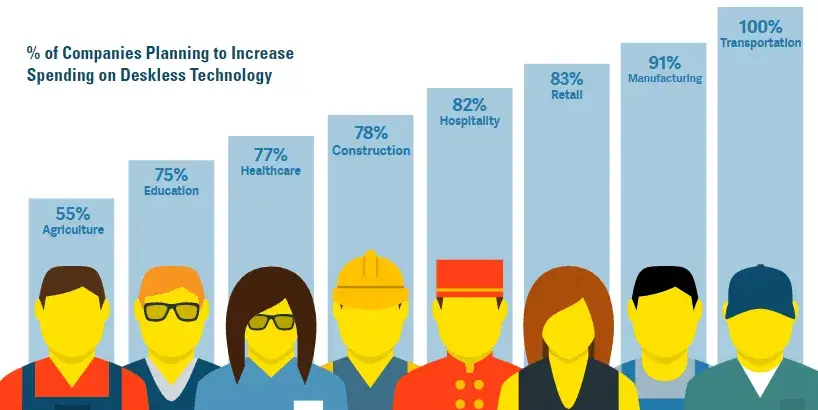
When organisations are asked why they are increasing investment in technology for deskless workers, their reasons are closely tied to operational and people outcomes:
- Productivity 33%
- Employee experience 23%
- Cost savings 21%
- Communication 11%
- Customer experience 10%
- Compliance 2%
Together, these priorities reflect a growing recognition that deskless teams directly influence efficiency, safety, and customer outcomes. Investments are increasingly focused on removing friction from day‑to‑day work—reducing manual processes, improving access to information, and enabling faster coordination across shifts and locations.
More Interesting Facts About Deskless Workers
Because deskless workers operate under very different conditions than office‑based teams, organisations continue to invest in research to better understand how to engage, empower, and protect them at work. These insights highlight both the scale of deskless work and the persistent gaps in technology, communication, and process design.
Here are some of the most notable findings:
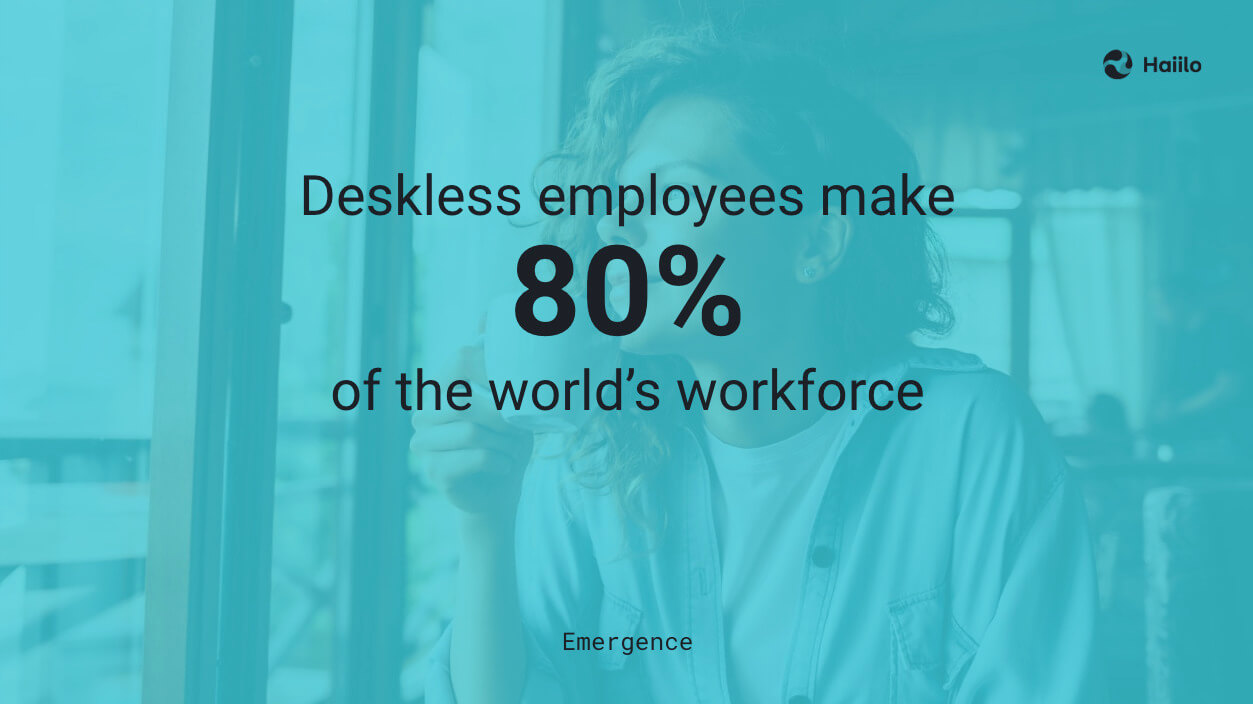
- Deskless workers make up roughly 80% of the global working population.
- Many deskless roles still rely heavily on shared computers, paper forms, or verbal handovers rather than dedicated digital tools.
- Only a small proportion of organisations rely entirely on digital processes for deskless work, with paper still playing a significant role in daily operations.
- A majority of deskless workers say they would benefit from better technology to help them do their jobs more effectively.
- Many employees are provided with desktop or laptop devices even though their roles require them to work away from desks.
- A significant proportion of workers feel the communications they receive are inadequate or arrive too late to be useful.
- Software investment has historically focused on desk‑based employees, leaving frontline use cases underserved.
- Organisations increasingly expect their mobile and deskless workforce to grow over the coming years.
- A lack of purpose‑built tools continues to hamper everyday work for a large share of deskless employees.
- Paper processes remain common, contributing to inefficiency, errors, and frustration.
- Some deskless workers report feeling disconnected due to working away from central company locations.
- Access to appropriate technology is strongly linked to higher job satisfaction among deskless workers.
The Role of Technology in Enabling and Empowering Deskless Workers
It’s clear that technology is https://blog.haiilo.com/blog/top-13-employee-experience-tips-right-now/transforming the employee experience across industries. Mobile devices, apps, and cloud‑based tools are now part of everyday life for most workers, making mobile‑first work both practical and expected—particularly for deskless workers who rarely, if ever, sit at a desk.
Despite widespread comfort with smartphones and digital tools in daily life, many deskless workers remain constrained by workplace technology that is slow, fragmented, or poorly suited to their roles. While much of their working day still involves interacting with technology in some form, the tools provided often fail to support productivity, collaboration, or real‑time communication.
This disconnect highlights a core issue: adopting new technology alone is not enough. To truly empower deskless workers, organisations need solutions that are intuitive, fast, and designed specifically for frontline realities—supporting communication, access to information, and participation in the wider organisation without adding complexity to already demanding jobs.
As employee communication is clearly one of the biggest challenges organisations face when supporting deskless workers, it’s no surprise that social and communication apps have become a major investment priority. Used well, these tools have real power to remove https://blog.haiilo.com/blog/communication-barriers/the biggest communication barriers in the workplace—such as delayed updates, siloed information, and one‑way messaging.
Research into social technologies consistently shows that better communication and collaboration can significantly improve how work gets done. Improved access to shared information, conversations, and knowledge can increase productivity among interaction‑heavy roles by meaningful margins, particularly where coordination and speed matter. As McKinsey explains:
“Messages become content; a searchable record of knowledge can reduce, by as much as 35%, the time employees spend searching for company information.”
For deskless workers, this impact is even more pronounced. When information is easy to find and communication is timely, employees can act faster, make safer decisions, and spend less time chasing answers. Investing in an internal communications strategy that uses mobile technology also helps organisations https://blog.haiilo.com/blog/interpersonal-communication-definition-importance-and-must-have-skills/make communication more interpersonal—connecting strategy to day‑to‑day operations, employees to purpose, and leaders to frontline realities.
Let’s now look at how modern, mobile‑first employee communications apps such as Haiilo can help employers and https://blog.haiilo.com/blog/what-are-the-top-leadership-skills-that-make-a-great-leader/leaders better support their people, while enabling deskless workers to be more productive, engaged, and satisfied at work:
- Create targeted groups and teams so employees stay connected across locations, shifts, and roles
- Share and amplify company news and updates consistently with frontline employees—not just office‑based staff
- Enable intuitive, mobile‑first communication for employees without access to corporate email
- Make critical documents, updates, and events easy to access for the deskless workforce
- Deliver personalised, relevant information to reduce overload and avoid lost productivity
- Use instant push notifications for urgent or safety‑critical messages
- Open up two‑way communication so deskless workers can share feedback, ideas, and concerns
- Automatically surface content from trusted internal and external sources
- Empower managers to communicate directly with their teams regardless of location
- Enable collaboration across the organisation, connecting frontline and corporate teams
- Integrate communication channels into a single platform to drive adoption and scale
- Measure engagement with communications campaigns to optimise reach and relevance
- Link communication efforts to business goals and KPIs, such as reducing incidents, improving productivity, advancing digital transformation, and supporting company‑wide initiatives
Frequently asked questions about deskless workers
What exactly are deskless workers?
Deskless workers are employees who don’t work at a desk or have regular access to a computer during their day. Instead, they carry out their roles on the frontline—on shop floors, in hospitals, on construction sites, in warehouses, or out in the field. For most deskless workers, work is hands‑on and location‑dependent, which means traditional office tools like email or intranets often don’t match how they actually operate.
Why do deskless workers often feel less informed than office staff?
The biggest challenge is access. Deskless workers typically don’t sit behind a screen all day, and many don’t have corporate email accounts or time to log into complex systems. Important updates are often shared via noticeboards, team briefings, or word of mouth—methods that are easy to miss or delay. Over time, this creates information gaps, even when the messages are highly relevant to their work.
What are the main challenges organisations face with deskless workers?
Organisations commonly struggle with reaching deskless workers quickly, sharing accurate information, collecting feedback, and creating a sense of belonging. High turnover, safety risks, and reliance on paper‑based processes increase the complexity. When deskless workers can’t easily access information or make their voice heard, engagement drops and operational risks increase.
How can technology better support deskless workers?
The most effective solutions are mobile‑first and designed around real frontline workflows. That means quick access to updates, documents, and policies on personal or shared devices, as well as simple ways to give feedback or ask questions in real time. When technology fits naturally into everyday work, deskless workers feel more informed, more valued, and better equipped to do their jobs safely and efficiently.
Check out our report on the synergy of multichannel communication and employee listening, featuring Forrester!