
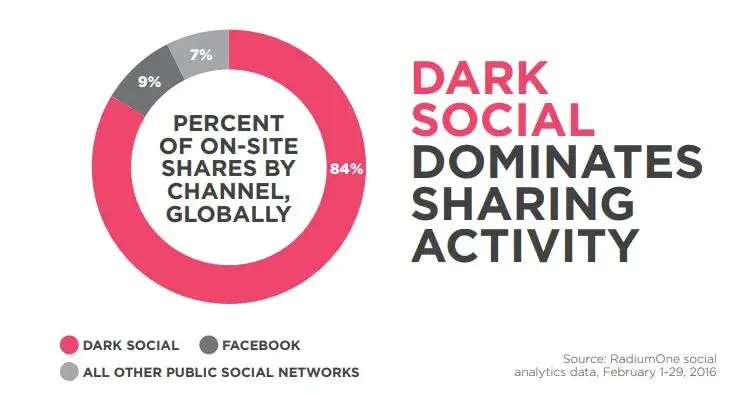
Dark social channels are the channels invisible for analytics programs. Estimates suggest that up to 84 percent of online sharing can happen through dark social channels. That means a large part of your traffic social media reports may be missing the real source. How do you manage invisible traffic?
Understanding Dark Social
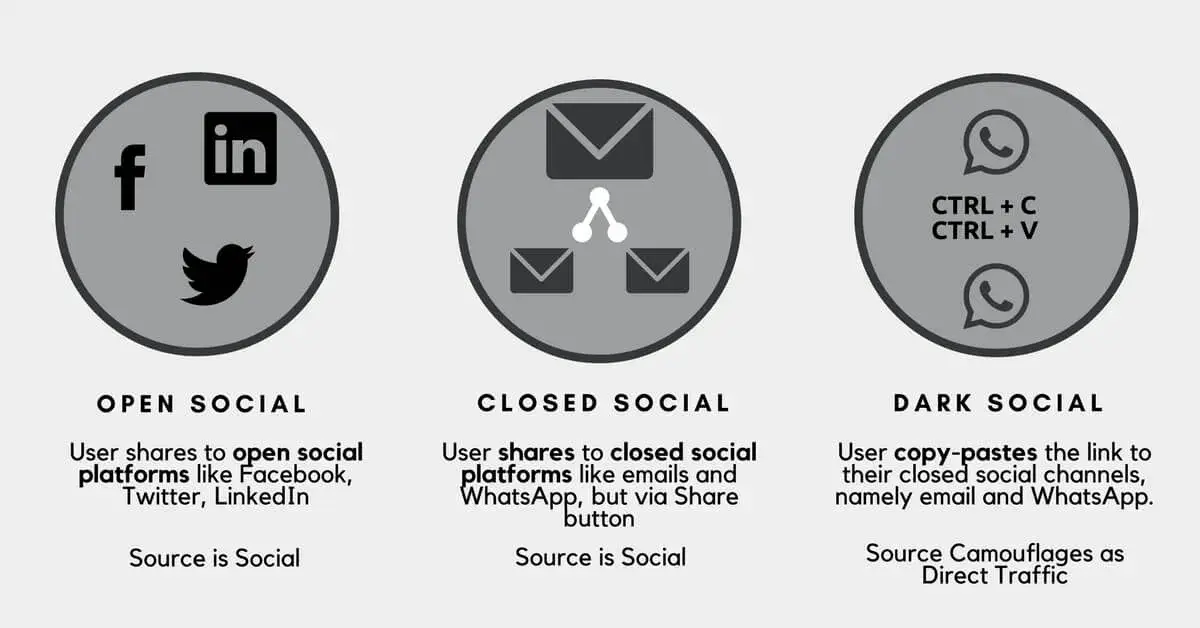
Online content can be shared in two ways: a reader can either use a share button provided or copy and paste a link to their content onto their social media platform. From this, you can differentiate three types of social sharing: open social, closed social and dark social platforms.
Open social and closed social sharing present themselves in your analytics programs as social, “correct” traffic, but dark social does not. Dark social (not to be confused with “dark web”, where the trolls roam free) is the invisible, hidden world of social sharing we aren’t able to access. It often comes from private messages, email, chat apps and copied links. To analytics tools, these visits can look like direct traffic, even when someone arrived through a recommendation.
As long as dark social remains a secret, we will not get a full picture of our return on investment for our social media marketing efforts. Moreover, dark social makes up a major part of content sharing activities. This makes it harder to see which articles, campaigns and messages are really driving interest. It can also lead marketers to undervalue the content people share most often in private.
Defining Open Social, Closed Social and Dark Social
For you to understand the difference between these 3 terms, let’s define them. Each one affects how your traffic social media data appears in analytics, so the distinction matters.
1. Open social
Open Social is the most basic type of sharing and it is the easiest one to measure. Open social sharing means a user sharing a post in their open social platforms such as X, LinkedIn or Facebook (but do remember, Facebook Messenger is a closed social platform). This doesn’t mean the profile itself has to be open, just the type of platform. The key point is that the share happens in a public or semi-public feed, where analytics tools can usually identify the source.
2. Closed social
Closed Social sharing happens in closed social platforms like Slack, email, and WhatsApp. The way it differs from dark social is that the sharing has occurred via a Share-button, preserving the metadata.
This enables a website to track visitors from these social sources. Closed social platforms have started to provide the Share-button more and more, but private sharing can still be harder to track when people choose to copy and paste links instead. That is why closed social can sit between measurable social traffic and fully hidden dark social traffic.
3. Dark social
Dark Social sharing happens when someone copies a link and pastes it into a closed social channel like WhatsApp or email. During this process, the metadata within the link is lost and when the next person clicks the link, it will look like direct traffic in your analytics processor.
This is when things get tricky, then, because that traffic is far from direct, as not only was it shared to a social platform, it was shared directly to the person or people receiving the link. It may be a colleague sending a useful article in Slack, a friend sharing a product page by text, or a customer forwarding a link by email.
As traffic source information can be lost when links lack clear tracking data, it’s definitely a good idea to understand what type of marketing content really gets the most shares amongst people. Without that context, you may overvalue obvious channels and miss the content that people are sharing in private conversations.
Finding Your Dark Social Traffic
When you first start using Google Analytics direct traffic reports, you might be thrown off by the massive relative amount of direct traffic coming to your website. The simplified view is that all of this traffic basically stems from people typing your URL into a toolbar or from people clicking a bookmarked link.
These do explain some amount of your homepage visitors, branded landing pages and returning customers, but looking at specific sites and new visitors, is it really possible that so many people have written those specific URLs to their toolbar?
We’d be talking about a lot of people who have a lot of time on their hands to be guessing post names and URLs. Another, slightly more likely, explanation is that this traffic stems at least partly from dark social. In other words, some of your traffic social media activity may be hiding inside direct traffic.
If you want to get an idea of your dark social traffic but don’t want to go into downloading a separate tool for it, you can get an approximate idea of the amount in your analytics processor (in this case, Google Analytics). It will not give you a perfect number, but it can help you spot patterns and see which pages are likely being shared privately.
Finding Dark Social Traffic With Google Analytics
In Analytics, you can either exclude direct traffic from pages that make sense for direct traffic (like your homepage or pricing info) or include traffic that is likely to come from dark social sharing (these are long, complicated URLs and most likely URLs including individual blog posts, for example).
You can find your direct traffic in GA4 by going to Reports, then Acquisition, then Traffic acquisition. From there, look for Direct in the session default channel group. To narrow the view, add page path as a secondary dimension or use an exploration to focus on long URLs, blog posts and other pages people are unlikely to type by hand.

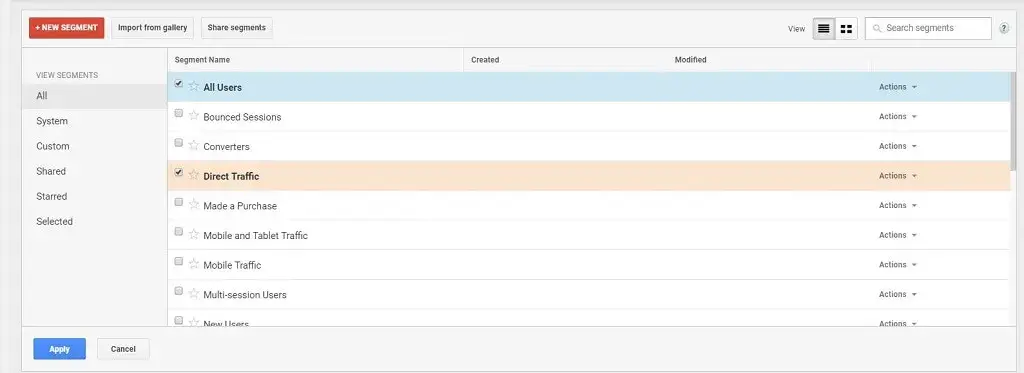
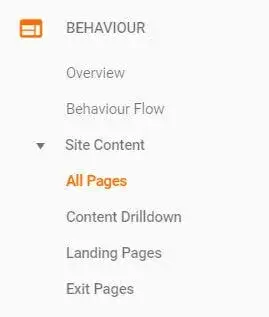
Click Apply (the blue little box on the left) and then go to Behaviour, Site Content, and to All Pages.
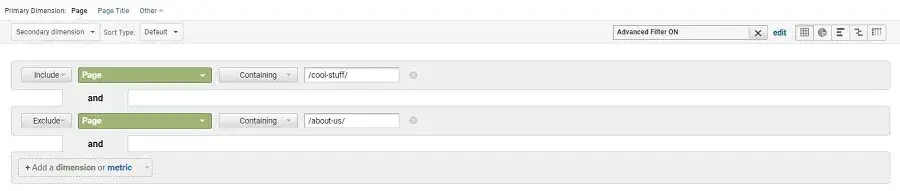
On the right lower corner, choose Advanced filter (the little box in the right corner). Choose Page as the primary dimension. You can now either include or exclude pages containing a specific word.
You can exclude the simplest web pages we can assume your visitor can come up with by themselves (such as awesomecompany.com/contact).
You can also exclude URLs suggested by the user’s toolbar because of a previous visit or the popularity of that page (such as awesomecompany.com/features). Exclude links people aren’t necessarily sending each other between cat photos in WhatsApp (like awsomecompany.com/boring-pricing-information-not-relevant-to-you) as well.
Another way to approach this is to include all traffic containing a specific word. Let’s say you have a blog, and your URL contains the term “blog” (or “insights” or “cool-stuff”, whatever rocks your boat). In this case, you can filter your results to show all pages including this term, that is to say, all blog posts.
This is a good way to study and identify your likely dark social traffic if your website architecture allows it. It’s also smart if you have a lot of additional pages with different terms and excluding all of them would take too long.
Once you’ve made your choices, click Apply, and a view becomes visible to you. Tada!
You can study the pages and compare them to your all-around-successes and you could find some interesting, in-depth information about what it is people share to each other directly. Remember this isn’t a 100 percent accurate, but while it isn’t a fool-proof method of measuring, you can still find valuable data especially about your most engaging content.
Why Finding Dark Social Content is Important
Finding your dark social shares is an incredibly useful way to gather data about the content your users find most valuable.
When a link is copied and pasted directly to a person or group of people who may find it useful, the subject and content have been pre-approved by someone to be useful, interesting or very, very funny.
Regardless, the bar to click the link is minimal and the engagement which can follow is already deeper than if the link would have been clicked on in open social platforms.
This is because the content has been personally suggested to the reader by someone they know. And that is the kind of golden content you want to keep providing.
FAQ
What is dark social traffic?
Dark social traffic is website traffic that comes from private sharing, but shows up as direct traffic in your analytics. This often happens when someone copies a link and sends it through WhatsApp, Slack, email or a private message. The visit is still driven by sharing, but the source is hidden. That is why your traffic social media reports may not show the full impact of your content.
Why does dark social matter for marketing teams?
Dark social matters because it can hide some of your most valuable engagement. When people share content privately, they are often recommending it to someone specific. That makes the click more intentional. For marketing teams focused on lead generation, this can make it harder to see which articles, campaigns or employee shares are really creating demand.
How can I find dark social traffic in Google Analytics?
You will not get a perfect number, but you can look for clues. Start with direct traffic, then filter for long URLs, blog posts and landing pages people are unlikely to type by hand. If those pages get a lot of direct visits, some of that traffic may be dark social. It also helps to use clear UTM tracking on campaigns and encourage sharing through trackable links where possible.
How can companies reduce the impact of dark social?
You cannot remove dark social completely, but you can make it easier to understand. Use share buttons, consistent campaign tracking and employee advocacy tools that help people share approved content in a measurable way. This is especially useful for employer branding, talent acquisition and brand advocacy. You can also learn more about what motivates people to share in this guide on why people share on social media.