
Work today is noisy.
Before anyone really starts their job, they’re already navigating email, chat, calendars, documents, dashboards, and updates spread across dozens of tools (33 on average). By the time people figure out where to focus, a chunk of their energy is already gone.
AI was supposed to help with that.
Instead of searching, employees could just ask. Instead of hunting for updates, answers would surface instantly. At least that was the promise…
But in practice, many AI tools have inherited the same flaw as the systems they were meant to replace. And crucially, they still expect employees to do the work.
Pull-based work is exhausting (and we’ve normalized it)
Most workplace systems – including many AI-powered ones – are built on a pull model.
That means employees have to:
- know where to look
- know what to ask
- know when to check
- know what they might have missed
This was already hard with traditional search. AI hasn’t magically fixed it.
“Just ask AI” sounds simple, but it assumes people:
- know what information exists
- understand how to phrase the question
- trust that the answer will be complete
- have the mental space to stop and ask in the first place
In reality, people are busy, distracted, and context-switching constantly. According to Microsoft’s Work Trend Index, employees are interrupted every two minutes on average during the workday. In that environment, pull-based systems add cognitive load – even when they’re technically faster.
💡Read: The 2026 guide to AI in internal comms
Why “just ask AI” breaks down at work
Consumer AI has trained us to believe that asking questions is frictionless. At work, it’s rarely that simple.
Employee questions are often:
- situational (“What applies to me right now?”)
- time-sensitive (“Did this change?”)
- role-dependent (“Is this relevant to my team?”)
That means employees don’t just need answers. They need context.
In noisy workplaces, pull-only AI creates a subtle tax:
- You have to remember to ask
- You have to phrase the question correctly
- You have to decide whether to trust the response
Over time, this leads to a familiar behavior: people stop checking. They rely on colleagues. They default to what they already know. AI becomes another optional tool. Impressive, but easy to ignore.
Push vs pull: a more realistic model for work
The next phase of workplace AI isn’t about choosing between push or pull. It’s about combining both.
Pull still matters. People should be able to search, ask, and explore when they need to.
But push is what reduces effort.
Push-based systems move relevant information to employees:
- updates appear where people already work
- changes surface when they matter
- context arrives without being requested
We already accept this model outside of work. Navigation apps push traffic alerts. Streaming services surface recommendations. News apps flag breaking stories.
At work, we’ve been slow to adopt, partly because content is fragmented, and partly because systems haven’t been well connected.
AI changes that, but only if it’s used deliberately.
When AI actually helps (and when it doesn’t)
AI becomes useful when it reduces decisions, not when it adds them.
In a push + pull model:
- employees don’t have to remember to check five places
- important updates don’t rely on someone searching at the right time
- AI can surface what’s relevant based on role, location, and activity
This is where AI stops feeling like a destination and starts feeling like infrastructure.
If intranet updates stay trapped in the intranet. If search only sees part of the picture. If AI assistants don’t have access to real workplace knowledge. AI ends up reinforcing pull behavior instead of relieving it.
👀Watch: How AI works at Haiilo
The role of connectors in making push possible
For AI to push information intelligently, it needs access to the right sources and the ability to distribute content across tools.
That’s where AI connectors come in.
💡Read: What is an AI connector?
Connectors allow workplace content – policies, updates, knowledge articles, events – to flow into:
- enterprise search solutions
- AI assistants and copilots
- the tools employees already use every day
Instead of asking, “Where should I look?”, employees start experiencing work as:
- “This showed up when I needed it”
- “I didn’t have to go find this”
- “I didn’t miss anything important”
This shift sounds subtle, but it fundamentally changes how work feels.
Why EXPs matter in a push + pull world
Not all content sources are equally suited to this model.
Employee experience platforms are designed to do more than store information. They curate it, contextualize it, and communicate it in human terms. They capture what’s changing, what matters, and why.
That makes EXPs a natural engine for push-based AI.
When EXP content is connected outward – into enterprise search and AI assistants – it stops being something employees have to remember to visit. It becomes part of the flow of work itself.
This is the difference between:
- another system to check
- and a system that quietly supports you
Where Haiilo fits
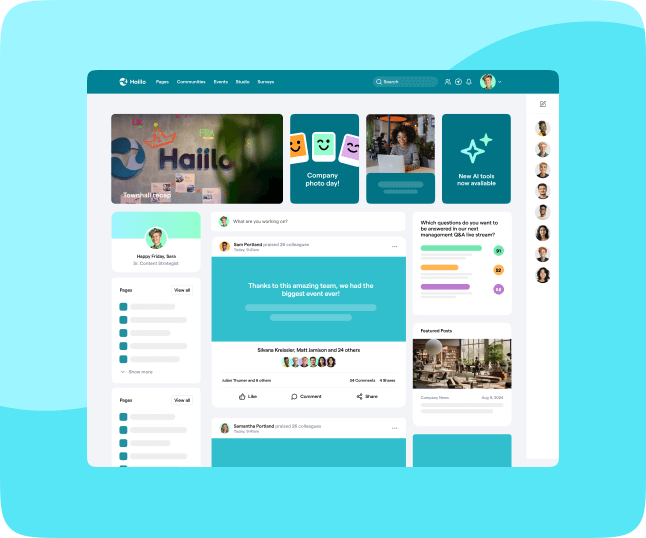
Haiilo is built around a simple idea: work should feel lighter, clearer, and easier to navigate.
As an employee experience platform, Haiilo is designed to distribute content outward, not hoard it. Through its API-based Enterprise Search Content Connector, Haiilo supports a push + pull AI model by:
- Making intranet content discoverable inside enterprise search and AI assistants
- Allowing enterprise search to act as the primary search layer inside Haiilo
- Feeding AI with curated, up-to-date workplace context
- Reducing the need for employees to remember where to look
The goal isn’t more AI. It’s less effort. Because the best AI doesn’t feel like work. It quietly removes it.