
Choosing an intranet platform is rarely just a software decision. It’s a decision about how work feels.
Does your digital workplace help people focus or fragment their attention? Does it make communication clearer or noisier? Does it bring tools together or quietly add another destination employees have to remember to visit?
Unily is often one of the first platforms large enterprises consider. It’s powerful, well-established, and feature-rich. But for many organizations, that power comes with trade-offs: complexity, long implementation timelines, and heavy reliance on Microsoft architecture.
If you’re looking for a Unily alternative, this guide walks through five options – starting with Unily itself for context – and evaluates each against the same criteria:
- Core focus and positioning
- User experience and adoption
- Implementation and IT complexity
- Customization and scalability
- Where it works well and where it can fall short
We’ll end with Haiilo, and explain why many organizations ultimately choose a different path.
1. Unily
Core focus and positioning
Unily is an enterprise-grade intranet platform built primarily on Microsoft technologies, especially SharePoint.
💡Read: The 2026 guide to building an intranet
Its positioning centers on:
- Large-scale digital workplaces
- Deep customization
- Enterprise architecture
- Complex global environments
Unily is designed for organizations that want a highly tailored intranet layered across Microsoft 365 ecosystems. It offers significant flexibility and robust feature depth.
But that flexibility is also part of the trade-off.

User experience and adoption
Unily can deliver a polished, branded experience — especially when significant design and configuration resources are invested.
However:
- Experiences often depend heavily on customization work.
- SharePoint foundations can create UX inconsistencies.
- Navigation complexity can grow as features expand.
In practice, adoption varies widely. When governance is strong and change management is thorough, it can work well. When not, organizations sometimes struggle with engagement — particularly among frontline or deskless employees.
Implementation and IT complexity
This is where Unily often demands the most.
Implementations can involve:
- Multi-month projects
- Significant SharePoint configuration
- Ongoing IT support
- Dedicated internal ownership
For organizations with mature Microsoft expertise, this may be manageable. For others, it can feel heavy and resource-intensive.
💡Read: What everyone should know before using Sharepoint as their intranet
Customization and scalability
Customization is a major strength.
Unily supports:
- Highly tailored intranet structures
- Deep Microsoft integrations
- Large global rollouts
However, customization can increase cost, timeline, and long-term maintenance complexity.
Where it works well — and where it can struggle
Strong fit:
- Very large enterprises
- Microsoft-first organizations
- Companies with strong IT capacity
Potential challenges:
- Long time to value
- High implementation overhead
- Risk of over-engineering
- Adoption friction if UX isn’t tightly managed
If you want deep architectural control, Unily is powerful. If you want simplicity and speed, it may feel like more than you need.
2. LumApps
Core focus and positioning
LumApps is a cloud-based intranet platform closely aligned with Google Workspace and Microsoft 365 environments.
It emphasizes:
- Personalized employee experiences
- Communication
- Clean integration into existing ecosystems
It’s often positioned as a modern, structured intranet layer rather than a full employee experience transformation.

User experience and adoption
LumApps offers:
- Personalized dashboards
- Targeted content
- Clean interface design
The UX is professional and structured. However, it can feel more traditional than social or engagement-driven platforms.
Adoption tends to work well in communication-focused organizations. But it may not radically shift engagement dynamics if the broader digital workplace remains fragmented.
💡Read: State of intranet usability 2025
Implementation and IT complexity
LumApps is generally lighter than heavy SharePoint-based builds.
However:
- Configuration still requires planning
- Ecosystem alignment is critical
- Larger deployments can become complex
It’s not “plug and play,” but it’s typically less infrastructure-heavy than Unily.
Customization and scalability
LumApps scales effectively for global organizations.
Customization is possible, though typically within structured frameworks rather than open-ended architectural builds.
Where it works well — and where it can struggle
Strong fit:
- Google-centric enterprises
- Communication-led transformations
- Structured global organizations
Potential challenges:
- Less emphasis on deep employee engagement
- May not consolidate fragmented tool ecosystems
- Experience improvements can feel incremental rather than transformative
LumApps modernizes communication — but it may not fundamentally redesign how work flows.
3. Staffbase
Core focus and positioning
Staffbase began as a mobile employee app and is strongest in internal communications — especially for frontline-heavy organizations.
Its emphasis is clear:
- Reach every employee
- Drive communication campaigns
- Prioritize mobile engagement
It’s communication-first, not intranet-first.

User experience and adoption
Staffbase performs well in:
- Mobile push notifications
- Frontline messaging
- Campaign-based internal communication
It excels at visibility.
However:
- Knowledge management depth is more limited
- It may not serve as a central operational hub
- It can sit alongside other systems rather than replace them
Adoption is strong for communication use cases. For broader digital workplace consolidation, it may require additional tools.
💡Read: How to improve intranet usability in 2026
Implementation and IT complexity
Implementation is often faster than enterprise intranet builds.
Because its scope is more communication-driven, the lift can feel lighter.
However, if you’re seeking to replace a complex intranet ecosystem, Staffbase may not fully eliminate system sprawl.
Customization and scalability
Staffbase scales well globally and supports segmentation and targeting.
Customization focuses on communication structures rather than deep architectural frameworks.
Where it works well — and where it can struggle
Strong fit:
- Large frontline workforces
- Organizations prioritizing communication reach
- Companies focused on internal campaigns
Potential challenges:
- Limited depth as a full digital workplace hub
- May not significantly reduce tool fragmentation
- Less focus on knowledge architecture and AI-driven workflows
Staffbase ensures people see messages. It doesn’t necessarily redesign how work connects.
4. Simpplr
Core focus and positioning
Simpplr positions itself as a modern, AI-powered intranet emphasizing simplicity and automated governance.
Its core narrative:
- Clean UX
- Easy administration
- AI-driven recommendations
It’s often considered by organizations replacing aging SharePoint environments.

User experience and adoption
Simpplr is widely praised for usability.
Features include:
- Smart search
- Automated content governance
- Personalized experiences
It feels lighter than legacy intranets and is generally intuitive.
However:
- The experience can still function primarily as a destination intranet
- It may not deeply unify everyday tools into one workflow starting point
💡Read: Your intranet has a UX problem. Here’s how to fix it.
Implementation and IT complexity
Simpplr implementations are typically faster than large-scale SharePoint builds.
It integrates well with Microsoft environments without requiring deep customization.
That said, enterprise rollouts still require governance and change planning.
Customization and scalability
Simpplr scales effectively and supports enterprise governance.
Customization exists but is often template-driven to preserve simplicity.
Where it works well — and where it can struggle
Strong fit:
- Enterprises modernizing SharePoint
- Organizations prioritizing UX improvements
- Teams wanting easier governance
Potential challenges:
- May not significantly consolidate tool ecosystems
- Less emphasis on engagement and culture dynamics
- AI features focus on content management more than workflow flow
Simpplr improves usability. It may not fully transform how fragmented work feels day to day.
5. Haiilo
Core focus and positioning
Haiilo takes a different starting point.
Rather than asking, “How do we build a better intranet?” it asks:
Why does work feel so fragmented in the first place?
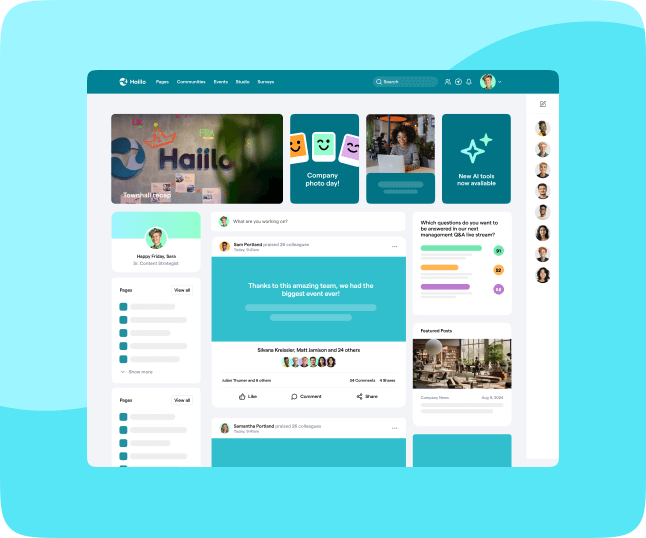
Haiilo is an employee experience platform designed to reduce digital friction — not just publish content.
It unifies:
- Internal communication
- Knowledge
- Social connection
- Advocacy
- AI assistance
Into one coherent, calm starting point for the workday.
It’s designed to be the place work begins.

User experience and adoption
Haiilo is social and mobile-first.
Employees get:
- Personalized feeds
- Targeted communication
- Findable, structured knowledge
- Native mobile access
- AI support through AVA to surface the right information at the right moment
The design philosophy is simplicity by intent.
Instead of layering features endlessly, Haiilo focuses on clarity and flow. That tends to drive stronger adoption — especially in organizations experiencing change fatigue or tool overload.
Implementation and IT complexity
Compared to heavier enterprise builds:
- Deployment is typically faster
- SharePoint dependency is lower
- IT overhead is lighter
- Consolidation is prioritized over expansion
Haiilo integrates with Microsoft 365, Google Workspace, HRIS systems, and other tools — but without requiring deep architectural rework to function effectively.
Time to value tends to be significantly shorter than traditional enterprise intranet rebuilds.
Customization and scalability
Haiilo supports:
- Enterprise-scale deployments
- Multi-language environments
- Global governance
- Flexible branding
- Desk-based and frontline teams
Customization is strong — but guided. The goal is structured clarity, not endless complexity.
That balance helps maintain simplicity at scale.
Where it works well – and why organizations switch
Strong fit:
- Enterprises seeking to reduce digital friction
- Organizations struggling with low intranet adoption
- Companies with frontline and desk-based employees
- Businesses wanting communication, knowledge, and advocacy unified
- Teams prioritizing engagement alongside governance
Compared to other Unily alternatives, Haiilo stands out in three areas:
- It’s not SharePoint-dependent.
- It actively reduces tool sprawl rather than sitting beside it.
- It combines communication, engagement, knowledge, and advocacy into one experience — rather than splitting them across systems.
It’s less about building a technically impressive intranet.
It’s more about making work feel coherent again.

So, which Unily alternative is right for you?
If your organization thrives on architectural complexity and deep Microsoft customization, Unily remains powerful.
If communication reach is your primary challenge, Staffbase may fit.
If you want a structured modernization of SharePoint, Simpplr or LumApps might serve you well.
But if your deeper issue is fragmentation — too many tools, too much noise, too little clarity — then the solution isn’t more architecture.
It’s better design.
The most effective digital workplaces aren’t the ones with the longest feature lists.
They’re the ones employees actually use.
They’re the ones that feel calm instead of chaotic.
Connected instead of scattered.
Human instead of broadcast-heavy.
That’s where many organizations ultimately find Haiilo isn’t just a Unily alternative.
It’s a different philosophy entirely.
And for teams trying to create real flow at work — that difference matters.