
Every January, the same lists roll around.
AI will change everything. Hybrid work is here to stay. Employees want authenticity.
We’ve heard it all before (and quickly scrolled past).
But something stranger is happening. Internal comms is changing in quieter, odder, more human ways. Employees have grown allergic to buzzwords, skeptical of “exciting updates,” and vocal about what they actually want from their company.
The new world of internal comms is less about shiny new tools and more about behaviour, trust, and connection. The messy kind.
Here are ten trends shaping the weird (and very real) future of internal comms.
1. Anti-hype messaging
For years, internal comms have leaned on optimism. Every update was “exciting news” or “a major step forward.” But employees are becoming allergic to corporate gloss.
In 2026, communicators will learn to dial it back, to acknowledge uncertainty, admit when things aren’t perfect, and show honesty instead of spin. Because when people feel their company is telling the truth, they’re far more likely to listen.
💡 Part of a shift toward authenticity and “de-influencing” culture. Honesty is the new PR.
2. Hyper-local storytelling
The age of the global all-staff email is ending. People are drawn to stories that feel relevant to them. Their team, their site, their world.
The best comms teams are now acting like local editors. They surface smaller stories with real emotional weight: a shift team supporting each other through a tough period, or a small office leading a sustainability project.
💡 Part of a bigger trend toward decentralised communication and community-based engagement.
3. “Dark comms” channels
Not all comms happen in official spaces. Employees increasingly gather in private group chats or unofficial online communities where they can speak openly and without filtering themselves.
It’s easy to see these as threats. But the smartest communicators treat them as signals – places where truth, emotion, and culture show up first. By listening to these informal networks (without invading them), comms teams can get an early sense of what employees really care about.
💡 Reflects the wider movement toward psychological safety and employee-led communication.
4. Employee avatars as comms channels
AI is learning to capture how we sound, write, and even express ourselves. In the near future, our digital selves could share updates, reminders, or feedback on our behalf, complete with tone and gesture.
It’s a strange idea, but not far-fetched. As hybrid work becomes more asynchronous, communicators will rely on technology that lets people feel present even when they’re not physically there.
💡 Driven by the rise of hyper-personalised AI and the merging of digital and human presence at work.
5. Reverse comms: employees brief the C-suite
For years, “employee voice” has meant surveys and suggestion boxes. In 2026, it looks different.
AI can now analyse the tone and topics of thousands of internal messages to build an anonymised picture of what’s really happening across a company. Some organisations are already experimenting with “state of the employees” briefings: short summaries or video reports created for leadership.
It’s not spin. It’s unfiltered insight, and it’s forcing leaders to listen in new ways.
💡 Part of the larger data-driven shift from anecdotal to evidence-based employee insight.
6. The Slackless office
The constant flow of messages has become a productivity drain, and many teams spend their days reacting instead of thinking.
That’s why a growing number of companies are experimenting with quiet days: turning off chat tools one day a week to protect focus and sanity. At first it sounds radical. But when people rediscover what it feels like to have uninterrupted time, they start to communicate with more intention.
After all, silence is a form of communication.
💡 Echoes the wider trend of digital minimalism and the backlash against constant connectivity.
7. Neuroinclusive comms design
Internal comms has always talked about inclusion, but rarely considered how different brains process information.
That’s starting to change. There’s a much-needed focus on cognitive accessibility: designing updates that are clear, spaced out, and offered in multiple formats. For some, that means shorter videos. For others, transcripts, visuals, or calm layouts.
It’s communication designed for every kind of mind, and not just the neurotypical one.
💡 Part of the growing recognition of neurodiversity and accessible design in the workplace.
8. The internal influencer economy
Influence doesn’t flow only from the top anymore.
In many organisations, credibility now lives with the employees others trust – the ones who command respect and trust for reasons other than seniority.
Forward-thinking comms teams are investing in these people: training them, recognising them, and involving them early in campaigns. This isn’t about creating new hierarchies; it’s about making communication more peer-led and believable.
💡 Taps into the wider rise of peer-to-peer trust and micro-influence within organisations.
9. AI as an empathy amplifier
The next frontier for AI in communication isn’t speed, it’s sensitivity.
New tools can analyse sentiment, adjust tone for different audiences, and even suggest phrasing that feels more human. It’s helping communicators write with warmth and adapt their message to the moment, not just automate it.
Used well, AI won’t replace empathy; it will embed it.
💡 Reflects the larger move from automation to augmentation — using AI to enhance, not replace, humanity.
10. The return of the intranet homepage (done right)
For a while, it seemed like intranets were being replaced by chat platforms and file-sharing tools. But as digital life has become more fragmented, companies are rediscovering the value of a single home base.
The modern intranet homepage isn’t a dumping ground for news. It’s a personalised, story-driven space. A calm, consistent entry point in a noisy digital world.
The difference this time: people will actually use it.
💡 Part of the wider shift from scattered tech stacks toward digital simplicity and intentional design.
The future feels strange – and that’s a good thing
If these trends sound unconventional, it’s because internal comms is finally catching up with how people really behave.
We’ve entered a phase where the human side of work – honesty, neurodiversity, emotion, imperfection – is shaping technology, not the other way around.
The future of internal communication won’t be defined by how loudly companies speak, but by how closely they listen.
And yes, it might look a little weird. But weird, it turns out, is exactly what we need.
How Haiilo can help
If your comms feel a little too noisy, scattered, or out of sync, Haiilo is an employee engagement platform built for exactly that world.
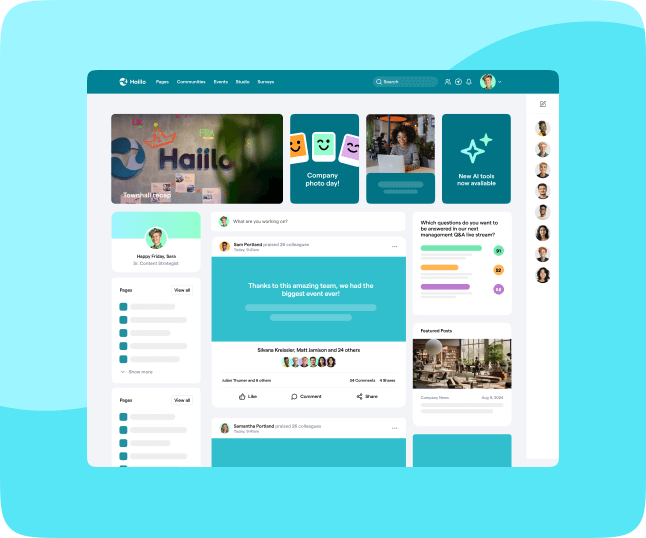
We bring everything (and everyone) back to one calm, personalised digital home. Think of it as your intranet, reimagined for 2026: a space where stories feel local, updates feel human, and employees actually want to show up.
With Haiilo, you can:
- Personalise content so every employee sees what truly matters to them.
- Create story-led homepages that turn news into connection, not noise.
- Use data and sentiment insights to understand what employees really care about
- Support inclusive comms with accessible design, translations, and flexible formats
In a world of dark chats, AI clones, and message fatigue, Haiilo gives internal comms teams something beautifully simple: a trusted, central space that helps people feel informed, included, and connected again.
Because the future of internal comms might be weird, but your intranet doesn’t have to be.