
Workplace communication has never been trickier.
Half your team is in the office, half is on video calls. Messages land across Slack, Teams, email, and somewhere in between. Important updates disappear between the cracks. Misunderstandings happen. Projects slow down. Morale dips.
We’re all drowning in communication.
The irony is that most communication problems aren’t about talking too little, but not talking effectively. According to a McKinsey study, employees spend nearly 30% of their week just managing communication, yet most say they feel less informed than ever.
So what actually works? How do you make communication clearer, faster, and more human?
Here are seven actionable, evidence-based tips for effective communication in the modern workplace, all grounded in psychology, backed by technology, and designed for real teams.
1. Start with clarity, not quantity
Why it matters:
The human brain can only process so much information. According to cognitive load theory, once we exceed that limit, comprehension plummets.
Against a backdrop of constant notifications, clarity is your best friend.
📌Actionable tip:
Before sending a message, ask:
“What’s the one thing I want this person to understand or do?”
Strip your communication down to the core. Use short sentences, clear headlines, and structured formats (like bullet points or numbered lists). It’s all about saying what matters.
How tech can help:
Digital writing assistants and AI summarizers are now baked into everyday tools, helping employees cut through fluff and get to the point, fast. Smart formatting features, templates, and AI-generated highlights make complex updates easier to digest.
2. Build psychological safety before pushing for openness
Why it matters:
Google’s famous Project Aristotle found that psychological safety – the belief that you won’t be punished for speaking up – is the number one predictor of team success.
If people don’t feel safe, they won’t share feedback, ask questions, or raise issues early. And silence, in a business context, is expensive.
📌Actionable tips:
- Show vulnerability: Leaders go first. Admit mistakes, ask for input, and thank people for challenging ideas.
- Recognize feedback publicly: When someone raises a tough issue, highlight it as valuable.
- Replace anonymous surveys with transparent, ongoing conversations.
How tech can help:
Employee feedback platforms, pulse survey tools, and digital suggestion boxes give everyone a safe, accessible space to share how they really feel. Some tools allow anonymous or sentiment-based responses to help leaders spot issues before they escalate.
3. Choose the right channel for the right message
Why it matters:
Communication fatigue is real. Every tool, from chat to video, has a certain psychological effect.
💡Read: Digital fatigue – how fragmented tools are hurting your team
Psychologists call it media richness theory: the more emotionally complex a message, the richer the medium you need. For example:
| Type of message | Best channel |
| Quick task update | Chat or short post |
| Policy change | Email or intranet news |
| Sensitive feedback | 1:1 video or in-person |
| Recognition or praise | Public social feed or meeting |
📌Actionable tip:
Create a team “communication charter.” Agree on which channels are for what. This helps prevent “where was that message again?” confusion.
How tech can help:
Unified communication platforms let you centralize updates and segment audiences. Integration between tools (Slack, Teams, email, intranet, etc. ) reduces duplication, so messages reach the right people, in the right place, automatically.
4. Turn information into interaction
Why it matters:
Neuroscience tells us that the brain remembers stories and experiences far more than static information. When employees passively read updates, they forget most of it within days (see: “Ebbinghaus forgetting curve”).
📌Actionable tips:
Memorable communication is a two-way street. Ask questions. Invite reactions. Turn updates into conversations.
- End posts with prompts like: “What’s one thing you’d add to this?”
- Use polls to check understanding or sentiment
- Let employees comment, react, and tag colleagues
How tech can help:
Interactive tools like polls, comment threads, emojis, and Q&As boost engagement. Whether it’s a digital town hall or a company post, modern platforms turn passive updates into social interactions.
5. Recognize more, assume less
Why it matters:
Recognition isn’t a fluffy extra, it’s necessary – and it’s grounded in science. Dopamine, the “feel-good” neurotransmitter, spikes when people feel appreciated to boost motivation, creativity, and collaboration.
Too often, leaders assume people “just know” they’re doing a good job. They don’t.
📌Actionable tips:
- Give micro-recognition daily (a quick “great job” on chat)
- Celebrate wins in team channels or town halls
- Tie recognition to company values (“Thanks for living our ‘customer first’ mindset”)
💡Read: How your intranet can be the vehicle for real organizational change
How tech can help:
Recognition software and kudos systems make it easy to spotlight great work publicly or privately. Gamification features, badges, and rewards also make appreciation more visible and consistent, especially in hybrid and remote teams.
6. Embrace transparency through storytelling
Why it matters:
Humans respond to stories. In fact, research from Stanford shows people remember stories up to 22 times more than facts alone.
Transparency builds trust. Transparency with narrative builds belonging. When leaders share not just what decisions were made but why, employees feel included.
📌Actionable tips:
Encourage leaders and teams to:
- Share “behind the scenes” updates > what challenges were faced, what was learned
- Use personal writing and photos in internal posts
- Replace corporate jargon with real voices
How tech can help:
Video messaging platforms, internal blogs, and employee-generated content tools make it easier for leaders and teams to tell authentic stories. They add personality and human connection back into communication, remotely or not.
7. Use data to listen better, not talk louder
Why it matters:
Communication analytics shouldn’t focus on vanity metrics like open rates. It’s about understanding what resonates.
When we see how our message landed, we adapt. The same applies to organizations.
📌Actionable tips:
- Track engagement by topic or department to see where communication lands best
- Use sentiment analysis to spot where morale may be dipping
- Close the loop by communicating what you’ve learned (“We heard you want more transparency – here’s what we’re changing”)
How tech can help:
Analytics can show how employees engage with updates, what content performs best, and where engagement drops. AI-powered insights can even highlight patterns in feedback, helping you to communicate in a meaningful and authentic way.
Prioritizing connection over communication
Communication works when it feels human, relevant, and two-way. When messages aren’t just broadcast, but believed. When employees aren’t just informed, but inspired.
That’s why the most effective communication strategies combine psychological safety, emotional intelligence, and digital simplicity.
How Haiilo can help
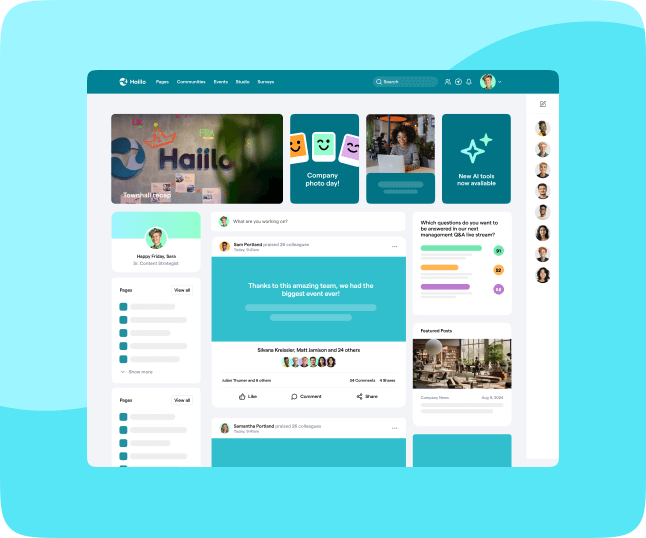
Haiilo brings all of this together in one employee engagement platform to provide a single digital home for your team.
Here’s how:
- Reach everyone, whether they’re in the office, at home, or on the frontline
- Simplify updates with a modern social intranet that replaces noise with clarity
- Encourage participation, with built-in reactions, comments, and feedback loops
- Build culture through recognition by giving kudos and celebrating wins
- Turn employees into advocates with inbuilt employee advocacy tools
- Measure and improve with built-in analytics show what’s working (and what’s not)
Haiilo doesn’t just help you communicate, we help you connect. Because in the end, effective communication isn’t about sending messages. It’s about creating meaning.
And that’s exactly what Haiilo is built for.