
Enterprise AI is having a moment.
From chatbots and copilots to “ask anything” enterprise search tools, organizations are racing to bring AI into everyday work. According to McKinsey, over 70% of companies now report experimenting with generative AI in some form, up sharply from just a year ago. The ambition is clear: faster answers, less friction, better productivity.
And yet, for many employees, the experience is… underwhelming.
They ask a question and get an answer that sounds confident, but vague. They try again, rephrase it, double-check it. They still end up asking a colleague or opening five tabs “just to be safe.”
This isn’t a model problem. It’s a connection problem.
AI doesn’t struggle because it lacks intelligence. It struggles because it lacks access. To the right information, at the right time, in the right context. That’s why every serious enterprise AI strategy eventually runs into the same missing piece: the AI connector.
AI without context is just guessing
Large language models are extremely good at language. They’re fast, fluent, and persuasive. What they aren’t good at – at least not on their own – is understanding your organization.
They don’t know:
- which policy is current and which one was replaced last quarter
- how work actually happens across teams and roles
- which updates matter to frontline employees versus HQ
- what information someone is allowed to see
Without access to real internal knowledge, AI has limited options. It can generalize. It can hedge. Or it can guess.
Gartner has repeatedly warned that hallucinations and lack of grounding in trusted enterprise data are among the biggest risks to generative AI adoption at work. When employees don’t trust the answers, they stop using the tool, no matter how advanced it looks.
This is where AI connectors come into play.
What an AI connector does (in plain English)
An AI connector is not another AI model. It’s not a chatbot. And it’s not a shiny interface.
It’s the connective tissue between AI and your organization’s real sources of truth.
👀Read: How Haiilo’s AI connector works
It allows an AI system – typically powered by an LLM – to securely access internal platforms such as:
- intranets and knowledge bases
- document repositories and file storage
- HR, IT, or operational systems
- collaboration and communication tools
Instead of responding based on generic training data, AI can reference your content, your updates, and your structure.
A simple way to think about it: AI connectors don’t make AI smarter. They make it relevant.
Why employee questions expose the gap
Employee questions are a stress test for enterprise AI.
They’re rarely abstract. They’re specific, contextual, and often time-sensitive:
- “What changed in the new policy?”
- “Where do I find the latest version of this?”
- “Who owns this now?”
Answering questions like these requires access to living, evolving workplace knowledge.
Cottrill Research estimates that employees spend nearly 1.8 hours every day searching for information or tracking down colleagues who can help. That’s not a productivity failure. It’s a discoverability failure.
AI promises to fix this. But it can only do so if it’s connected to the systems where that information actually lives.
Enterprise search only works when it’s connected
Enterprise search has existed for years, but for many organizations it’s been incomplete or underused. Content lives in silos. Results are hit-or-miss. Employees don’t trust that they’ll find what they need.
AI raises expectations. Once people experience conversational search in their personal lives, they expect the same simplicity at work.
That expectation collapses when key content – especially intranet updates, internal pages, and community knowledge – is missing from search results.
AI connectors change this by allowing enterprise search to pull from across the digital workplace, not just a subset of systems. Search is less about knowing where to look and more about simply asking.
And this connection can work both ways. Some organizations choose to use their enterprise search solution as the primary search experience inside the intranet itself. One search, one mental model, fewer dead ends.
Trust matters more than speed
Speed gets the headlines. Trust determines adoption.
Data governance, transparency, and access control are top concerns for organizations scaling AI. Employees need to know that answers are not only fast, but correct, current, and appropriate for them.
AI connectors do a lot of heavy lifting here. They ensure AI respects permissions, understands roles, and surfaces information responsibly. They allow answers to be traced back to known sources.
This matters more than it might seem. When people can see where an answer comes from – and recognize it – confidence builds. And when confidence builds, usage follows.
Why intranets and EXPs are such powerful sources
Not all systems are equally valuable to AI.
Some store raw data. Others store meaning.
Employee experience platforms sit at the intersection of information, communication, and context. They contain curated content, timely updates, and the human layer of work: policies, announcements, knowledge articles, communities, and conversations.
This is the information employees rely on to understand what’s happening and what to do next.
Connecting intranet content to enterprise AI and search tools dramatically increases their usefulness. AI responses stop feeling generic and start reflecting the organization as it actually is.
The foundational piece
AI connectors rarely get the spotlight. They’re not flashy. But they are foundational.
Without them, AI remains a standalone tool: impressive in demos, unreliable in practice. With them, AI becomes part of the workplace fabric, embedded into how people search, learn, and make sense of change.
That’s the real shift organizations are navigating right now. Not whether to use AI, but how to connect it properly.
Because AI only creates value by fitting into work as it really happens. And that only works when everything is connected.
💡Download: The 2026 guide to AI in internal comms
Where Haiilo fits
AI connectors are only as useful as the content they connect to.
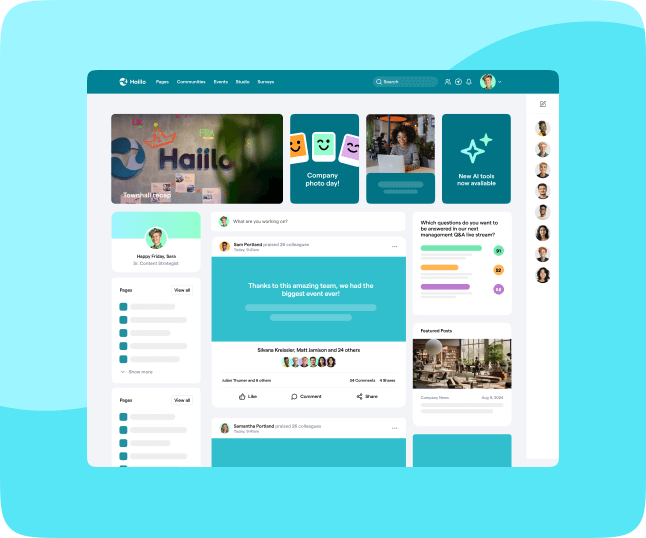
Haiilo acts as a trusted source of workplace knowledge: bringing together communication, content, and context in one place. Through its API-based Enterprise Search Content Connector, Haiilo fits naturally into enterprise AI and search strategies by:
- Making intranet content discoverable in enterprise AI and search tools
- Allowing enterprise search to serve as the primary search experience inside Haiilo
- Providing AI with curated, up-to-date workplace context
- Respecting roles, permissions, and governance by design